Pure Digital Passion with Moses Kemibaro

Moses Kemibaro

Details

This is pure digital passion, the podcast of Moses Kemibaro, one of Kenya's and Africa's leading digital marketers, techbloggers, and technology analysts. Join me for insightful interviews and commentaries on all things digital from across the African continent on a myriad of compelling topics and themes. I share Africa's stories of pure digital passion!

Recent Episodes

OCT 17, 2026
Episode 198 - Klaas Glenewinkel On Monetizing Africa's Radio Stations & Building An App To Stream African Radio
Not every episode of the Pure Digital Passion Podcast is recorded in a studio. This one was recorded a few weeks ago on a phone, audio only, at a restaurant table in Westlands, Nairobi, Kenya with Klaas Glenewinkel, Managing Director of MiCT (Media in Cooperation and Transition) in Berlin and Director of the East Africa Radio Service (EARS) in Kampala, Uganda. Seven years ago Klaas decided that aid money was not the answer to keeping Africa's local radio stations alive, revenue was. EARS now bundles small and rural stations across Uganda into audience packages that advertisers can buy on one package instead of 150, and Klaas says it shared almost USD 2 million in advertising revenue with those stations last year. His argument is simple: in the ratings, the stations filed under "others" would be the market leader if they were one station. Now EARS is going digital with a lightweight audio app that aggregates radio stations, podcasts and audiobooks, streams at as little as 8 kilobits per second, lets listeners download overnight when data is cheaper, and is funded by targeted pre-stream advertising rather than subscriptions. The app is in closed Android testing, the server has never been pushed past 100 concurrent listeners, and it does not yet have a name. So we spent the last ten minutes attempting to name it! We also get into why radio refuses to die (in Uganda and in Germany), the gateway problem of big tech preloaded on cheap phones, my Gen Z Uber driver who still buys the newspaper to save data, what the platform means for podcasters like me, and how I actually make money from a podcast in Kenya. If you run a radio station, publish podcasts or audiobooks, or buy audio advertising in East Africa, this one is for you. CHAPTERS (00:12) Welcome: an impromptu, audio-only episode from Westlands (00:41) Why aid money was failing local media, and the birth of EARS (01:13) One contract instead of 150: how EARS bundles small stations (02:36) "Others" is the market leader: the long tail of local radio (04:44) Almost USD 2 million shared with stations last year (05:48) The threat from religious radios and why independence matters (06:53) Analogue ad spend, cheaper smartphones and the FM chip (07:57) Why radio endures, in Uganda and in Germany (09:36) Big tech on the phone: Facebook Zero and net neutrality (11:09) The Gen Z Uber driver who still buys the newspaper (12:23) An app built for 8 kilobits: overnight downloads and offline listening (13:27) Where the app stands: Android testing, West Africa and the diaspora (15:04) Advertising, not subscriptions: targeted pre-stream audio ads (16:35) The 100-listener question: a bootstrapped build (17:43) The flywheel: stations promote the app on air (18:52) The end game: survival of local radio, then West Africa (20:14) Calling all publishers, stations and podcasters: RSS syndication (21:27) How I actually make money from a podcast in Kenya (24:40) Kenya's podcast scene, and what the youth want on demand (26:40) Name the app: six candidates on the table (28:17) My verdict: Ongea, Oyodo, and why I fight with "cast" (31:42) The Ongair idea: speak, over the air (32:40) Jambo Cast and the French-speaker test (35:20) How EARS sells: brands, governments, aid agencies and ad agencies (36:39) Twenty people on the ground, one deal at a time (37:04) Close Guest links: EARS - https://www.ears.ug/ MiCT - https://mict-international.org/ Klaas Glenewinkel on Linkedin - https://www.linkedin.com/in/klaas-glenewinkel-a7a69b6/

37 MIN
SEP 20, 2026
Episode 196 - How This Is Digital Trained 800+ Professionals On AI & Became Meta's AI Training Partner In Kenya
Just over a year after launching This Is Digital, co-founders Grace Murugi and Greg Wanjama have trained more than 800 professionals, served more than 40 organisations, and reached a milestone that could significantly expand their impact: becoming Meta's AI training partner in Kenya.This episode of the Pure Digital Passion podcast was recorded in a wonderfully impromptu manner immediately after I attended a practical Claude workshop delivered by This Is Digital in collaboration with Isaac Hunja of KaaraWorks. I went into the session thinking of myself as a fairly experienced AI user. I left with a clear appreciation of how much more work is required to move from basic prompting to properly designed agentic workflows.That made the timing of this conversation particularly appropriate. I had delivered the keynote address at the launch of This Is Digital in July 2025, where I traced the past, present, and future of Kenya's digital transformation. A little over a year later, Grace and Greg joined me to discuss what they have learned from building an AI-native business and teaching professionals and organisations how to use artificial intelligence in real work.We explore how This Is Digital used AI to shape and challenge its original business strategy, why AI accelerates a sound business model but cannot rescue a broken one, and why effective agents require context, specialised responsibilities, standard operating procedures, and substantial work at the beginning.Grace and Greg also share what they are seeing in Kenya. Adoption may be high, but much of it remains at the level of replacing Google Search with a chatbot. The real opportunity lies in critical thinking, privacy awareness, adaptability, responsible use, and applying AI to create measurable value for customers and organisations.The conversation concludes with a major announcement. Meta has partnered with This Is Digital to deliver AI Academy Kenya, combining a Pitchathon for Kenyan startups and developers with a sponsored eight-week online Masterclass for 300 students, startup founders, developers, and career professionals.Apply here: https://thisisdigital.ai/meta-ai-academy-kenyaLearn more about This Is Digital: https://thisisdigital.ai/Timestamps00:00 Introduction and welcome01:05 Grace Murugi's journey from computer science to AI strategy02:53 Greg Wanjama's journey through software, entrepreneurship, and the UN05:41 What I learned at the Claude workshop with This Is Digital and KaaraWorks06:49 How an AI exercise helped Grace identify the business opportunity09:10 Validating the market and choosing to launch publicly15:38 Is This Is Digital an AI-native company?16:21 Why AI accelerates a business but cannot repair a broken model20:50 Tuning AI for the context of a specific organisation23:00 Using AI for business strategy, research, content, and quarterly analysis30:18 What This Is Digital has learned about AI adoption in Kenya31:56 The hype around chatbots and AI agents36:14 Why building useful agents takes more work than people expect37:00 From AI skeptics to AI advocates39:06 How learners are turning AI skills into new services and careers41:46 This Is Digital becomes Meta's AI training partner in Kenya43:34 The AI Academy Kenya Pitchathon45:20 The sponsored eight-week online Masterclass46:11 What the next two to five years of AI adoption could look like50:43 The ambition to empower one million Africans with AI skills53:18 Responsible AI, customer value, and moving beyond vanity use cases55:54 Why adaptability may become the defining professional advantage58:00 Using AI as a coach and critical sparring partner1:00:05 Learning, unlearning, and relearning in the AI era1:01:13 Where to find This Is Digital, Grace, and Greg1:02:43 Closing thoughts and the invitation to apply
63 MIN
AUG 16, 2026
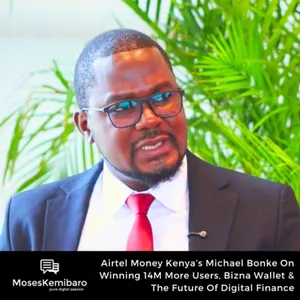
Episode 195 - Airtel Money Kenya’s Michael Bonke On Winning 14M More Users, Bizna Wallet & The Future Of Digital Finance
Airtel Money Kenya is entering a new chapter under Acting Managing Director Michael Bonke.In this episode of the Pure Digital Passion Podcast, I sat down with Michael shortly after Airtel Money launched its Bizna Wallet for small businesses and enhanced its cashback proposition from airtime rewards to actual cash a couple of weeks ago. We explore how Airtel Money has grown from a relatively small challenger to a platform that now says it serves more than six million customers, has approximately 270,000 agents, supports more than two million merchant points and holds around 11% of Kenya’s mobile-money market.But perhaps its largest immediate growth opportunity already exists within Airtel itself.Michael estimates that around 14 million active Airtel connectivity customers are not yet using Airtel Money—and converting more of them is one of his most important priorities.We discuss:✅ Michael Bonke’s appointment and immediate priorities✅ How Airtel Money moved from roughly 2% to 11% market share✅ Why distribution, liquidity and banking partnerships matter✅ Airtel Money’s 270,000-agent footprint✅ Why SMEs are central to the next phase of growth✅ Airtel Money Bizna Wallet✅ Separating personal and business finances✅ Protecting merchants from unauthorised reversals✅ Free customer payments into Bizna Wallet✅ The move from airtime rewards to real cash cashback✅ Why customer experience matters more than promotions✅ Fraud prevention, customer protection and trust✅ Embedded finance, SME lending and analytics✅ Cross-border payments across Airtel’s 14 African markets✅ Whether Airtel Money could eventually become financial infrastructure for African SMEs✅ Michael’s three-year vision for Airtel Money KenyaOne of the most interesting moments comes when I ask Michael whether Airtel Money could eventually become an operating system for small businesses across Africa.His response:“That is our goal for sure.”CHAPTERS00:00 — Introduction00:50 — Michael Bonke’s new role at Airtel Money Kenya01:32 — The 14M-customer Airtel Money opportunity02:28 — How Airtel Money moved from 2% to 11%02:57 — Banking partnerships and distribution03:52 — Growing from under 20,000 to 270,000 agents04:43 — Why SMEs matter to Airtel Money05:32 — What merchants told Airtel06:50 — Free Bizna Wallet payments and merchant charges08:20 — Could Bizna Wallet become a broader SME platform?08:58 — Cross-network Bizna Wallet payments09:26 — Why cashback moved from airtime to cash10:41 — Turning promotions into lasting customer behaviour11:38 — Becoming a customer’s primary financial wallet12:04 — Fraud prevention, security and trust13:26 — Embedded finance and cross-border payments14:09 — Could Airtel Money become an operating system for African SMEs?14:46 — Michael’s brief take on the Airtel Money IPO15:06 — What success looks like three years from now16:11 — “It works—and now it pays you back”Michael’s closing message captures Airtel Money’s positioning particularly well:“With Airtel Money you can do anything... and now it pays you back.”The Pure Digital Passion Podcast explores the people, technologies, companies and ideas transforming business and the digital economy across Kenya and Africa.#AirtelMoney #MichaelBonke #PureDigitalPassion #BiznaWallet #Fintech #MobileMoney #FinancialInclusion #SMEs #DigitalPayments #Kenya #Africa
17 MIN
AUG 16, 2026
Episode 194 - Produce in Shillings. License in Dollars: Jason Corder’s Plan for African Media
I met Jason Corder last week to discuss NorthSouth Media, and our meeting became what I like to call a “gangster podcast”: an informal, impromptu Pure Digital Passion conversation recorded without the usual studio production. Jason is the founder and CEO of NorthSouth Media, a Nairobi-based company building an end-to-end system for financing, producing, owning, localizing and distributing African content. We discuss his journey from San Francisco to Africa, his work as a visual artist and performer, his experience acting in Mali, and how a trailer filmed in his Kilimani apartment became Stay, a television series backed by Nokia and subsequently distributed across multiple markets. Jason explains why that experience convinced him that African production companies must retain intellectual-property ownership. We also examine NorthSouth’s connected film and creator studios, direct-distribution strategy, localization relationship with Aview International and ambition to build a substantial library of owned African content. The conversation challenges the assumption that mobile and streaming growth must mean the end of television. Free-to-air broadcasting remains accessible, communal and commercially important across Africa and the wider Global South. NorthSouth is currently raising US$1 million at a US$7 million cap for a 24-month runway. The company plans to produce an opening slate of five owned shows, enroll 25 creators before scaling to 50 and build a sales operation targeting broadcasters and brands. CHAPTERS 00:00 – Introduction 00:13 – Why this became a “gangster podcast” 01:00 – Human stories made by human hands 04:23 – How African culture and storytelling travel globally 06:46 – Jason Corder’s origin story 14:27 – Why intellectual-property ownership matters 18:22 – Producing Stay with Nokia’s backing 22:36 – Free-to-air television and Africa’s media economy 31:11 – Film, community and human connection 38:35 – From artist and producer to entrepreneur 40:33 – Using Bordy and AI to accelerate the business 46:36 – Building NorthSouth’s end-to-end infrastructure 49:28 – The NorthSouth Media elevator pitch 51:16 – The Nairobi headquarters and Creator Studio vision 55:16 – Microdramas, mobile video and the “shiny object” 58:53 – A model for rebuilding African media 1:00:55 – How to connect with Jason 1:02:34 – Jason’s parting perspective ABOUT JASON CORDER Jason Corder is the founder and CEO of NorthSouth Media. He has worked across visual art, music, television, cultural diplomacy and media production and has lived and worked in more than 60 countries. NorthSouth Media: https://northsouth.africa Jason on LinkedIn: https://www.linkedin.com/in/jasoncordermedia
65 MIN