Rad Chat

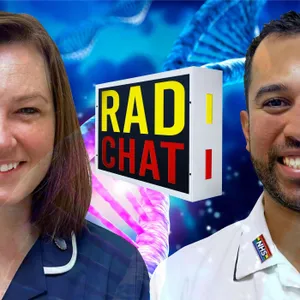
Naman Julka-Anderson and Jo McNamara

Details

Rad Chat is a forward-thinking global knowledge hub where healthcare professionals can advance their knowledge and expertise in radiotherapy and oncology by utilising the award winning, first therapeutic radiographer led oncology podcast and social media channels. We're empowering healthcare professionals worldwide by providing free, CPD-accredited radiotherapy and oncology education, by sharing real-world experience, expert insights, best practice and patient perspectives, we're helping healthcare professionals’ advance cancer care and improve patient outcomes.

Recent Episodes

NOV 11, 2026
E228: Dr. Amy Hancock and Rebekah Girling - Research in Advanced Practice
Trigger Warning: this episode discusses cancer and cancer treatment. Episode 228: Part of the Education and Workforce Development series (Part 80) Description: In this insightful episode, Naman Julka-Anderson and Jo McNamara sit down with Dr. Amy Hancock and Rebekah Girling. Dr. Amy Hancock is a therapeutic radiographer and Director of Medical Imaging at the University of Exeter. A qualitative researcher, Associate Editor and published author, she is a passionate advocate for research that enhances patient care and services. Amy holds several research and academic leadership roles in Patient and Public Involvement and Engagement (PPIE). She is a College of Radiographers Doctoral Fellowship awardee, Deputy Chair of the College research committee, Chair of the CoRIPS funding panel and Lead for the University of Exeter Ageing and Long-term Conditions research group. She is also part of the multidisciplinary team awarded £3.4 million of NIHR Health Technology Assessment funding for TOURIST, a series of randomised controlled trials in palliative radiotherapy for stage IV non-small cell lung cancer. Rebekah Girling is a Diagnostic Radiographer and Clinical Research Lead at Norfolk and Norwich University Hospitals NHS Foundation Trust, where she has led the development of clinical research across diagnostic and clinical services since 2013. She is also an NIHR Senior Research Leader and Imaging Specialty Lead for the NIHR Research Delivery Network in the East of England. With an Executive MBA and a background in clinical practice, research delivery and service development, Rebekah is passionate about embedding research into everyday healthcare, developing clinical research capability and improving opportunities for patients and staff to take part in research. This episode is a deep dive into why research matters in advanced and consultant practice, how the NIHR and its research portfolio work, routes into research such as becoming a Principal Investigator or joining an NIHR internship, and how CoRIPS funding can kick-start your first project. CPD Reflection Points: Embedding research in everyday practice: Rebekah explained that research-active organisations are linked with better patient care, and that the challenge now is giving clinicians the infrastructure and time to take part. How does research currently feature in your role, and what step could you take to get involved, such as supporting recruitment or acting as a Principal Investigator on a portfolio study? Starting small: Amy described CoRIPS as a starter pot of funding, and highlighted that service evaluations, audits and pilot work can all change practice. What question from your own clinical practice could become a small project, and who would you need on your team to make it happen? Patient voice and real-world impact: Amy's patient diaries showed that moving patients between machines, which staff saw as helpful, left them confused and anxious. How do you currently involve patients' lived experience in improving your service, and how would you turn research findings into tangible changes in practice? Complete this form for your accredited digital badge: Digital Badge Form. Links from the Episode: CoRIPS research grants – College of Radiographers CoRIPS guidelines College of Radiographers Research Strategy 2021–26 East of England NIHR Health and Care Professional Internship Programme NHS advanced practice: consultant-level practice TOURIST trial Research links from the Episode: Does the engagement of clinicians and organisations in research improve healthcare performance: a three-stage review Research Activity and the Association with Mortality The College of Radiographers Research Strategy for the next five years Radiation Reveal: Moving from research engagement to involvement Rad Chat Links: Rad Chat Website Link Tree Facebook Instagram LinkedIn TikTok BlueSky YouTube Credits: Music and jingle credits: Dr. Ben Potts and Adam Cooke. © Rad Chat 2026. All rights reserved. We (or our licensors) own all intellectual property rights in this podcast and all related content, online and offline. You may not use, copy, modify, download, archive, reproduce, distribute, display, publish, licence, create derivative works from or commercially exploit any part of our content unless we expressly agree in writing. You must not use any images, audio, video, graphics or clips separately from their accompanying context. Please acknowledge Rad Chat (and any identified contributors) clearly whenever referencing or sharing our content.

34 MIN
NOV 10, 2026
E227: Helen Gregory and Kim Whitlock - The Power of Networking in Advanced and Consultant Practice
Trigger Warning: this episode discusses cancer and cancer treatment. Episode 227: Part of the Education and Workforce Development series (Part 79) Description: In this insightful episode, Naman Julka-Anderson and Jo McNamara sit down with Helen Gregory and Kim Whitlock. Helen Gregory is a Consultant Radiographer at Peterborough City Hospital, specialising in palliative radiotherapy. Since qualifying in 2000, she has gained experience across the radiotherapy pathway. Before her current role, she spent 11 years at the University of Hertfordshire as a senior lecturer and Clinical Lead on the undergraduate radiotherapy programme, and pathway lead for the postgraduate programme. Kim Whitlock is a Consultant Therapeutic Radiographer specialising in breast radiotherapy at the Norfolk and Norwich University Hospital. Since qualifying in 2004, she has gained experience across the radiotherapy pathway, from pre-treatment and dosimetry to treatment, supported by an MSc in Advanced Radiotherapy and Oncology Practice. Kim now leads the breast radiotherapy pathway, undertaking patient clinics, consent, volume definition and plan approval, while helping to shape advanced and consultant practice within her Trust. In 2024, she completed an 11-month secondment with NHS England as a Radiography Clinical Fellow, and she now contributes to the Society of Radiographers' advisory and special interest groups. This episode is a deep dive into why advanced and consultant practice can feel isolating, the value of structured peer support, how to network authentically even if the word fills you with dread, overcoming imposter syndrome, and how to create opportunities that help others develop. CPD Reflection Points: Overcoming professional isolation: Helen and Kim described how autonomous roles, unseen workloads and competing pressures across the four pillars can leave practitioners feeling isolated. Who do you turn to when you need support from someone who truly understands your role, and how could you build or join a peer network that gives you that space? Networking authentically: Kim and Helen both dread traditional networking, yet see it as being approachable, curious and connecting people to each other. How could you become more of a "critical connector" in your own setting, and what small step could you take this month to build a two-way professional connection? Creating opportunities for others: Both guests spoke about stepping out of their comfort zones and encouraging colleagues to take rotations, placements and new opportunities. How do you currently support the development of others in your team, and how could you help a colleague add "a string to their bow"? Complete this form for your accredited digital badge: Digital Badge Form. Links from the Episode: Supporting the workforce: East of England Consultant Radiographer Network – Synergy Research links from the Episode: How and why are communities of practice established in the healthcare sector? A systematic review of the literature Independent research report: advanced practice(HCPC) Multi-professional consultant-level practice capability and impact framework Why do 77% of student radiographers feel like imposters? Why peer networks are important(Chartered Society of Physiotherapy) Rad Chat Links: Rad Chat Website Link Tree Facebook Instagram LinkedIn TikTok BlueSky YouTube Credits: Music and jingle credits: Dr. Ben Potts and Adam Cooke. © Rad Chat 2026. All rights reserved. We (or our licensors) own all intellectual property rights in this podcast and all related content, online and offline. You may not use, copy, modify, download, archive, reproduce, distribute, display, publish, licence, create derivative works from or commercially exploit any part of our content unless we expressly agree in writing. You must not use any images, audio, video, graphics or clips separately from their accompanying context. Please acknowledge Rad Chat (and any identified contributors) clearly whenever referencing or sharing our content.

25 MIN
NOV 9, 2026
E226: Michelle Bates and Kim Whitlock - Introduction to the East of England Consultant Radiographer Series
E226: Michelle Bates and Kim Whitlock - Introduction to the East of England Consultant Radiographer Series Trigger Warning: this episode discusses cancer and cancer treatment. Episode 226: Part of the Education and Workforce Development series (Part 78) Description: In this insightful episode, Naman Julka-Anderson and Jo McNamara sit down with Michelle Bates and Kim Whitlock. Michelle began her career as a Therapeutic Radiographer, working across a variety of departments in England, Ireland and New Zealand. These experiences gave her a broad understanding of radiotherapy and sparked her interest in service improvement and the value of collaboration to share learning. She moved into her current role as Radiotherapy Network Manager five years ago, where she supports radiotherapy departments to collaborate effectively, improve access and quality, and keep patient experience at the centre of service delivery. Kim Whitlock is a Consultant Therapeutic Radiographer specialising in breast radiotherapy at the Norfolk and Norwich University Hospital. Since qualifying in 2004, she has gained experience across the radiotherapy pathway, from pre-treatment and dosimetry to treatment, supported by an MSc in Advanced Radiotherapy and Oncology Practice. Kim now leads the breast radiotherapy pathway, undertaking patient clinics, consent, volume definition and plan approval, while helping to shape advanced and consultant practice within her Trust. In 2024, she completed an 11-month secondment with NHS England as a Radiography Clinical Fellow, and she now contributes to the Society of Radiographers' advisory and special interest groups. This episode is a deep dive into the East of England Consultant Radiographer Network, why a podcast series on advanced and consultant practice was created, the value of peer support and regional collaboration, the group's impact study, and the debate around fast-track pathways from band 5 to consultant practice. CPD Reflection Points: Working across the four pillars: Kim highlighted that all roles, whatever the level of practice, should work across clinical practice, education, leadership and research. Which of the four pillars do you find hardest to evidence in your current role, and what opportunity could you take over the next year to strengthen it? Peer support and collaboration: Michelle and Kim described how a regional group reduces isolation and stops teams duplicating work in silos. How connected are you to colleagues beyond your own department or Trust, and how could you engage more with your radiotherapy network to share learning and "ask the silly question"? Evidencing your impact: Rather than writing an editorial, the group chose to collect data to show the impact of their roles. How do you currently capture the difference your role makes to patients and services, and how could that evidence support business cases, appraisals or your own career progression? Complete this form for your accredited digital badge: Digital Badge Form. Links from the Episode: Supporting the workforce: East of England Consultant Radiographer Network – Synergy College of Radiographers Education and Career Framework Research links from the Episode: Multi-professional consultant-level practice capability and impact framework The Perceived Professional and Organisational Impact of the Consultant Therapeutic Radiographer(CTR): a UK Case Study Evaluation of the East of England Multiprofessional Aspiring and Consultant Practitioner Programme: Cohort 1 Operational Delivery Networks for External Beam Radiotherapy Services(Adults) Why do 77% of student radiographers feel like imposters? Rad Chat Links: Rad Chat Website Link Tree Facebook Instagram LinkedIn TikTok BlueSky YouTube Credits: Music and jingle credits: Dr. Ben Potts and Adam Cooke. © Rad Chat 2026. All rights reserved. We (or our licensors) own all intellectual property rights in this podcast and all related content, online and offline. You may not use, copy, modify, download, archive, reproduce, distribute, display, publish, licence, create derivative works from or commercially exploit any part of our content unless we expressly agree in writing. You must not use any images, audio, video, graphics or clips separately from their accompanying context. Please acknowledge Rad Chat (and any identified contributors) clearly whenever referencing or sharing our content.
34 MIN
NOV 5, 2026
E225: Pierre Montay-Gruel - Radiobiology and the FLASH Revolution
Trigger Warning: this episode discusses cancer and cancer treatment. Episode 225: Part of the Education and Workforce Development series (Part 77) Description: In this fascinating episode, Naman Julka-Anderson and Jo McNamara sit down with Dr. Pierre Montay-Gruel. Pierre graduated from the École Normale Supérieure de Cachan and Université Paris-Sud 11 with training in oncology and radiobiology. He obtained his PhD in 2018 through a joint programme between the University of Lausanne and Université Paris-Sud under Prof. Marie-Catherine Vozenin, where he was among the first researchers investigating FLASH radiotherapy for glioblastoma and normal brain preservation. Following a postdoctoral fellowship at the University of California, Irvine, he joined Iridium Netwerk in Antwerp as Radiobiology Group Leader and is a Visiting Professor at the University of Antwerp. His research focuses on FLASH radiotherapy and its clinical translation. Pierre is actively involved in ESTRO, serving on the Scientific Council, FLASH Focus Group, Early Career Committee and Equity, Diversity and Inclusion Working Group, and coordinating the ESTRO Mentorship Programme. This episode is a deep dive into the fundamentals of radiobiology, the Rs of radiobiology behind fractionation, why patients respond differently to radiotherapy, the science and promise of FLASH radiotherapy, and why Pierre believes we should never forget ourselves in the process. CPD Reflection Points: Applying the Rs of radiobiology: Pierre explained how repair, reoxygenation, redistribution and immune reactivation underpin fractionated radiotherapy. How confidently could you explain to a patient why their treatment is delivered in fractions, and how could you use radiobiology to strengthen the way you discuss side effects, treatment gaps or lifestyle factors such as exercise? Individual radiosensitivity: Pierre described how genetic differences can make some patients far more sensitive to radiation, and how biomarkers may one day allow screening before treatment. When a patient develops unexpectedly severe side effects, how do you currently recognise, document and escalate this, and how might personalised radiosensitivity testing change your role in the future? From bench to bedside: Pierre discussed the long journey from preclinical models to clinical use of FLASH radiotherapy, and his hope for a truly interdisciplinary community that involves patients. How do you stay informed about emerging techniques such as FLASH, and what could you do to strengthen links between your clinical team, researchers and patients? Complete this form for your accredited digital badge: Digital Badge Form. Links from the Episode: Pierre's first paper: Irradiation in a flash Éric Deutsch – Gustave Roussy Institut Curie Vincent Favaudon – Institut Curie Marie-Catherine Vozenin research group – University of Geneva ESTRO Early Career Committee ESTRO Mentoring Programme Bladder carbogen and nicotinamide(BCON) radiotherapy – The Christie Research links from the Episode: An exploration of the Rs of radiobiology in prostate cancer The 6th R of Radiobiology: Reactivation of Anti-Tumor Immune Response The Normal, the Radiosensitive, and the Ataxic in the Era of Precision Radiotherapy: A Narrative Review Ultrahigh dose-rate FLASH irradiation increases the differential response between normal and tumor tissue in mice Biology news in a FLASH Rad Chat Links: Rad Chat Website Link Tree Facebook Instagram LinkedIn TikTok BlueSky YouTube Credits: Music and jingle credits: Dr. Ben Potts and Adam Cooke. © Rad Chat 2026. All rights reserved. We (or our licensors) own all intellectual property rights in this podcast and all related content, online and offline. You may not use, copy, modify, download, archive, reproduce, distribute, display, publish, licence, create derivative works from or commercially exploit any part of our content unless we expressly agree in writing. You must not use any images, audio, video, graphics or clips separately from their accompanying context. Please acknowledge Rad Chat (and any identified contributors) clearly whenever referencing or sharing our content.
38 MIN