ReadMultiplex.com Podcast.

Brian Roemmele

Details

Multiplex is an experiment, an experiment that will be on going. An experiment in publishing as I am not a professional writer nor will it be likely any contributors would be professional writers. Much of the content for Multiplex will be direct results from first hand empirical research that I am personally working on or other researchers are working on. Multiplex will also follow the work of other great researchers that are inventing new technology or new uses for existing technology. The experimental nature of Multiplex means that content can be dense and sparse at times. What we won’t do is write just to fill in space. We will aim to have regular content for the member-only area, This means that if you choose to become a member you are supporting the work of the writers and not an exact number of postings. There will always be free content to be found on the site as well as the X feed.—Brian Roemmele Website: ReadMultiplex.com

Recent Episodes

NOV 23, 2026
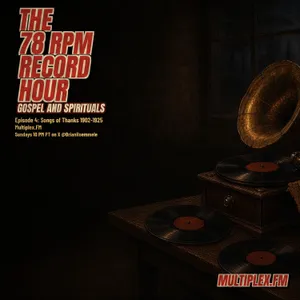
78 RPM Record Hour: Gospel and Spirituals
Got something to say to this podcast? Send a voicemail, and you might hear yourself on the next episode! The 78 RPM Record Hour, Episode 4: Gospel and Spirituals (Songs of Thanks). Fifteen original records from 1902 to 1925 (Victor and Columbia 78s) with the Fisk Jubilee Singers, the Dinwiddie Colored Quartet, the Tuskegee Institute Singers, Homer Rodeheaver, the Bethel Jubilee Quartet, and Marian Anderson. Hosted by Brian Roemmele. First aired Sunday, November 22, 2026 at 10:00 PM PT on Multiplex.FM, right before The Elon Hour. New episodes of The 78 RPM Record Hour air Sundays at 10:00 PM PT. TRACK LIST 1. Fisk University Jubilee Singers (label: Fisk University Jubilee Quartet) — "Swing low, sweet chariot" (released March 1910, Victor 16453, mx B-8420-3). Recorded December 1, 1909, Camden, N.J. 2. Dinwiddie Colored Quartet — "Down on the old camp ground" (1902-1903, Victor 1714, pre-matrix B-1714-2). Recorded October 29, 1902, Philadelphia. The opening 7.30 seconds of the transfer (a 1902 spoken label announcement) were trimmed. 3. Dinwiddie Colored Quartet — "Steal away" (1902, Victor 1716, pre-matrix B-1716-2). Recorded October 29, 1902, Philadelphia. 4. Fisk University Jubilee Singers — "Little David, play on yo' harp / Shout all over God's heaven" (about 1910, Victor 16448, mx B-8450-1). Recorded December 8, 1909, Camden, N.J. 5. Tuskegee Institute Singers — "Go down Moses" (about 1914-1915, Victor 17688, mx B-15167-1). Recorded August 31, 1914. 6. Tuskegee Institute Singers — "Good news" (released January 1915, Victor 17663, mx B-15168-1). Recorded August 31, 1914. 7. Homer A. Rodeheaver — "Brighten the corner where you are" (released June 1915, Victor 17763, mx B-15855-1). Recorded April 3, 1915. Composition: Ina Duley Ogdon and Charles H. Gabriel, 1913. 8. Fisk University Jubilee Singers — "I ain't goin' to study war no more" (released 1922, Columbia A3596, mx 79614-3). Recorded December 29, 1920, New York. 9. Bethel Jubilee Quartet (dir. T. H. Wiseman) — "Hush, somebody's calling my name" (released 1923, Victor 19119, mx B-28172-6). Recorded July 13, 1923, Camden, N.J. 10. Marian Anderson (arr. H. T. Burleigh, 1916) — "Deep river" (released April 1924, Victor 19227, mx B-29072-2). Recorded December 10, 1923, Camden, N.J. 11. Mrs. William Asher and Homer A. Rodeheaver — "Shall we gather at the river?" (1924, Columbia 211-D, mx 81835-2). Recorded June 19, 1924, New York. Composition: Robert Lowry, 1864. 12. Fisk University Jubilee Singers — "Hope I'll join the band" (released 1924, Columbia 163-D, mx 81704-2). Recorded April 21, 1924, New York. 13. Marian Anderson (arr. H. T. Burleigh, 1918) — "My Lord, what a mornin'" (released July 1925, Victor 19560, mx B-31347-10). Recorded December 23, 1924, Camden, N.J. The flip side was not used. 14. Fisk University Jubilee Singers — "There is a balm in Gilead" (released June 1910, Victor 16487, mx B-8451-1). Recorded December 9, 1909, Camden, N.J. 15. Fisk University Jubilee Singers — "Great campmeeting" (released June 1910, Victor 16487, mx B-8500-1). Recorded December 21, 1909, Camden, N.J. All 15 sides are U.S. recordings first published 1902-1925 (before January 1, 1926) and are in the public domain in the United States (17 U.S.C. 1401). Transfers from the Library of Congress National Jukebox. ALSO HEARD Opening: J. S. Bach, Prelude No. 1 in C major, BWV 846, performed by Kimiko Ishizaka, Open Well-Tempered Clavier (CC0 public domain dedication). Outro bed: HoliznaCC0, "Cosmic Waves" (CC0). Host narration produced with VoiceBox. Watch on YouTube: https://youtu.be/UMEU5JVZYj8 Live on X: https://x.com/BrianRoemmele Multiplex.Today: https://multiplex.today Read Multiplex: https://readmultiplex.com

59 MIN
NOV 21, 2026
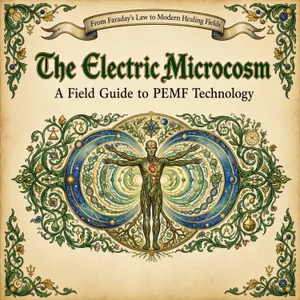
ReadMultiplex.com: The Field That Heals: Why Pulsed Electromagnetic Fields May Have Profound Benefits.
Got something to say to this podcast? Send a voicemail, and you might hear yourself on the next episode! Every cell in your body has lived its whole life inside a magnetic field. The Earth is a dynamo, and it has been on for billions of years. Lightning rings the planet with a faint electromagnetic pulse several times a second. Bone, when you load it, makes its own small voltages. Every cell membrane holds a charge like a tiny battery. The body is not merely like an electrical instrument. It is one. And if that is true, then a precisely shaped, gently pulsed magnetic field, applied from the outside, may be one of the most elegant ways we have ever found to speak to the body in its own native language. That is the premise of this article, and I want to be clear about it from the first paragraph: I believe pulsed electromagnetic field technology, PEMF, very well may have profound benefits for human health. Not because a brochure says so, but because the trail of evidence now runs from Michael Faraday's bench in 1831, through Columbia University's bone-healing coils, through a U.S. Food and Drug Administration approval in 1979, through decades of randomized trials and meta-analyses, to an FDA decision this very year that moved PEMF bone stimulators into a lower-risk device class. That is what a frontier technology looks like on its way from the margins to the mainstream. It is also a story about doing it right. When a technology this powerful becomes popular, the marketplace fills with copies. Some of them are not worth your time, and a few of them are not worth your safety. So I will show you what the studies have found, what the best engineering looks like,for low-intensity, whole-body PEMF, and exactly what to watch for in the cheap mats that borrow the letters P, E, M, and F without the science behind them. Read more at: ReadMultiplex.com Support this work by buying us a coffee: https://ko-fi.com/brianroemmele
50 MIN
NOV 19, 2026
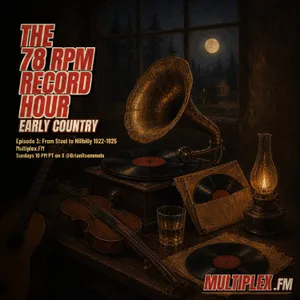
78 RPM Record Hour: From Steel to Hillbilly
Got something to say to this podcast? Send a voicemail, and you might hear yourself on the next episode! The 78 RPM Record Hour, Episode 3: From Steel to Hillbilly (Early Country). From steel to hillbilly: Frank Ferera, the steel-guitar star of the Hawaiian hour, is the guitarist on Vernon Dalhart's Prisoner's Song. Twelve original records from 1922 to 1925 (Columbia and Victor 78s) that follow the steel into the first hillbilly sides, with the stories behind each side. Hosted by Brian Roemmele. First aired Sunday, November 15, 2026 at 10:00 PM PT on Multiplex.FM, right before The Elon Hour. New episodes of The 78 RPM Record Hour air Sundays at 10:00 PM PT. TRACK LIST 1. Ferera and Franchini (Frank Ferera, steel guitar; Anthony Franchini, guitar) — "Susquehanna Shore" (1922, Columbia A3560, mx 80059-4). Recorded January 6, 1922. 2. Gid Tanner and Riley Puckett — "The Arkansaw Traveler" (1924, Columbia 15017-D, mx 140045-1). Recorded September 12, 1924; released by 1925. 3. Eck Robertson (Nathaniel Shilkret, piano) — "Done Gone" (released October 1924, Victor 19372, mx B-26669-1). Recorded July 1, 1922. 4. Riley Puckett and Gid Tanner — "Little Old Log Cabin in the Lane" (1924, Columbia 107-D, mx 81600-2). Recorded March 7, 1924. 5. Riley Puckett — "Rock All Our Babies to Sleep" (1924, Columbia 107-D, mx 81633-1). Recorded March 8, 1924. 6. Samantha Bumgarner — "Fly Around My Pretty Little Miss" (1924, Columbia 146-D, mx 81716-1). Recorded April 23, 1924. 7. Wendell Hall — "It Ain't Gonna Rain No Mo'" (1923, Victor 19171, mx B-28741-2). Recorded October 12, 1923; released November 1923. 8. Kelly Harrell — "New River Train" (1925, Victor 19596, mx B-31584-2). Recorded January 7, 1925; released April 1925. 9. Charlie Poole and the North Carolina Ramblers — "Don't Let Your Deal Go Down Blues" (1925, Columbia 15038-D, mx W140789-1). Recorded July 27, 1925. 10. Charlie Poole and the North Carolina Ramblers — "Can I Sleep in Your Barn Tonight, Mister" (1925, Columbia 15038-D, mx W140788-2). Recorded July 27, 1925. 11. Riley Puckett — "Casey Jones" (1924, Columbia 113-D, mx 81605-1). Recorded March 7, 1924; released 1924. 12. Vernon Dalhart (Frank Ferera, guitar; Murray Kellner, violin) — "The Prisoner's Song" (1925, Columbia 257-D, acoustic take 140136-6). Recorded November 25, 1924; released 1925. This is the acoustic take only; the March 1926 electrical remake was not used. All 12 sides are U.S. recordings first published 1922-1925 (before January 1, 1926) and are in the public domain in the United States (17 U.S.C. 1401). Transfers from the Library of Congress National Jukebox. The Prisoner's Song is the acoustic Columbia take 140136-6 only. ALSO HEARD Opening: J. S. Bach, Prelude No. 1 in C major, BWV 846, performed by Kimiko Ishizaka, Open Well-Tempered Clavier (CC0 public domain dedication). Outro bed: HoliznaCC0, "Cosmic Waves" (CC0). Host narration produced with VoiceBox. Watch on YouTube: https://youtu.be/_w41casjxh8 Live on X: https://x.com/BrianRoemmele Multiplex.Today: https://multiplex.today Read Multiplex: https://readmultiplex.com

59 MIN
NOV 19, 2026
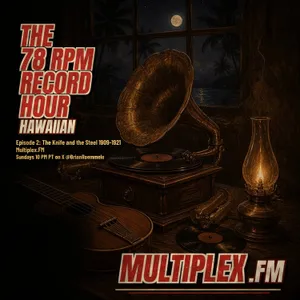
78 RPM Record Hour: The Knife and the Steel
Got something to say to this podcast? Send a voicemail, and you might hear yourself on the next episode! The 78 RPM Record Hour, Episode 2: The Knife and the Steel (Hawaiian). The knife of the blues slide guitar and the Hawaiian slide/steel guitar are cousins. Fourteen original records from 1909 to 1921 (Edison cylinders and Victor 78s) that follow the steel from Joseph Kekuku to the Hawaiian craze, with the stories behind each side. Hosted by Brian Roemmele. First aired Sunday, November 8, 2026 at 10:00 PM PT on Multiplex.FM, right before The Elon Hour. New episodes of The 78 RPM Record Hour air Sundays at 10:00 PM PT. TRACK LIST 1. Joseph Kekuku & John K. Paaluhi — "Kawaihau Waltz" (1909, Edison Gold Moulded 20714). Note: the cylinder label spelled it "Kawaihan." 2. Toots Paka's Hawaiians — "Aloha Oe (Farewell to Thee)" (1913, Edison Blue Amberol 1812) 3. Toots Paka's Hawaiians — "Akahi Hoi" (1909, Edison Blue Amberol 22539 / Amberol 11504) 4. Frank Ferera (Palakiko Ferreira) — "Ua Like No Alike (Medley of Hawaiian Hulas)" (1915, Edison Blue Amberol 2685) 5. Toots Paka's Hawaiians — "Moani Ke Ala" (1909, Edison Blue Amberol 22537 / Amberol 11502) 6. Pale K. Lua & David K. Kaili — "Kilima Waltz" (1915, Victor 17701) 7. Toots Paka's Hawaiians — "Pulupe" (1913, Edison Blue Amberol 1916) 8. Toots Paka's Hawaiians — "Tomi! Tomi! (Hawaiian Hula)" (1913, Edison Blue Amberol 1917) 9. Helen Louise & Palakiko Ferreira [Frank Ferera] — "Hapa Haole Hula Girl" (1916, Edison Blue Amberol 2956) 10. Ford Hawaiians — "Akahi Hoi" (1917, Edison Blue Amberol 3285) 11. Helen Louise & Frank Ferera — "Hawaiian Butterfly" (1917, Indestructible 1563) 12. Gladys Rice & Elizabeth Lennox — "Sweet Luana" (1921, Edison Blue Amberol 4153) 13. Helen Louise & Frank Ferera — "Wailana Waltz" (1917, Indestructible 3409) 14. Pale K. Lua & David K. Kaili — "Wailana Waltz" (1915, Victor 17767) All 14 sides are U.S. recordings first published 1909-1921 (before January 1, 1926) and are in the public domain in the United States (17 U.S.C. 1401). Transfers from the University of California, Santa Barbara Library Cylinder Audio Archive (Edison / Indestructible) and the Library of Congress National Jukebox (Victor 17701 and 17767). The Edison Gold Moulded cylinder for track 1 labeled the title "Kawaihan"; the accepted spelling is Kawaihau. ALSO HEARD Opening: J. S. Bach, Prelude No. 1 in C major, BWV 846, performed by Kimiko Ishizaka, Open Well-Tempered Clavier (CC0 public domain dedication). Outro bed: HoliznaCC0, "Cosmic Waves" (CC0). Host narration produced with VoiceBox. Watch on YouTube: https://youtu.be/c3mFOKsyqwE Live on X: https://x.com/BrianRoemmele Multiplex.Today: https://multiplex.today Read Multiplex: https://readmultiplex.com
59 MIN