


Building Satellites Closer to Earth: Anatolii Papulov, CEO of NewOrbit, on VLEO, SpaceTech and the Future of Space Infrastructure
OCT 21, 202631 MIN
Description
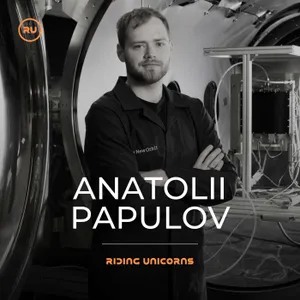
In this episode of Riding Unicorns, James and Hector sit down with Anatolii Papulov, Co-Founder & CEO of NewOrbit, the UK SpaceTech company developing satellites designed to operate much closer to Earth than conventional satellite constellations. The company recently raised an $18.5 million Series A to bring its technology to market.
Most satellites operate around 500–600km above Earth. NewOrbit is working to unlock Very Low Earth Orbit (VLEO), at altitudes closer to 200km, where satellites could deliver better imagery, improved communications and new capabilities for industries increasingly dependent on space infrastructure.
The technical challenges are significant. At these altitudes, atmospheric drag can cause conventional satellites to fall out of orbit within weeks. NewOrbit is developing proprietary propulsion systems, satellite architecture and software to enable spacecraft to operate commercially for years.
Anatolii explains how NewOrbit has assembled engineers from organisations including SpaceX, NASA and Rocket Lab, and what it takes to build and finance a deep technology company where success depends on complex engineering milestones.
The conversation also explores the wider SpaceTech industry, including why rocket launch capacity is becoming a major bottleneck, SpaceX's growing influence and the possibility of moving computing, energy generation and other infrastructure into space.
Topics Covered
What Very Low Earth Orbit (VLEO) is and why it matters
How satellites closer to Earth could transform imaging and communications
Building spacecraft capable of surviving atmospheric drag at 200km
Developing proprietary ion propulsion and satellite systems
Why building in SpaceTech is fundamentally different from software
Managing testing, reliability and technical risk
Recruiting engineers from SpaceX, NASA and Rocket Lab
Raising an $18.5 million Series A and communicating technical milestones to investors
Why launch capacity is becoming SpaceTech's biggest bottleneck
SpaceX's influence on the commercial space industry
The potential for data centres and energy infrastructure in space
Why investment in SpaceTech is accelerating
Turning a university research project into a venture-backed company
Anatolii's Future Unicorn prediction and dream dinner party guests
Anatolii also shares how his interest in VLEO began during his master's degree, when he questioned why satellites operated so far above Earth. That question became a nine-year obsession with solving one of the industry's most difficult engineering challenges.
A fascinating conversation about the commercialisation of space, breakthrough hardware and the future of infrastructure beyond Earth.