



Rights in Russia
Rights in Russia
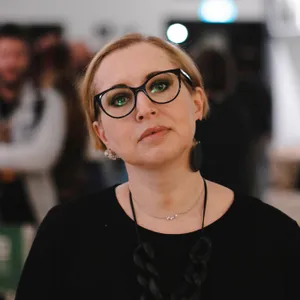
Podcast Then & Now #43: Teresa Cherfas in conversation with Linor Goralik
OCT 8, 202625 MIN
Description
Welcome to the 43rd edition of the Russian-language podcast Then & Now with me, Teresa Cherfas
Today our guest is the poet, writer, artist and activist Linor Goralik. Linor was born into a Jewish family in 1975 in Dnipropetrovsk. In 1989 her family emigrated to Israel. From 2000 to 2014, Linor lived and worked in Moscow. After that, she divided her time between Israel and Russia until November 2021. In March 2022, just two weeks after the start of the so-called ‘Special Military Operation’, Linor Goralik travelled to Tbilisi, Yerevan and Istanbul before returning to Israel – to Tel Aviv and Jerusalem – documenting the mass exodus of people from Russia triggered by the full-scale invasion of Ukraine. She subsequently presented these people’s testimonies in a bilingual publication by the Tamizdat Project entitled Exodus-22. The book was published last year.
‘In March 2022, after the full-scale invasion of Russian forces into Ukraine, I went on a trip that took me from Israel to Tbilisi to Yerevan to Istanbul and back to Israel. I hoped to take notes on this ‘Exodus-22’ – that is, to create a record of people leaving Russia over the course of these weeks. This experience was incredibly important for me, and I am endlessly grateful to the people who met with me, spoke with me, and helped me work with this material. I should add that all of the Ns in these notes are different people, and the order of the notes for each location is roughly chronological’ – Linor Goralik
‘Exodus-22 | Исход-22’ is published by the Tamizdat project
Questions
Do you remember your initial reaction when you heard the news about Russia’s full-scale invasion of Ukraine?
What prompted you to set off on this journey?
You started in Tbilisi. Tell us what you found there and how you began working with your interviewees.
After Tbilisi, you travelled to Yerevan. Did you notice a difference in the way Russian immigrants were received there?
You decided to refer to all your interviewees, without exception, as ‘N’. Why?
There’s a very palpable sense of disorientation in your interviewees’ conversations, regardless of where they are. Is this the experience of refugees everywhere or are there specific characteristics that are particular to Russians?
Did you observe any similarities in your respondents’ reflections whilst carrying out your research?
Many of those you spoke to are parents. What, in your view, lies in store for their children’s generation?
You yourself emigrated to Israel with your parents at a young age. Did you identify with their situation when you listened to their answers to your questions?
Among the new immigrants from Russia, is there a noticeable difference in attitudes between Jews and Russians?
Russians who left Russia after February 2022 are often accused of having an imperialist mindset. Is this justified, in your view?
Has their understanding of what it means to be Russian changed?
Did you sense any hope for Russia’s future?
The word ‘mosaic’ is often used to describe your book. Did you deliberately set out to present the experience of the new wave of Russian emigration in this way?
Is there a connection between your work and, say, the work of Svetlana Alexievich or Teffi?
In his review of Exodus-22, Ilya Utekhin wrote: ‘Diary entries preserve the contours of a moment before it becomes frozen in narrative, before a feeling is transformed into theory.’ Could you name some “moments” that surprised you in your conversations with your various ‘N’s?