Roots To Foods Podcast

RootsToFoods

Details

The RootsToFoods Capital Series Significant pools of private, philanthropic, and institutional capital, across the United States, Europe, Africa, Eastern Europe, India, and Southeast Asia, do not consistently reach the scalable impact opportunities they are designed to serve. This is not a series about aspiration. It is about mechanics, decision-making, and what it takes to close the gap between intent and deployment. And answer the key question of how capital intent can become capital deployment. Each conversation convenes a senior practitioner who is actively shaping how capital flows in practice, from blended finance structuring and family office transition to domestic capital architecture and entrepreneurship pipeline development. Together, the episodes form a practitioner-grade map of where capital is already moving, what enables it, and what holds it back. The Capital Series is an OviBees Ventures initiative. Founding partners: AV Ventures and ACDI/VOCA. Capital Insight Briefs Each episode of the Capital Series generates a Capital Insight Brief,  a practitioner-grade synthesis of the core insight, what is working, what is not, and what it takes to unlock capital deployment in practice. The Briefs are free, downloadable, and designed for practitioners, advisors, foundation programme officers, family office investment teams, and institutional capital professionals who want field-level insight without the full audio episode. Download the latest Capital Insight Brief below.  Wave 1 — Where Capital Is Already Moving Episode 1  |  Capital Deployment in Practice - Nathaniel Heller, EVP, Geneva Global. Episode 2  |  Blended Finance at Scale - Joan Larrea, CEO, Convergence Finance. Episode 3  |  Philanthropic Capital in Transition - Jennifer Kenning, Co-founder Align Impact. Episode 4  |  Mobilizing African Capital for Africa - Dr. Frannie Léautier, CEO, SouthBridge Investments. Episode 5  |  From Capital Platforms to Entrepreneurship Ecosystems - Jeff Hoffman, Global Entrepreneurship Network. Wave 2 and Wave 3 in development -  guests include leaders from Forum for Impact, Climate Philanthropy Catalyst Coalition, Harvard Kennedy School, Refugees Investment Network and leading family philanthropy platforms. Learn more at rootstofoods.com.

Recent Episodes

OCT 20, 2026
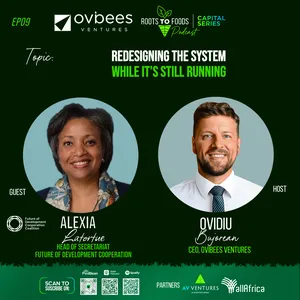
Alexia Latortue · Redesigning the System: While It’s Still Running
Every country has assets and liabilities. What would development cooperation look like if it started there instead of with aid? Ovidiu Bujorean speaks with Alexia Latortue, Head of Secretariat of the Future of Development Cooperation Coalition and former Assistant Secretary for International Trade and Development at the U.S. Treasury. She has worked inside CGAP at the World Bank, the EBRD, the Millennium Challenge Corporation and the Treasury. She now runs the Coalition, co-hosted by ACET and the Center for Global Development, which is rethinking how development cooperation works. In this episode: Why institutions are full of inertia, and how individuals inside them can move it. The development balance sheet: starting from a country’s own assets, liabilities and vision rather than the aid flow. The four purposes the Coalition proposes for development cooperation. Why aid is small but precious, and which flows actually drive development. Where change is already visible, from Rwanda’s country-led approach to multilateral development banks acting as enablers. “Because ODA it’s small and because it’s so precious, and because used well it can be so catalytic, we had better use it exceptionally well.” Alexia Latortue, on official development assistance 🎧 Episode 9 of the RootsToFoods Capital Series, produced by OviBees Ventures, with AV Ventures (an ACDI/VOCA affiliate) as founding partner and AllAfrica Global Media as media partner. A French edition follows on October 27, 2026. 📰 Capital Insight brief: rootstofoods.com 📩 Subscribe to the Capital Deployment newsletter on LinkedIn to get every Capital Insight brief as it’s published: https://www.linkedin.com/newsletters/capital-deployment-7454225038356013056 Next: Episode 10, on November 3, 2026 with Kanini Mutooni, Senior Managing Director of the Draper Richards Kaplan Foundation and Dr. Frank Aswani, CEO of the African Venture Philanthropy Alliance.
38 MIN
OCT 13, 2026
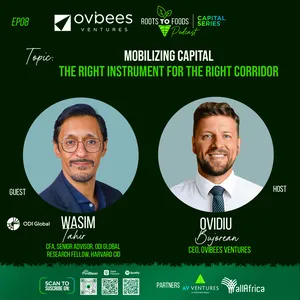
Mobilizing Capital. The Right Instrument for the Right Corridor.
How does private capital get from investors to projects in emerging markets, and what stops it on the way? Ovidiu Bujorean speaks with Wasim Tahir, CFA, Senior Advisor at ODI Global and Research Fellow at the Harvard Center for International Development. As a director at British International Investment, the UK’s development finance institution, Wasim developed its mobilization strategy and led its first secondary loan sale to an institutional investor. In this episode: What counts as private capital, and why shrinking aid budgets push development finance institutions to bring private investors with them. How BII moved from buy-and-hold to originate-to-share, selling aged loans to recycle capital into new deals. Why blended finance changes the risk of a whole deal, and how guarantees can be cut to fit one specific risk. Why domestic capital markets and national development banks matter more than another new instrument “It’s like saying you’ve got quite a spicy soup and you drop a bit of milk in to cool it down so more people can eat it. Everyone sort of benefits in some ways.” Wasim Tahir, on blended finance. 🎧 Episode 8 of the RootsToFoods Capital Series, produced by OviBees Ventures, with AV Ventures (an ACDI/VOCA affiliate) as founding partner and AllAfrica Global Media as media partner. 📰 Capital Insight brief: rootstofoods.com 📩 Subscribe to the Capital Deployment newsletter on LinkedIn to get every Capital Insight brief: https://www.linkedin.com/newsletters/capital-deployment-7454225038356013056
42 MIN
SEP 8, 2026
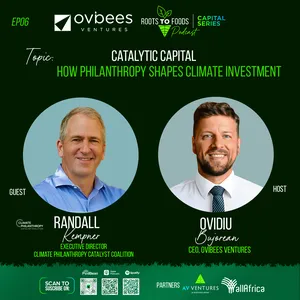
Catalytic Capital: How Philanthropy Shapes Climate Investment
EP06 - Catalytic Capital: How Philanthropy Shapes Climate InvestmentRandall Kempner, Executive Director, Climate Philanthropy Catalyst Coalition Wave 2 of the RootsToFoods Capital Series opens with the question that has run under every conversation so far: what is the specific form of capital that moves when nothing else will? Our guest built the Aspen Network of Development Entrepreneurs (ANDE) from the ground up, a field-building institution whose purpose was never a financial return but the ecosystem conditions that let profit-making businesses in emerging markets grow. He now leads the Climate Philanthropy Catalyst Coalition and has spent more time than almost anyone alive studying what philanthropy can do that nothing else can. In this conversation, Randall Kempner and host Ovidiu Bujorean cover: Why climate philanthropy has never exceeded 2% of total global giving, and why that's an intent problem more than a mechanisms problem. Why a foundation's real leverage isn't the 5% it grants each year. It's the other 95% sitting in its investment portfolio. Philanthropic collaboratives are where the highest-leverage work is happening right now. Groups like Forest & People Climate, Global Methane Hub, and ORCA (ocean resilience) pool resources around specific high-impact solutions. "Philanthropy should be the first in - period. Its job is to take the risk to move money." - Randall Kempner For the practitioner-level breakdown of this conversation, three takeaways, and the data behind it, subscribe to Capital Deployment, our LinkedIn newsletter for practitioners closing the gap between capital intent and deployment: https://www.linkedin.com/newsletters/capital-deployment-7454225038356013056
39 MIN
JUL 30, 2026
ÉpisConstruire l'écosystème qui absorbe le capital : la perspective de l'entrepreneur, avec Jeff Hoffman
Cofondateur de Priceline.com et Booking.com, producteur d'un album de jazz ayant remporté un Grammy Award, producteur exécutif d'une émission de télévision ayant remporté un Emmy Award, Président du Global Entrepreneurship Network - actif dans 190 pays - et membre du Conseil consultatif mondial d'OviBees Ventures, Jeff Hoffman clôture la Vague 1 de la RootsToFoods Capital Series. Dans cet épisode, Jeff explique pourquoi la plupart des fondateurs ne sont jamais formés à la mise à l'échelle, ce qui distingue une adéquation produit-marché réelle - trouvée sur le terrain, pas au bureau - d'une adéquation supposée, et pourquoi la qualité la plus prédictive du succès d'un fondateur est sa capacité à rester «coachable ». Il revient aussi sur le programme GIST à Jakarta en 2014, sur l'histoire de Tiket.com, et sur ce qui, douze ans plus tard, reste la même question: comment construire l'écosystème qui absorbe le capital d'impact. L'épisode se termine par la synthèse de la Vague 1 : cinq invités, cinq perspectives sur l'écart de déploiement du capital - et la conclusion de Jeff : la plus grande peur d'un entrepreneur ne devrait pas être de perdre du capital, mais de ne rien faire. Cet épisode est également disponible sur Spotify, Apple Podcasts et les autres plateformes connectées. La RootsToFoods Capital Series est une plateforme bilingue (anglais/français) destinée aux praticiens de la finance du développement, du blended finance et de l'intelligence des corridors de capitaux entre l'Afrique, le Golfe, l'Inde, l'Indonésie et les Amériques — à destination des family offices, des leaders philanthropiques, des entrepreneurs et des investisseurs institutionnels. Diffusée en partenariat avec AllAfrica Global Media. Pour recevoir chaque nouvelle Capital Insight directement sur LinkedIn, abonnez-vous à la newsletter Capital Deployment : https://www.linkedin.com/newsletters/capital-deployment-7454225038356013056 La Vague 2 revient en septembre, avec des conversations sur le capital institutionnel africain, la philanthropie indienne et les family offices indonésiens.
43 MIN