Rx for Success Podcast

MD Coaches

Details

The Rx for Success podcast spotlights physician leaders reflecting on the elements that made them successful. The podcast is hosted by Dr. Randy Cook, a well-regarded general and vascular surgeon, and former radio personality. Life-Changing Moments hosted by Dr. Dael Waxman is the Rx for Success companion podcast and focuses on the turning points in lives and careers that drive success

Recent Episodes

NOV 16, 2026
Preparing Residents for the Transition to Practice with Charley Lowry
Most residency programs do an excellent job preparing physicians to care for patients—but how well are they preparing residents to find the right job? Recent AMA data suggests physicians who completed training in the last several years stay in their first job for less than two years on average—far shorter than previous generations. That raises a critical question: are we preparing residents not just to get a job, but to find the right fit? In this episode, host Dr. Dael Waxman welcomes back Charley Lowry, Director of GME Relations at PracticeLink and one of the most respected voices in physician recruitment and career planning. Drawing on years of work with residency programs and thousands of physicians nationwide, Charley unpacks why the job search is so often underestimated, why starting early matters, and what residency educators can do to better support residents through this major life transition. From the "meeting with yourself" strategy to the three-category framework for evaluating what matters most, this conversation is packed with practical guidance for residents, fellows, and the educators who support them. Listeners will learn why Charley recommends starting the job search on day one of residency (or at least 18–24 months before finishing), the questions residents most often fail to ask, how to think about compensation without making it the only priority, and why being "picky" is not just allowed but encouraged. Whether you're a resident approaching graduation, a program director shaping curriculum, or a physician considering a career change, this episode offers a roadmap for finding a first practice that lasts. Key Topics Discussed Why the transition from residency to first practice is so frequently underestimated by residents and educators alike AMA data showing early-career physicians stay in their first job less than two years on average The case for starting the job search on day one of residency—or at minimum 18–24 months before finishing The "meeting with yourself" strategy: scheduling dedicated weekly or biweekly job-search time Using PGY-1 to build and strengthen your CV, explore job boards, and attend virtual career fairs What residency programs can implement: incremental career development curriculum across all years The value of alumni engagement and mentorship in job search preparation Contract education and negotiation: why it should be taught early and revisited annually Interview preparation and free CV workshops, especially valuable for IMGs The most common regrets physicians have about their first job—and why asking questions is essential What surprises new attendings: hours, call, salary realities, team dynamics, and leadership The difference between thriving and struggling in a first job: alignment, culture, and lifestyle fit The three-category framework: non-negotiables, willing-to-bend, and nice-to-haves Why family input matters in the job search decision The overlooked benefits of rural positions, including student loan repayment Thinking outside the box about geography—don't default to "going back home" without reconsidering Three recommendations for residency educators to implement in the next year Guest Information Charley Lowry Director of GME Relations, PracticeLink Host of the podcast Surviving and Thriving in Residency Charley Lowry has worked with residency programs and thousands of physicians across the country, helping residents think strategically about job search, contracts, compensation, practice selection, and the factors that determine whether a physician thrives or struggles in their first position after training. Prior to PracticeLink, he worked for an osteopathic school with third- and fourth-year students and alumni, where he developed an alumni mentorship network. PracticeLink — a free career platform serving physicians for over 30 years, offering CV reviews, lunch-and-learns, job board access, and provider relations support. No fees, free for a lifetime. Visit practice link dot com (practicelink.com). Relevant Links PracticeLink — practicelink.com (free job board, CV builder, virtual career fairs, provider relations team) MD Coaches — producer of Life Changing Moments; contact: [email protected] Sponsors: Navigate, MD Coaches, PracticeLink, Physician Outlook Companion podcast: Rx for Success with Dr. Randy Cook

35 MIN
NOV 2, 2026
Rx for Success – Staying Well-Rounded: A Journey from Allergy to Advocacy with Dr. Basil Kawash
What does it take to build a career that feels both successful and fulfilling—while staying true to yourself? In this engaging episode of Rx for Success, host Dr. Randy Cook sits down with Dr. Basil Kawash, an allergist and immunologist practicing in Columbus, Ohio, to explore a career shaped by family legacy, thoughtful choices, and a commitment to staying well-rounded. Dr. Kawash shares his journey as the son of Syrian immigrant physicians, his decision to attend a small liberal arts college, the gap year that shaped his maturity, and how mentors drew him to internal medicine and allergy/immunology. He also opens up about the difficult decision to leave academic medicine at Vanderbilt to return home to Columbus—and why it was the right move. Along the way, he offers four memorable prescriptions for success: stay well-rounded, seek advice from happy people, be an outlier, and don't take everything too seriously. Key Topics Discussed: Growing up in a family of physicians—both parents and several aunts and uncles. His parents' journey as Syrian immigrants navigating medical careers in the U.S. Choosing a small liberal arts college over a large university—and why it was the right fit. The gap year between college and medical school: maturity, experience, and a better application. Choosing internal medicine for breadth and mentorship. The 18 weeks of surgery that convinced him he wanted something else. Why allergy and immunology won him over—personal experience with asthma and eosinophilic esophagitis. The serendipitous path to Vanderbilt: a journal ad, a cold email, and a next-day phone call. Leaving academia for private practice in Columbus: family, familiarity, and a great group. Dr. Kawash's four prescriptions for success: Stay well-rounded. Seek advice from happy people. Be an outlier. Don't take everything too seriously. Guest Information: Dr. Basil Kawash, MD – Allergist and Immunologist, Columbus, Ohio Connect on LinkedIn: Basil Kawash Article co-authored with Dr. Graham Walker at offcall.com Relevant Links: MD Coaches: mymdcoaches.com Offcall: offcall.com Companion podcast: Life-Changing Moments with Dr. Dael Waxman
31 MIN
OCT 5, 2026
Life Changing Moments – Rethinking Autonomy: A New Framework for Physician Fulfillment with Dr. Mark Greenawald
What do physicians really mean when they say, "I just don't have enough autonomy anymore"? Is autonomy something we either have or don't have? Is more always better? Or is the issue more complex than we've assumed? In this thought-provoking episode of Life Changing Moments, host Dr. Dael Waxman is joined by Dr. Mark Greenawald—professor, vice chair of Family and Community Medicine at Carilion Clinic, medical director of the Carilion Clinic Institute for Leadership Effectiveness, and a fellow coach and teacher at the Healthcare Coaching Institute. Together, they challenge one of medicine's most common assumptions and offer a richer, more nuanced framework for understanding autonomy. Drawing from their recent series of articles in Family Practice Management, Dale and Mark explore the six domains of autonomy—clinical, operational, ethical, economic, policy, and interpersonal—and explain why autonomy lives on a continuum, not a binary. They discuss how your "sweet spot" shifts across seasons of your career and life, why autonomy can become a "trigger word" for administrators, and the liberating paradox that by giving up some autonomy, you often gain more influence. Mark also shares his powerful coaching tool—pause, turn down the volume, and get curious—for anyone feeling their autonomy has been stripped away. Key Topics Discussed: Dael's personal story of being "shut down" after raising autonomy at a physician leadership retreat. Why autonomy has become a "buzzword" and a "trigger word" for administrators. The six domains of autonomy: Clinical – making clinical decisions in and beyond the exam room. Operational – influencing schedules, benefits, and workflow. Ethical – practicing in alignment with your values. Economic – controlling the business and compensation aspects. Policy – influencing organizational policies and procedures. Interpersonal – having a say in who you work with. Why autonomy lives on a continuum—and why more autonomy means more risk and responsibility. How your ideal spot on the continuum changes across seasons of life and career. The mismatch problem: when what you need economically conflicts with what you want operationally. Why the training model still primes physicians for independence, even as 90% of graduates enter employed practice. The developmental arc of residency: survival → identity → independence → interdependence. The paradox of autonomy: by being a team player and helping shape culture, you often gain more influence. Why operational autonomy is the most common source of frustration for employed physicians. "Treat me like an adult": the importance of sharing the why behind organizational decisions. Mark's three-part coaching tool: Pause, Turn Down the Volume, Get Curious. The difference between "What do you want?" and "What do you need?" Why physicians—who are trained as helpers—often struggle to acknowledge their own needs. Guest Information: Dr. Mark Greenawald, MD – Professor and Vice Chair, Department of Family and Community Medicine, Carilion Clinic; Medical Director, Carilion Clinic Institute for Leadership Effectiveness; Virginia Tech Carilion School of Medicine Articles in Family Practice Management: "How to Be Well Employed" (2022); Autonomy series (late 2025–2026) Dr. Dael Waxman, Physician Coach, MD Coaches – Host, Life Changing Moments Relevant Links: MD Coaches: mymdcoaches.com Family Practice Management – Articles by Dr. Mark Greenawald and Dr. Jason Marker Healthcare Coaching Institute Companion podcast: Rx for Success with Dr. Randy Cook

50 MIN
AUG 31, 2026
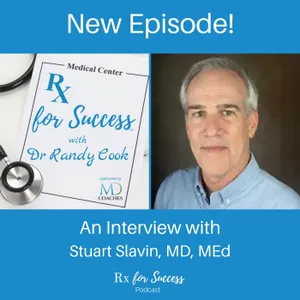
220. The Author: Dr. Stuart Slavin, MD, MEd
What happens when the relentless pursuit of success becomes the very thing that undermines our well-being? In this profound episode of Rx for Success, host Dr. Randy Cook sits down with Dr. Stuart Slavin—pediatrician, educator, researcher, and author of the new book The Success Trap: How the Pressure to Stand Out is Fueling Anxiety, Depression, and Burnout in Teens. Dr. Slavin shares his remarkable journey from a shy college student who wasn't sure medicine was for him to a transformative leader in medical education and physician well-being. He recounts the pivotal moment when he discovered that medical school itself was causing profound harm to students—and how he and his colleagues at St. Louis University transformed their curriculum, reducing depression and anxiety rates by 80% while actually improving academic performance. He also discusses his groundbreaking research on adolescent mental health, revealing that school-related pressures—not social media—are the top drivers of stress for today's youth. This conversation is a must-listen for anyone concerned about the well-being of the next generation of physicians and the culture that shapes them. Key Topics Discussed: Growing up with a physician father and a consumer advocate mother who modeled making a difference. The surprising path to medicine: deciding to apply to medical school mid-fall of senior year. Choosing pediatrics because of "who are my people?" and finding joy in the community. Getting a master's in education—a rare and career-defining decision. The pivotal moment: surveying medical students and realizing "we're doing this to them." Transforming the St. Louis University medical school curriculum: reducing class time, pass-fail grading, and freeing up time for meaning. The stunning results: 80% reduction in depression and anxiety, improved academic performance, and halved failure rates. The "success trap": how relentless achievement pressure and extrinsic motivation are harming young people. Research in 18 high schools: top stressors are school-related, not social media. The importance of sleep: average high school students get only 6.5 hours (need 9-10). Dr. Slavin's new book: The Success Trap—a parenting guide and call to rethink education. The wisdom of Viktor Frankl: success cannot be pursued; it must ensue from dedication to a cause greater than oneself. Big M and little M meaning: finding purpose in everyday moments of connection. Guest Information: Dr. Stuart Slavin, MD, MEd – Pediatrician, Educator, Researcher, Author Website: drstuartslavin.com Book: The Success Trap: How the Pressure to Stand Out is Fueling Anxiety, Depression, and Burnout in Teens (Available at local booksellers, Amazon, Barnes & Noble) Relevant Links: MD Coaches: mymdcoaches.com Companion podcast: Life-Changing Moments with Dr. Dale Waxman Viktor Frankl's Man's Search for Meaning
38 MIN
JUL 13, 2026
Life Changing Moments - Coaching Human Factors: Saving Cognitive Energy in Medicine with Dr. Sachiko Kaizuka
Why do some physicians thrive when new workflow tools are introduced, while others continue to struggle despite having access to the same resources? In this insightful episode of Life Changing Moments, host Dr. Dael Waxman sits down with Dr. Sachiko Kaizuka—Associate Professor of Family Medicine at the University of Rochester School of Medicine—to explore the intersection of physician well-being, workflow design, and coaching. Dr. Kaizuka shares her journey from rural practice burnout to becoming an EMR "super user" and wellness advocate. She introduces the concept of human factors ergonomics—a framework used in aviation and aerospace to optimize human performance—and explains how it applies to healthcare. Her research demonstrates that combining human factors principles with personalized coaching helps physicians reduce cognitive load, improve note closure rates, decrease after-hours EMR work, and sustain improvements in well-being long after coaching ends. This conversation offers practical tools for any clinician feeling overwhelmed by documentation, inbox management, and the competing demands of modern medicine. Key Topics Discussed: Dr. Kaizuka's personal journey through burnout and recovery in rural practice. The concept of human factors ergonomics and its application to healthcare. Understanding cognitive energy as a finite resource that must be budgeted and replenished. Why resilience and mindfulness alone aren't enough to address physician burnout. The "missing link" between workflow tools and physician adoption: personalized coaching. How coaching helps clinicians identify and challenge beliefs about perfectionism and expectations. Practical examples: reframing note-writing, setting boundaries, and letting go of unnecessary tasks. The NASA Task Load Index and the emotional cost of frustration. Results from Dr. Kaizuka's pilot study: improved note closure rates, reduced after-hours EMR use, sustained well-being improvements. The power of shifting from "EMR hater" to curious learner. Future plans: scaling the coaching model and training peer coaches. Guest Information: Dr. Sachiko Kaizuka, MD – Associate Professor of Family Medicine, University of Rochester School of Medicine MD Coaches: mymdcoaches.com Relevant Links: MD Coaches: mymdcoaches.com Companion podcast: Rx for Success with Dr. Randy Cook Society of Teachers of Family Medicine (STFM)
33 MIN