Scaling Nerds | Startup Marketing, Fundraising and Sales

Marina Schmidt

Details

Scaling Nerds (prev. Red to Green) helps science and tech founders master communication skills needed for VC-backed growth, covering the nuts and bolts of startup marketing, sales and fundraising. Ranked in the top 5% globally, with listeners in 160+ countries, Scaling Nerds is a top podcast for founders who want to raise money, build their founder brands or close corporate sales. Hosted by startup communications advisor Marina Schmidt. Scaling Nerds is a premier podcast for deep tech startup founders featuring storytelling for technical and science-driven companies.

Recent Episodes

NOV 11, 2026
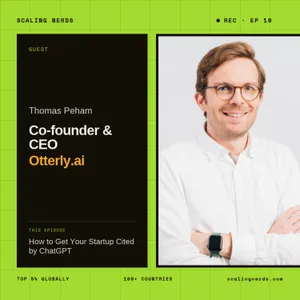
19. Get Claude and GPT to Recommend Your Company - AI Search, Geo Essentials – with Otterly.ai Co-Founder Thomas Peham
Your investor may already get an AI briefing on you before an upcoming meeting, and your customers ask the same online tools who to buy from. But if your website is all animation and less readable copy, what do those tools actually see? Does it match the story you want told? Thomas Peham, CEO and co-founder of Otterly.ai, has analyzed over 100 million websites to see what AI search engines cite. In this episode, you'll learn why ChatGPT and Claude share only 8% of recommended domains, and how his team got a fake agency recommended by ChatGPT after seven days by landing mentions in articles that were already cited. You also get a quick checklist: find the sources AI already trusts, test whether AI knows your brand, and check that crawlers can read your website. Fancy animations and JavaScript-heavy pages do not help here. LINKS Could use a strategic advisor on your communications and founder branding? Work with Marina at https://www.scalingnerds.com/ Marina Schmidt (host) on LinkedIn: https://www.linkedin.com/in/schmidt-marina/ Thomas Peham (guest) on LinkedIn: https://www.linkedin.com/in/thomaspeham/ Otterly.ai: https://otterly.ai/ Otterly.ai free brand authority score tool: https://geo.otterly.ai/geo/ai-brand-entity/ Otterly.ai free website crawlability check: https://otterly.ai/features/ai-crawler-checker CHAPTERS 00:00 - Who needs AI search optimization (GEO)? 07:31 - ChatGPT vs Claude vs Google: which sources AI cites 16:50 - The fake agency test: ranking in ChatGPT in 7 days 23:24 - GEO checklist: citations, brand entity, crawlability 27:16 - Positioning and keywords for AI search optimization 35:01 - Website tips: JavaScript, content chunking, FAQs, About pages ABOUT THIS EPISODE This episode of Scaling Nerds, the startup podcast for deep tech founders, explains AI search optimization and generative engine optimization (GEO) in plain terms. Thomas Peham shares data on how ChatGPT, Claude and Google cite sources, how brand entity and crawlability affect startup marketing, and why consistent positioning and content chunking matter for founder branding and startup PR. It is useful whether you are preparing a pitch deck, fundraising or rebuilding your website, and it ends with practical steps you can run in minutes. KEYWORDS ai search optimization, generative engine optimization, geo, chatgpt, claude, ai search, brand entity, content chunking, startup marketing, startup podcast, pitch deck, fundraising, deep tech founders, founder branding, startup PR
46 MIN
OCT 28, 2026
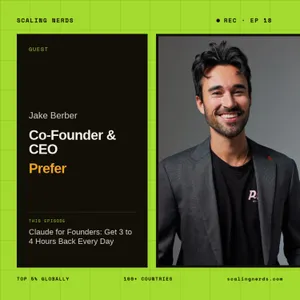
18. AI Use-cases for Founders: Get 3 to 4 Hours Back Every Day – with Jake Berber Co-Founder and CEO of Prefer
Claude for founders only pays off when it keeps working while you don't. Jake Berber's setup chased me five or six times, every three business days, to reschedule this very recording, in a voice that sounded exactly like his. I knew Claude wrote those messages and it still felt like the most on-top-of-it guest I've ever had. What would you do with three or four extra hours every day? Jake is CEO and co-founder of Prefer, a Singapore startup that makes coffee and cacao alternatives through fermentation. He leads sales, and he walks you through the Claude Cowork setup behind it: a second brain that merges email, CRM and meeting notes, a daily morning briefing, scheduled follow-up drafts and an NDA redlining agent. You also hear how he turns a stack of conference business cards into follow-ups in about an hour, built a financial model in 90 minutes, and why LinkedIn beats cold email for his outreach. LINKS Could use a strategic advisor on your communications and founder branding? Work with Marina at https://www.scalingnerds.com/ Marina Schmidt (host) on LinkedIn: https://www.linkedin.com/in/schmidt-marina/ Jake Berber (guest) on LinkedIn: https://www.linkedin.com/in/jakeberber/ Prefer (Jake's company): https://prefer.coffee/ Claude Cowork: https://claude.com/product/cowork Wispr Flow (voice dictation): https://wisprflow.ai/ Supabase: https://supabase.com/ Airtable: https://www.airtable.com/ Wikipedia, Signs of AI writing: https://en.wikipedia.org/wiki/Wikipedia:Signs_of_AI_writing CHAPTERS 00:00 - Claude for founders: how to get 3 to 4 hours back every day 02:39 - Claude Cowork setup: second brain, skills and scheduled tasks 11:15 - Founder sales with Claude: morning briefing, NDAs, follow-ups 20:12 - LinkedIn posts with Claude: hooks, tone of voice, AI patterns 25:08 - Fundraising with Claude: due diligence Q&A, financial model, pitch deck 32:27 - Claude usage tips: token limits, model choice, team adoption ABOUT THIS EPISODE A practical startup podcast episode on Claude for founders. Jake Berber, CEO of Prefer, shows how he uses Claude Cowork for startup marketing, sales follow-ups and fundraising. You get his approach to LinkedIn content and founder branding, plus how he handles due diligence questions, a financial model and a pitch deck with AI. If you are one of the deep tech founders short on time, this episode helps you automate admin and spend your hours on customers, investors and storytelling. KEYWORDS claude for founders, claude cowork, ai for startups, founder sales, sales follow-ups, linkedin for founders, ai fundraising, financial model, pitch deck, due diligence, startup marketing, startup podcast, deep tech founders, founder branding, fundraising

41 MIN
OCT 14, 2026
17. Customer Discovery Interviews Mislead You: Test Buyer Pull Instead – with Rob Snyder
Customer discovery is the one piece of startup advice everyone repeats, and it can still steer you straight into the iceberg. You spend dozens or even hundreds of hours talking to customers, find a burning problem and build the fix. Then nobody pays. What if the problem was never the point, and the real question is who would be weird not to buy from you? Rob Snyder is a Harvard Business School grad, former McKinsey consultant and author of The Power of Pull. He teaches and advises founders at Harvard. You get his PULL framework (Project, Unavoidable, List of options, Limitations) and learn why polite feedback like "this is really impressive" is a soft no. You hear how an eBay security chief said a tool would save $40 million a year and still did not buy, how Wiz began by asking CISOs what they would pay for, and how Rob's own company hit $1M ARR on spreadsheets. Plus the four questions that turn a discovery call into a demand diagnosis, and why deep tech founders should pre-sell before the lab work is done. LINKS Could use a strategic advisor on your communications and founder branding? Work with Marina at https://www.scalingnerds.com/ Marina Schmidt (host) on LinkedIn: https://www.linkedin.com/in/schmidt-marina/ Rob Snyder (guest) on LinkedIn: https://www.linkedin.com/in/rsnyder1/ Rob Snyder's website: https://robsnyder.org/ The Power of Pull by Rob Snyder: https://robsnyder.org/book The Heart of Innovation: https://www.amazon.de/-/en/Heart-Innovation-Navigating-Authentic-Demand/dp/152300570X Wiz: https://www.wiz.io/ Clay: https://www.clay.com/ Oversubscribed by Daniel Priestley: https://www.amazon.com/dp/0857086197 CHAPTERS 00:00 - Customer discovery vs the PULL framework 03:34 - How to sell to corporates: find the internal champion 06:05 - Buying signals: why polite feedback is a no 10:46 - Why customer discovery interviews fail and how to pre-sell deep tech 31:42 - From failed product to $1M ARR: Rob's story 38:52 - Sales call questions that replace customer discovery interviews ABOUT THIS EPISODE This startup podcast episode shows deep tech founders how to run customer discovery that ends in a sale, not in polite feedback. Rob Snyder explains the Pull framework, why interviews create the illusion of knowledge, and how to pre-sell before your product exists. You learn how to find the internal champion in a corporate account, read real buying signals and ask the Hail Mary question. Useful for anyone working on startup marketing, founder branding, startup storytelling, fundraising or a pitch deck that needs proof of real customer demand. KEYWORDS customer discovery, customer discovery interviews, pull framework, the power of pull, rob snyder, product market fit, pre-selling, sales calls, startup marketing, startup podcast, pitch deck, fundraising, deep tech founders, founder branding, startup storytelling
54 MIN
OCT 7, 2026
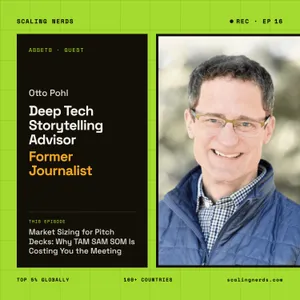
16. Nailing Market Sizing for Your Next Fundraising Deck – with Otto Pohl
Most investors skip your market sizing slide. Not because the number is too small, but because a $5 billion figure pulled off Statista tells them nothing about how you get your first customer. And when you claim 1% of a huge market, you quietly undercut the entire deck you just spent ten slides building. So what does a market slide that actually sells the business look like? Otto Pohl helps deep tech founders tell better company stories, with a focus on university spinouts. Former journalist, serial entrepreneur, head of communications for startups, and he has taught entrepreneurial communications at USC. In this episode he and Marina take apart the TAM SAM SOM habit and rebuild the market slide from the bottom up. You will hear why the same blood-analysis technology needs three completely different market pitches depending on whether you are talking to a medtech VC or to SoftBank, how a data center cooling startup found its one number by anchoring on PUE instead of the total market, why conquering Belgium can be a more convincing first move than claiming the world, and what changes in your market narrative between pre-seed and Series A. Plus the reason academic founders keep showing up to the beach in a tuxedo. LINKS Could use a strategic advisor on your communications and founder branding? Work with Marina at https://www.scalingnerds.com/ Marina Schmidt (host) on LinkedIn: https://www.linkedin.com/in/schmidt-marina/ Otto Pohl (guest) on LinkedIn: https://www.linkedin.com/in/ottopohl Otto Pohl's website & biweekly newsletter: https://www.ottopohl.com/ Otto's consulting, Core Communications: https://www.ottopohl.com/services CHAPTERS 00:00 - What the market sizing slide is actually for 14:27 - Bottom-up market sizing: the numbers investors believe 41:02 - Picking your wedge: why a small first market wins 49:34 - Academic vs business communication: the tuxedo at the beach 54:15 - How market sizing changes from pre-seed to Series A ABOUT THIS EPISODE A practical guide to market sizing for startup pitch decks, built for deep tech and university spinout founders. Otto Pohl and Marina Schmidt cover TAM SAM SOM and its limits, bottom-up market sizing, how the market slide connects to your go-to-market strategy, choosing a beachhead market, and how investor expectations shift from pre-seed to Series A. Scaling Nerds is a startup podcast on communications, storytelling and PR for VC-backed founders raising their next round. KEYWORDS market sizing, tam sam som, pitch deck, market slide, bottom-up market sizing, go-to-market strategy, beachhead market, investor pitch, deep tech startup, university spinout, fundraising, startup marketing, startup storytelling, founder branding, startup podcast 28.10. - changed the title (M)
57 MIN
APR 22, 2026
15. How AI Is Changing the Media Landscape & PR – with Former Media Journalist Steven Perlberg From Merantix Capital
The Future of Media, AI & Founder Visibility Guest: Steven PerlbergLinkedIn: ⁠https://www.linkedin.com/in/sperlberg/⁠ · Merantix Capital: ⁠https://www.merantix-capital.com⁠Head of Communications at Merantix Capital — Berlin-based VC investing in early-stage AI. Former reporter at WSJ, BuzzFeed News, and Business Insider covering media, tech, and politics. Happy to connect with journalists exploring life after reporting. Host: Marina SchmidtLinkedIn: ⁠https://www.linkedin.com/in/schmidt-marina/⁠ · Website: ⁠https://www.scalingnerds.com⁠Communications advisor helping science and tech founders get seen, heard, and backed — on stages, podcasts, and in the press. The media landscape is shifting fast — and as a founder, understanding that shift is no longer optional. Steven Perlberg, Head of Communications at Merantix Capital and former tech journalist at the Wall Street Journal, BuzzFeed News, and Business Insider, joins Marina to unpack what AI, fragmentation, and the death of the "mushy middle" mean for how founders should think about visibility, PR, and media strategy. Warning: this one gets philosophical. US vs. European tech media — The fundamental difference is size and reach. US outlets skew toward covering Silicon Valley companies, making it harder for European seed-stage startups to break through without a strong narrative hook, major fundraising news, or a US expansion angle. Steven's rule: define your goal first, then pick the outlets that match it. Why founders should pitch journalists directly — When Steven was a reporter, a direct email from a founder saying "I cover your space, want to grab coffee?" always got a yes. Today's version of the five-reporter shortlist might include a Substack writer or LinkedIn creator. Build those relationships personally, not through agencies. The AI slop problem — Faceless, generic AI content is flooding every channel. The counter-move: a growing premium on human faces and authentic voices. OpenAI's acquisition of tech news show TBPN for reportedly hundreds of millions signals exactly this. LLMs as the new search — If your audience is getting their news via AI tools instead of clicking TechCrunch, the tier of the outlet matters less than it used to. What matters is that your company and point of view exist across enough credible sources to be surfaced by LLMs. GEO is becoming as important as SEO. Opinions as the new gold — As information becomes a commodity, what becomes scarce and valuable is judgment, taste, and a distinctive point of view. Founders who show up consistently with a genuine perspective are positioned to become trusted, parasocial key opinion leaders in their space. The 10-80-10 rule for AI-assisted content — 10% you → 80% AI → 10% you again to edit, humanize, and make it sound like yourself. Prompt it to use your actual language from transcripts and speeches. Don't let it default to "momentum" and bullet points. Trust Me, I'm Lying — Ryan Holiday TBPN — live tech news show acquired by OpenAI ETN — European equivalent of TBPN
48 MIN