Scaling Up Business with Bill Gallagher

Bill Gallagher

Details

Do you dream of an easier way to scale and grow your business? Do you wish you didn’t have to work so hard and put in as many hours? Do you find growth too slow, or hard to sustain? This podcast—Scaling Up Business with Bill Gallagher—can help you achieve and maintain the growth you want. A message from your host: “I’ve been in your shoes as a founder, CEO, and executive leader. I’ve coached and trained many leaders just like you over more than 15 years to grow their businesses successfully and profitably. But more than that, I’ve helped give them their time and sanity back. My core strength is making the growth process easier, faster, and way more fun.” A dynamic thought leader, Bill talks with fascinating and brilliant guests each week, including visionary CEOs, trailblazing entrepreneurs, best-selling authors, renowned business strategists, and more. Broadly, each episode focuses on one of the four major decision areas every entrepreneur and company must get right: People, Strategy, Execution, and Cash. More specifically, the show explores topics such as: * Business Growth & Scaling. * Customer Experience & Marketing. * Innovation & Differentiation. * Leadership Development. * Delegation & Accountability. * Vision & Strategy. * Team Dynamics. * Hiring & Talent Management. * Company Culture. * Employee Engagement. * Crisis Management. * Effective Communication. * Influence & Persuasion. * Business Strategies. Running a business is ultimately about freedom. Subscribe to this podcast to learn how leaders like you can get your organizations moving in sync, create something significant, and still enjoy the ride. Subscribe if you want to elevate your business to unprecedented heights by tuning in to a masterclass in business excellence. For information on Bill Gallagher’s coaching and training programs, and Scaling Up Workshops, visit www.ScalingCoach.com

Recent Episodes

OCT 21, 2026
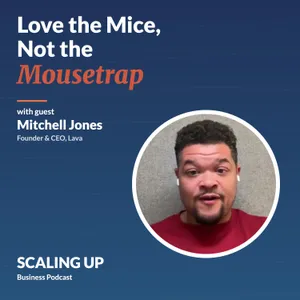
Love the Mice, Not the Mousetrap: AI Inside Your Tools, with Mitchell Jones
In early 2025, Mitchell Jones sat in his basement in Ohio and burned a few hundred dollars trying to build an AI agent that fills out forms, a job that should have taken an afternoon. He kept paying for access to the same models through different wrappers. That friction turned into a company. Bill talks with Mitchell, founder and CEO of Lava, about how that basement experiment became a business, and then a different business. Lava started as a gateway: one key and one bill for every model, on the bet that AI is a utility and every utility ends up on a meter. Then users at an event kept asking to plug it into Claude. Instead of telling them they were using it wrong, Mitchell asked why. That answer turned Lava into what it is today, an AI agent that works inside the tools a business already runs on, like QuickBooks, Gmail, Salesforce and HubSpot, with no engineering required. They get into why Cursor's simple layout (your work on the left, an agent on the right) beat the blank chat box, why customers rarely describe their pain cleanly, and why you should fall in love with the mice problem instead of your mousetrap. Mitchell makes the case for planning in three-, six- and nine-month windows while still building an all-weather business, and for building something that gets better as the models get better instead of fighting the frontier labs. Bill closes with a challenge for leadership teams: if you aren't using AI every hour of the workday, ask your AI what you're missing. Then find the enthusiasts already in your company, buy them lunch every week, and have each one share something cool they did with AI and something they're stuck on. Before Lava, Mitchell co-founded LendTable, a Y Combinator company he scaled to about 40 people and $40 million raised. He's a Forbes 30 Under 30 honoree and has worked at Meta and spent time at Yale. In This Episode How a basement side project turned into Lava Why AI is a utility, and why every utility ends up on a meter The customer question that turned a payment gateway into an AI agent What Cursor got right that most AI tools still miss Love the mice problem, not your mousetrap Why founders should plan in three-, six- and nine-month windows right now Bill's hourly AI rule and the weekly lunch-and-learn for your flag bearers Why you shouldn't trust an AI answer that came back in two seconds Guest Links Lava: lava.so Host Links Scaling Coach: scalingcoach.com Busy Is Broken: busyisbroken.com CEO Behavior Study: scalingcoach.com/study Scaling Up Business Podcast with Bill Gallagher

44 MIN
OCT 7, 2026
Why Apple Built Retail on Kindness with Ron Johnson
When Apple announced it was opening retail stores in 2001, analysts gave the idea two years before the lights went out. Twenty-five years later, Apple Stores are the most profitable retail spaces on earth — more sales per square foot than Tiffany — and the man who built them says the secret was never technology. It was kindness. Bill talks with Ron Johnson, the creator of the Apple Store and the Genius Bar, about what it actually took to build the fastest retail concept ever to a billion dollars in annual sales. Ron was the senior vice president of retail at Apple, working directly with Steve Jobs. Before Apple, he helped Target win the discount wars through design — pioneering the first-ever retailer-designer collaboration and riding the design wave of the 1990s. After Apple, he took the CEO role at J.C. Penney, which he candidly calls a disaster: he treated a century-old department store like a tech startup, moved too fast for the teams and the customers, and got it wrong. Ron talks about why Apple built stores in the first place (Steve's "five down, ninety-five to go" — they were going after everybody, not the existing five percent), and why the number-one enemy wasn't Microsoft, it was fear. He explains how the Genius Bar was built around service over tech credentials — the kind of person who could go toe to toe with Steve on technology but whom the Ritz-Carlton would hire as a greeter — and why he fought to keep it walk-in and resisted the appointment system. He shares why he chased a long-held dream to kill the cash register, moving Apple to mobile checkout a decade before the rest of retail (300 employees ringing up 300 iPads a minute at the Fifth Avenue store on iPad launch day). And he gets at the ideas in his new book Shop Different: that you haven't earned the right to win a new customer until you've taken care of the one you've disappointed, that every relationship is either launching, deepening, or restoring, and that in an age of AI the physical store and human connection matter more, not less — because as the world gets more convenient, people convene more. Ron is now a Professor of the Practice at Georgia Tech and a sought-after keynote speaker. His book Shop Different: How Retail Revealed Apple's Genius, co-authored with Zander Nethercutt, is published by HarperCollins on September 22, 2026 — the 25th anniversary of the first Apple Store. Scaling Up Business Podcast with Bill Gallagher In This Episode Guest Links Host Links Mentioned in this episode: PhD Research on CEOs Quick favor: I'm in the middle of my doctoral research, and I need CEOs Here's the question: is there a point where working more hours actually indicates a worse leader? Nobody has measured it. I'm measuring it. If you're a CEO or president with at least ten people in the business and three direct reports, it takes just a few minutes. And Your team answers a few anonymous questions. What you get back is a report comparing how you rate yourself to how your team rates you. That gap is usually the interesting part. ScalingCoach.com/study

55 MIN
SEP 23, 2026
Stop Being the Tin Man — Build an Octopus Organization, with Jana Werner
Most organizations are still built like machines — standardized, siloed, controlled from the top. Jana Werner calls them Tin Man organizations: rigid, efficient in a predictable world, but rusting solid the moment things get complex. And right now, with AI accelerating change faster than any planning cycle can absorb, everything is complex. In this conversation with Bill Gallagher, Jana breaks down the core idea of her Harvard Business Review Press book, The Octopus Organization, co-authored with Phil Le-Brun. An octopus has two-thirds of its neurons in its arms — each arm can sense, react, and make decisions independently while the central brain sets direction. That's the model for companies that actually thrive: distributed intelligence, fast learning, and radical adaptability. Not the five-year plan. Not the top-down transformation. Small experiments, rapid iteration, meaningful results. Jana shares what she sees advising Fortune 500 executive teams at AWS — including two CXOs in the same week telling her "my people aren't imaginative enough," only to discover through coaching that the organization itself had trained the imagination out of them. She and Bill dig into the thirty-six antipatterns the book catalogues — conditioned habits like jargon that creates no clarity, zombie projects that never tackle the hardest problem first, and approval layers that take five months while AI can build a prototype in five days. The conversation keeps circling back to one uncomfortable truth: the biggest antipattern is usually the leader's own shadow. The AI section is particularly sharp. Jana makes the case that if all AI development stopped today, companies would still need five years to catch up with what's already available. At Amazon, when they debate building one prototype or another, they now just build both — because the delivery cost is converging toward zero. But their organizational approvals still take months. The organizations haven't caught up to the technology. In This Episode Guest Links Host Links Scaling Up Business Podcast with Bill Gallagher Mentioned in this episode: PhD Research on CEOs Quick favor: I'm in the middle of my doctoral research, and I need CEOs Here's the question: is there a point where working more hours actually indicates a worse leader? Nobody has measured it. I'm measuring it. If you're a CEO or president with at least ten people in the business and three direct reports, it takes just a few minutes. And Your team answers a few anonymous questions. What you get back is a report comparing how you rate yourself to how your team rates you. That gap is usually the interesting part. ScalingCoach.com/study
56 MIN