School of Podcasting: Expert Tips for Launching and Growing Your Podcast

Dave Jackson

Details

You want to start a podcast, but you’re unsure where to start. You need advice on how to grow or monetize your show, and stop being so scared that it won’t work! I can help by showing you what mistakes NOT TO MAKE and much more. Subscribe to the show and soak in the 18+ years of podcasting experience from Podcaster Hall of Fame Inductee Dave Jackson.

Recent Episodes

NOV 16, 2026
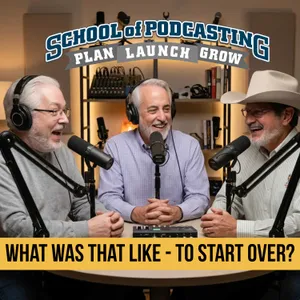
What Was That Like To Start Over? With Scott Johnson and Glenn Hebert
What happens when two podcasters with decades of combined experience start a brand-new show from zero? Scott Johnson, of the wildly successful What Was That Like, has tested 140 different ways to grow a podcast, and he’ll tell you which ones still work today. Glenn Hebert, who has put out more than 4,100 episodes of Horses in the Morning, reveals where 70% of his new listeners actually come from. Hint: it isn’t an algorithm. Together they launched Did I Hear That Right?, and they’re sharing what has changed since they started, why they made a show with no pressure to earn a dime, how they find guests in a flood of AI pitches, and the one mistake that makes them stop listening within two minutes. If you’ve ever wondered whether you’re doing enough to grow your show, this episode will make you rethink “enough.” Note: While these show notes were created by AI, the content is not. - Dave 140 Ways to Grow a Podcast (and Why There's No Magic Switch) What happens when two podcasters with more than 50 years of combined experience start a brand-new show from zero? Scott Johnson, of the wildly successful What Was That Like, has tested 140 different ways to grow a podcast, and he tells me which ones still work today. Glenn Hebert, who has put out more than 4,100 episodes of Horses in the Morning, reveals where 70% of his new listeners actually come from. Hint: it isn't an algorithm. Together they launched Did I Hear That Right?, and they're sharing what has changed since they started, why they made a show with no pressure to earn a dime, how they find guests in a flood of AI pitches, and the one mistake that makes them stop listening within two minutes. If you've ever wondered whether you're doing enough to grow your show, this episode will make you rethink "enough." Meet Two Professional Podcasters Scott was an early School of Podcasting member. He started with The Computer Tutor back in 2012 (he still has a few remote computer repair clients who beg him never to retire), then launched What Was That Like. Glenn has been on this show more than any other guest, and he still runs Horses in the Morning, the daily flagship show of the Horse Radio Network. These two put serious time into every episode: Scott: about 15 hours per episode of What Was That Like, from idea to promotion. Glenn: five to eight hours per daily episode of Horses in the Morning, including booking five to six guests a week. (As he says, everybody knows booking guests is the biggest pain of all.) What's the Difference Between a Hobby Podcaster and a Pro? Glenn's definition comes from the horse world: in competition, a pro is someone who makes their living from competing. Same for podcasting. If you make your living from it, you're a pro. Scott agreed, then joked that the problem with the new show is figuring out what to do with all the money coming in. 140 Podcast Marketing Strategies (and Counting) Scott has documented every marketing strategy he's tried since starting his show almost nine years ago. The count is around 140. Did he just say 140? Yes, 140. So while you're sitting there wondering, "Would that work? What's the return going to be?" Scott is out there trying it. Scott's advice: Do the tried-and-true stuff. He still guests on other shows and does promo trades all the time. Think outside the box sometimes too. Stop looking for the one big thing. Instead of hunting for the switch that brings in hundreds of listeners, do 100 different strategies that each bring in a few. Some of what he tried didn't work, and something that works for him may not work for you. You only find out by trying. I talked about this same idea in episode 1053, Attention vs. Connection: quit trying to hit a grand slam, and grow your audience one listener at a time. And yes, Scott is going to write a book about all of this at some point. The line starts behind me. Word of Mouth Still Wins Glenn has run enough listener surveys to know that 70% of his new listeners come from referrals. "But Dave, there's no algorithm. There's a discoverability problem in podcasting." Poppycock. Glenn also points out that hitting "subscribe" is a bigger commitment than it was 10 years ago. There's more to listen to and less time, so people are doing math in their heads: "Do I have an extra hour a week for this?" Scott goes a step further. He thinks about which show he'd have to drop to make room for a new one. That's also why I've never understood seasons for most independent shows. Take three weeks off, and you're hoping nobody takes your slot in a listener's routine. How to Write Podcast Episode Titles People Click When you're staring at 48 unplayed episodes, you cherry-pick, even from shows you love. Scott names his episodes for that person scrolling past. "Somebody got bitten by a rattlesnake? I want to hear that story." A few titles from these guys: What Was That Like: "Matt Counseled New Millionaires," "Angel Tried to Kill His Father," "Felicia Was at the Pentagon on 9/11" Horses in the Morning: "Barn Hacks: It's Only Weird If It Doesn't Work," "Police Horse Retirement," "Horses and Halloween" Did I Hear That Right?: "Phil Won $500,000," "Robin Worked for Burt Reynolds," "She Lived in a Swiss Castle," "She Adopted the Neighbor" Here's my test: does the title make you want to click? If it does, it's a good title. Glenn uses the 80/20 rule, and his surveys back it up. About 20% of your audience loves you and will listen to anything you put out. The other 80% are reading titles. Write for the 80%. As Scott puts it: you've got to have a hook. Starting a New Podcast From Square One Did I Hear That Right? is a brand-new show trying to build a brand-new audience. The difference from What Was That Like: the stories are about people who chose to do something unusual, not things that happened to them. There's no trauma, less crying, and the interviews are cut off at 15 minutes. What about going from four- and five-figure downloads back to small numbers? It doesn't bother them. They have no expectations. As Scott says, their why isn't 100,000 downloads an episode. They like hanging out with each other and talking to fun people. That's the part people miss. Many shows start for fun, then decide they aren't "real" until they have sponsors, and stop enjoying the sun they're standing in. The shows that keep it fun keep going, and the ones that keep going grow. (Glenn admits they're already set up to monetize if the audience shows up. They just aren't putting a deadline on it.) Tips for Podcast Co-Hosts Have the awkward conversation. Every year, Jim Collison and I have the "awkward conversation" about who does what on Ask the Podcast Coach and who makes what. Glenn and Scott split the work almost down the middle, made a list, and didn't have to talk about it again. Sign an agreement, even if you never expect to make money. They did the legal agreement up front. Different styles help. Scott has three pages of checklist items for every episode. Glenn puts out a daily show and can wing it and still sound great. If your co-host is exactly like you, you have one of you too many. Find the same passion with a different viewpoint. Give Your Audience Your Thoughts After the Interview Glenn's pet peeve with interview shows: when the interview ends, the show ends, and the host never says what they thought. People come for the content and stay for the host. On Did I Hear That Right?, after the 15-minute interview, Scott and Glenn talk about it for up to 10 minutes. Did they ever win money? What would they have done? I call this the Jerry Springer: after the chair-throwing, Jerry looked into the camera and asked what we learned today. It gives listeners your take on the guest, and it quietly reminds everyone whose show this is. And please don't end with "visit my guest's website, see you next week." The last URL on your podcast should be yours. How to Find Podcast Guests Through Your Community With AI, we all get 30 bad pitches an hour. Did I Hear That Right? uses one question: "What's the one unusual thing you've done that no one else you know has?" Scott and Glenn post that question in their Facebook groups and mine the comments, and that's where many of their guests have come from. When they disagree on a guest, they just do the episode anyway. How to Build a Podcast Community Both of these guys have vibrant communities, built in different ways: Glenn's community is made up of Patreon supporters, so there's a built-in filter. He calls them his auditors because they audit the show and tell him things like "never have that guest back." Scott's Facebook group is free, private, and has around 10,000 members, and he's the only admin. "Join the Facebook group" has been his call to action on almost every episode. Glenn's point: the biggest mistake podcasters make is not giving their community a place to be a community. When your content is engaging enough, listeners need somewhere to talk about it, because none of their friends listen to your show. How Much Do Patreon and Subscriptions Really Make? Scott: subscriptions (Patreon, Supporting Cast, and Apple Podcasts Subscriptions with ad-free and bonus episodes) are roughly 10% of his income. Glenn: about 5%, and his Patreon consistently converts 3 to 5% of his average audience. That lines up with what I've found: NPR told me about 1% subscribe to NPR Plus, Teachable said 2%, and most of the people I interviewed for my book said about 3%. Not the answer people want, but it is what it is. The best way to monetize a podcast is still to sell your own product or service. Glenn told us about a history-and-food YouTuber who just raised $800,000 on Kickstarter for a board game based on his show. Think outside the box. Working With a Podcast Ad Agency Scott has been with Glassbox Media for almost three years, after two years with a different agency, and he's hosted on Megaphone. The agency handles sponsor acquisition, talking points, and collecting the money. He doesn't even want to be involved in rate negotiations as long as the direct deposit shows up. How big is "big enough"? When Scott started, agencies wanted roughly 10,000 to 15,000 downloads per new episode in the first month. Now, because programmatic ads monetize the whole back catalog, he thinks they look for about 100,000 total downloads a month as a minimum. On CPMs, he'd only say that they vary by brand. Podcast Mistakes That Make Pros Stop Listening Not editing (Scott). Crutch words, repetition, and tangents make some shows unlistenable to him, even big ones. Edit to make your guest sound good, or they won't share the episode. Losing them in the first two minutes (Glenn). You decide fast whether you like a host. Glenn completely changed how Horses in the Morning opens after hearing me ask, "Why are you wasting my time at the beginning of the show?" The apology opening and the "I don't know what I'm talking about today" opening (me). If you don't know what you're going to talk about, I'm not going to let you waste my time. "So what'd you do last weekend?" (Scott). No one cares at the start. Move it to the end, where your 20% are still listening because they love you. Podnews Weekly Review does this with James Cridland and Sam Sethi. Try a Low-Cost Community Platform I use Heartbeat for the School of Podcasting, and Circle is another great option, but both cost a bit more. If you want to test a paid community, look at Skool (spelled with a K). The entry plan is $9 a month, and they take 10% if you sell memberships. Once your community grows, you can move to the higher plan (I believe about $99 a month) and pay a lower transaction fee. A community tells you who you're talking to, and when you know that, you make better content. Glenn's auditors tell him when a guest stunk up the joint. Scott knew the true-crime audience would like his true stories, so he cross-promotes with true-crime shows even though his isn't one. (You're looking for a show that shares an audience). Doing nothing to promote your show because you're not sure something will work is wasting your time. Scott tried 140 things. Try one. How Long Does It Take to Make Money Podcasting? Scott said it without me asking: "You don't make money for three years anyway." Congratulations, Scott, you've joined the montage. Stick around to the end of the episode to hear the newly updated version of podcasters and creators saying it takes about three years. I'm not trying to discourage you. I'm trying to help you set realistic expectations. Want to Launch Your Podcast in January 2027? Start Now Apple typically takes the last two weeks of the year off, so if you want your show live in January, you really needed to start about a week and a half ago. Get going today. Need help? That's what we do at schoolofpodcasting.com: courses, an amazing community, and coaching with me. Use the coupon code LISTENER for a monthly, quarterly, or yearly subscription. My website is courtesy of PodPage. Websites Mentioned School of Podcasting (coupon code LISTENER): https://schoolofpodcasting.com Episode 1062 show notes and links: https://schoolofpodcasting.com/1062 Episode 1053, Attention vs. Connection: https://schoolofpodcasting.com/1053 Follow the School of Podcasting: https://schoolofpodcasting.com/follow Did I Hear That Right? (pitch your unusual story): https://didihearthatrightpodcast.com What Was That Like: https://whatwasthatlike.com Horses in the Morning / Horse Radio Network: https://horseradionetwork.com Ask the Podcast Coach: https://askthepodcastcoach.com Everything Everywhere Daily (Gary Arndt): https://everything-everywhere.com Glassbox Media: https://glassboxmedia.com Supporting Cast: https://supportingcast.fm Patreon: https://patreon.com Heartbeat: https://heartbeat.chat Circle: https://circle.so Skool: https://supportthisshow.com/skool Podnews (Podnews Weekly Review): https://podnews.net PodPage: https://podpage.com This content may contain affiliate links, meaning I earn a small commission if you purchase through these links at no additional cost to you. I only recommend products or services I trust and believe will provide value to you. Thank you for your support! Mentioned in this episode: Live Appearances I love traveling and telling the world about podcasting. Check out where I'll be using this link Where Will I Be? Question of the Month: What is a "Newbie Podcaster" Poll Question: What makes someone a “newbie podcaster”? Is it how long they’ve been podcasting or how many episodes they’ve published? Is it something else? How would you define a newbie podcaster? Leave your answer at schoolofpodcasting.com/question by November 27th and don't forget to mention your show and your website address so I can link to it in the show notes. (Please try to keep them under 5 minutes if you can). Question of the Month You Have A Message That Needs to Be Heard You have a message that needs to be shared. Discover the art of podcasting at the School of Podcasting. We teach you to shine a light on your stories, inspiring others one episode at a time. Let your voice be your legacy. Go to www.schoolofpodcasting.com/join <a...

48 MIN
NOV 9, 2026
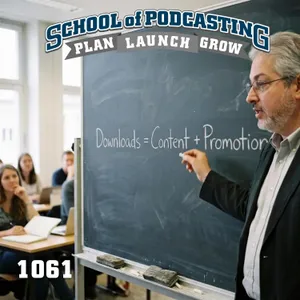
Podcast Growth Beyond Consistency: Create Stories People Remember
Is Posting Consistently Overrated? Why Great Storytelling Can Beat the Algorithm What if the advice you hear all the time (post consistently, feed the algorithm, follow best practices) isn't the only way to grow? This week I'm looking at a YouTuber called Dr. Plants who posts three videos a year and averages tens of millions of views. He's zagging while everyone else zigs, and he has a lot to teach podcasters about storytelling and great content. I also cover why Buzzsprout's Kevin Finn says Spotify isn't being a good partner, what to check before a surprise Black Friday renewal hits your account, the RSS feed cloning problem on Spreaker, and why you need to start now if you want your podcast launched in January 2027. Best Practices vs. Amazing Content The last time I really dug into this topic was back in October 2016 on episode 535 (the one with the weird commercial for my cats' record). Last week, Brian Cottington from Libsyn walked us through titles, thumbnails, and hooks, and all of that absolutely matters for getting found. But in the end, amazing content matters too. Then I watched Sean Cannell of Think Media interview Dr. Plants, and I thought, "Here's someone who isn't zigging. He's zagging." "YouTube Is Just a Storytelling Contest" Dr. Plants' view is simple: the people telling the best stories are the people getting the most views. When Sean asked him for the most overrated piece of YouTube advice, his answer was posting consistently. He puts out three videos a year, on random dates, whenever each one is done to the best of his ability. He admits consistency might build a more loyal audience, a deeper connection with fans, or more product sales. But if you only care about views, he says you could post one video a year. Is YouTube (or Podcasting) Too Saturated? YouTube says 20 million videos are uploaded every day. Is it too late to start? Dr. Plants says there has never been less competition, because AI has made everyone's content exceptionally average. That's why so much of YouTube looks the same. His formula: find what everyone else is doing and do it 10% better, because being 10% better can multiply your views tenfold. Improve one little thing on every video and it's nearly impossible to lose. So, Dave, Is Consistency Important or Not? Yes, I still think consistency is important. When you publish on a schedule, you become part of someone's routine. I've had listeners tell me I'm with them every Monday on the way to the feed store, and there are shows I listen to on certain days of the week. When you take a couple of weeks off, you give someone else a chance to get at your audience. (If you're doing it to keep your sanity, that's a good reason.) But nothing in podcasting is mandatory. Dan Carlin of Hardcore History has always been the poster boy for "well, it depends." He's in the Podcaster Hall of Fame, and he releases an episode every two or three months. Each one is three or four hours long, basically a small audiobook. So there are best practices, and then there's Dan. If your gut says there's a better way to do something, but your head says "that's not how everyone else does it," that might be a really good sign. That's zagging when everyone else zigs. AI Is Making Content Average I'm not anti-AI, but I see people trying to be thought leaders using thoughts from ChatGPT. Dr. Plants is right: AI is making a lot of content average. Not bad. Just average. If you want to break out, you have to be better than the competition. You have to be relevant, and you have to resonate. Turning on two microphones and shooting the shinola with your friends probably isn't amazing content. It isn't bad, but it isn't going to inspire someone to tell a friend. How to Tell Better Stories on Your Podcast I've been singing this song for years: it's all about storytelling. Most storytelling books just tell you stories are good and have been around since the caveman. Yeah, duh. My favorite, Storyworthy by Matthew Dicks, actually shows you how to cut out the non-essential parts of your content. He also points out that stories always have a transformation. His example: Jurassic Park isn't about dinosaurs. The first scene has a man complaining about how expensive and smelly kids are. By the end, that same man is risking his life to save the children. The biggest storytelling tip I can give you is figuring out where to start the story. We usually give way too much background. Find where the transformation starts, then back up only as far as you need to give the listener enough context to understand it. Great Podcast Content = Content + Delivery Dr. Plants sounds crazy at first, but he's really just the flip side of feeding the algorithm: he's feeding the emotional side. Both are great. Remember that an episode is made up of content and delivery. Amazing content delivered in a boring way won't work. Amazing delivery about paint drying won't work either. (I was watching the NFL, and the voiceover guy has incredible delivery... about Burger King.) On YouTube, the algorithm is kind of the delivery, and Dr. Plants is all about the content. How to Promote Your Podcast Once the content is great, you still have to market it: Social media Newsletters Appearing on other podcasts Going to where your audience is, making friends, and telling them about your show Which of those are you doing? If the answer is "a little bit of social media" and you're not happy with your growth, maybe do more. Buzzsprout's Kevin Finn: Spotify Isn't a Good Partner I've said over and over that Spotify isn't a good media host (free or not), and I'm not the only one. On Buzzcast, Buzzsprout co-founder Kevin Finn shared a support case where a customer sent screenshots of the Spotify for Podcasters settings. Right on the screens podcasters must visit to enable video distribution, Spotify displays banners asking why they're hosting somewhere else and offering free hosting. Kevin's point: the Spotify team is nice to work with in person, but the app tells a different story. Podcasters who switch often come back after struggling with support, stats, and unresolved issues, and he feels Spotify's hosting is mostly a way to pick off successful shows for its ad program (which you don't even need to host with Spotify to join). Compare that to Apple, which consistently asks how to strengthen the relationship. Buzzcast is one of my favorite shows, and I love Jordan, Alban, Kevin, and the whole Buzzsprout team. Podcast Download Stats: See Where You Stack Up If you're a fan of Rob Walsh and Elsie Escobar, they used to publish mean and median download stats at a previous company. Now that's happening again on In and Around Podcasting. You can also see where you stack up at Buzzsprout's stats page. Check for Surprise Subscription Renewals Before Black Friday I've worked at the School of Podcasting, Libsyn, and now PodPage, and one thing I see over and over is people getting mad when a company renews their subscription. That's like asking Netflix why it charged you again. And it's a no-win situation: when companies send reminders, people ask why they keep reminding them. It's November as I record this, which means last year's Black Friday deals, especially the annual ones, are about to renew. Log into the checking account you use for your podcast (you do use a separate account for your podcast, right? I covered that on Your Podcast Consultant). Look for anything you're not using. Every year someone discovers a $94 charge for something they forgot they bought, and getting a refund isn't guaranteed because it's in the terms they didn't read. Put it on your to-do list before this year's Black Friday sucks you in again. Cloned RSS Feeds on Spreaker School of Podcasting member Nancy May (Family Tree Food Stories) asked me about a story going around: people are taking the RSS feeds of very popular shows, importing them into Spreaker (a free, ad-supported host owned by iHeart), and earning ad money from them. That money doesn't go to the original creator. It goes to whoever cloned the feed, and to iHeart. James Cridland at Podnews has pointed out lots of these cloned shows, and Spreaker doesn't seem to be in a giant hurry to remove them. What does that mean for you? Unless your show is very popular, you probably don't need to worry about this. It's not a great look for the Spreaker brand. On Podcasting 2.0, Adam Curry and Dave Jones (who run the Podcast Index) talked about cleaning out AI slop, fake shows, and cloned shows. One of the red flags they considered was whether a show is hosted on Spreaker. I'm not telling you to leave Spreaker. But my own observation: whenever a new show opens with three pre-roll ads, I check, and it's usually hosted on Spreaker. That's serving the ad, not the audience. If the brand gets linked to low-quality podcasts, keep an eye on it. How to Protect Your Podcast RSS Feed A good media host knows it's the foundation everything else is built on. Your host should let you lock your feed, usually with a single switch. Ask their support, "How do I lock my feed?" If they say, "What do you mean, lock your feed?" it's time to find a new host. Thank You, Pod Indy Thanks to everyone at Pod Indy this weekend in Indianapolis. I had a great time with Dr. Brad Miller, Cliff Ravenscraft, and Daniel J. Lewis, with attendees from Ohio, Kentucky, and Wisconsin (plus online). I'd never heard Cliff speak live, even though we've known each other for 20 years, and he really got me thinking. I'll be talking more about that in the future. If you missed it, check the Pod Indy website for recordings. And a big thank-you to Mark Lawley and his wife Krista of The Practical Prepping Show for dinner. Research Links Buzzcast: Buzzsprout Podcast Captivate Podcast: In and Around Podcasting Podpage: Great looking Podcast Websites Join the School of Podcasting Stop the Scroll: Better Podcast Titles and Thumbnails Is It Time To Zag? Episode 535 Know What Your Buying: Podcast Subscriptions Think Media Dr. Plants on YouTube He Got 6 Million Subscribers With Only 12 Videos - YouTube Mentioned in this episode: Podpage Email Alerts Podpage just launched a feature called Episode Alerts. It automatically emails your subscribers the moment a new episode goes live — no third-party email tool needed. When you publish, Podpage sends the email, links listeners straight to the episode, routes replies to your own inbox, and handles unsubscribes automatically. They also run every email address through validation and monitor bounces/spam complaints to protect your sender reputation. It's not meant to replace a full newsletter platform — no drip campaigns or segmentation — just a simple "hey, new episode's up" notification. It's available for Pro and Elite users, with monthly sending caps of 500 emails on Pro and 5,000 on Elite. For more information see https://www.podpage.com/updates/introducing-episode-alerts/ Podpage Started a Podcast But You Feel Stuck? You're already podcasting, but you feel stuck. I get it. Let's fix that. Join me inside the School of Podcasting and let's get your show growing again. Go to schoolofpodcasting.com, code LISTENER. Thirty-day money-back guarantee. School of Podcasting Question of the Month: What is a "Newbie Podcaster" Poll Question: What makes someone a “newbie podcaster”? Is it how long they’ve been podcasting or how many episodes they’ve published? Is it something else? How would you define a newbie podcaster? Leave your answer at schoolofpodcasting.com/question by November 27th and don't forget to mention your show and your website address so I can link to it in the show notes. (Please try to keep them under 5 minutes if you can). Question of the Month Live Appearances I love traveling and telling the world about podcasting. Check out where I'll be using this link Where Will I Be?
27 MIN
NOV 2, 2026
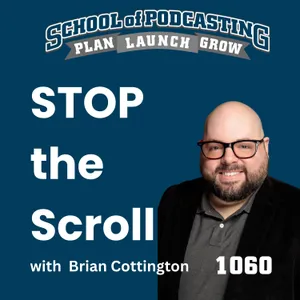
Stop the Scroll: Better Podcast Titles and Thumbnails
Remember standing in the video store on a Friday night, holding two boxes and trying to decide which movie to rent? According to my old friend Brian Cottington, head of video marketing at Libsyn, that's exactly how YouTube works in 2026. This week Brian explains why your thumbnail is a billboard (not an SEO tool), the three thumbnail styles that work best for podcasts, why his slick motion-graphics intro caused his viewers to fall off a cliff, and whether you should use AI to make your artwork. And even if you're thinking, "Dave, I don't do YouTube," stick around. Everything we talk about works for episode artwork and titles in audio-only podcast apps too. Plus, a word of caution about NaPodPoMo before you sign up for 30 episodes in 30 days. There's No Such Thing as Competition in Podcasting Here's a fun fact: Brian found me through the Podcasters' Roundtable, a show I did with Daniel J. Lewis and Ray Ortega, who are technically my "competition." He liked what he heard, started listening to the School of Podcasting, and years later we worked together at Libsyn. Brian does the same thing on his own show, The Cinema Psychos. He keeps an eye on social media, spots movie podcasts he thinks are funny, and invites them on as guest reviewers. The Silver Linings Playlist podcast and the Movie Dumpster podcast are regular collaborators, and they trade appearances every few months. To the new podcaster who worries a guest will "steal" their audience, Brian puts it best: you're starting at zero, so it can only help you. At the very least, you're building a network of people who will like, comment on, and share your stuff. Why Brian Added Video to His Podcast Brian has always been a filmmaker. He started podcasting in 2016 as a creative outlet (an article by Kevin Smith gave him the nudge), and only moved to video after hearing Doc Rock from Ecamm encourage podcasters to try it. The question that sold him: is my audience there? For a movie show, a big chunk of it was on YouTube. Two things I love about how he approached it. He treated it as an experiment, and he's having fun with it, constantly looking for ways to make the workflow faster so he doesn't burn out producing both versions. If video stops being fun for you, quit the video, not the podcast. Your YouTube Thumbnail Is a Billboard Brian answered my "where do I start?" question with a question: what made you pick a movie at the video store? The box art. Then the title. Then you flipped it over and read the hook on the back. YouTube is just the video store in 2026. His process for packaging an episode: Find the hook first. What's the main value of this episode? What do you want people to walk away with? Put that hook at the very beginning of the episode. It doesn't have to be a cold open, but it has to be up front. Make the thumbnail and title reflect that same hook. The thumbnail stops the scroll. The title gives the image context. The first line of the description backs it up. The mistake he sees constantly is treating the hook, the title, and the thumbnail as three separate things. If someone clicks and doesn't immediately get what those two signals promised, they bounce. It's also why I got straight to the interview this week. You saw Brian's face on the artwork, so you knew it was an interview. Nobody needs to hear what my cat did to my couch first. 3 Podcast Thumbnail Styles That Work At Podcast Movement, Brian broke down the thumbnail styles podcasters use most. Hint: don't make a MrBeast thumbnail. You're not doing challenge videos. Host and guest flanking the image, with four to six words. Not the episode title. The most curiosity-driving words you can find. If the episode is about weight loss, the thumbnail might say "I wish I knew this sooner," and the title says "How I Lost 25 Pounds With One Technique." Brian calls that the "brain gap." Your face reacting to a visual story. He showcased the Call Me Chris podcast, which uses this with no text at all. It's great for topic-based shows because it triggers an emotional "what am I looking at?" response. No words at all. You don't have to put text on a thumbnail. The thing I was guilty of: slapping the episode title on the artwork. The thumbnail and title should work together, not repeat each other. Episode Artwork Matters for Audio-Only Podcasts Too If you don't do YouTube, this still applies. Apple Podcasts showcases episode artwork, and the eye directs the hand to click. Brian's theory (his words, not a study) is that audio listeners are easier to convince than video viewers, because they're already in the mindset to sample an episode. Packaging your audio episodes this way can give you an edge. Moving From Audio to Video: Rethink Your Episode Structure The biggest shift for audio podcasters going to video isn't the camera. It's the content structure. A long music bumper followed by ten minutes of breakfast banter might look fine in your Apple consumption graph, but a video-first audience won't sit through it. Brian learned this the hard way. He built a beautiful 20-to-30-second motion graphics intro, and YouTube Studio's audience retention graph showed a cliff right when it played. Now it's about five seconds, just the logo, then straight to him. His advice: if you want to play YouTube's game, you have to play YouTube's game. Don't try to run an audio-only playbook in a YouTube sandbox. It works the other way, too. If your show is built for video, check how it sounds as audio. Brian tried to listen to an AI tutorial podcast and couldn't follow it, because everything was on screen. Know not just why your audience consumes your show, but how. Live Streams Are Different I confessed that my live streams start with an intro and an ad, and the content doesn't arrive for about two minutes. Brian's take: treat live as its own thing. A monthly live episode is for super fans who want to interact with you, and bumpers don't matter there. The Movie Dumpster crew does a no-frills wide-shot Q&A live once a month, completely separate from their heavily edited regular episodes. Should You Use AI to Make YouTube Thumbnails? Tools like 1of10 (around $90 a month), TubeBuddy, and VidIQ will make thumbnails for you. Brian, a fine artist and graphic designer at heart, uses AI as a helper, not a replacement: Upscaling or cleaning up an image in Adobe Firefly is fine. He hadn't shaved one day, so he gave Firefly a still and asked it to make him look sad with a three-quarter turn. It was a little creepy, but good enough. A/B test it. YouTube lets you test thumbnails. Try an AI-assisted one against one you made, and keep whichever drives more watch time. Don't clone someone else's thumbnail. The algorithm is smart enough to notice, and if your hook and title don't match, a ripped-off thumbnail won't save you. Study the composition and adapt it for your audience instead. Should You Put Your Audio Podcast on YouTube as a Still Image? Nobody is forcing you to do video. The podcast police are not going to knock on your door. Brian did still-image episodes for four or five years, and his most-viewed video, with over 100,000 views, is a still-image interview with an actor from the 1996 movie Skyscraper starring Anna Nicole Smith. He has no idea why. But understand the expectation: people click on YouTube to watch video. Big shows can get away with a static image. Indie podcasters have to work harder. If your audience is genuinely on YouTube, consider simple live-action video. If not, a still image is fine, just expect low engagement. Brian's Favorite Podcast and Video Tools Ecamm Live for recording (he loves the vertical feature for social clips) Stream Deck to live-edit his show, so production takes as long as recording Premiere Pro for editing Photoshop's Generative Fill to extend his backgrounds (Canva occasionally) Adobe Firefly for AI image help VidIQ, his one paid YouTube tool recommendation (there's a free version) Claude and ChatGPT for automation experiments Kit for his newsletter (though he admits he's terrible at newsletters) And CapCut? He doesn't like it. The multicam feature he'd tested disappeared in the middle of a live demo, and support told him it wasn't released yet. My Take: Don't Let Video Kill Your Podcast I know YouTube's game. I just don't have the time to play it fully, so I do what I can and accept the results. My biggest fear is the podcaster who adds video thinking it's the thing that will catapult them, gets crushed by the extra time, effort, and money, and then cancels the whole podcast instead of dropping the video. Former Libsyn colleague Elsie Escobar said it well: try video, and if it works, great. If it's too much, go back to audio. NaPodPoMo: 30 Episodes in 30 Days November is NaPodPoMo (National Podcast Post Month), where you record 30 episodes in 30 days. For a brand-new podcaster, it's a great way to get your reps in. Measure uploads, not downloads. Just know that around day 12 you may run out of content and feel the pressure. If you feel overwhelmed, remember it's batting practice. Unless you're planning a daily show (which is a huge grind without a team), that's not what podcasting normally looks like. Check it out at napodpomo.org, and say hi to Jennifer for me. Launching a Podcast in January 2027? Start now. Aim to have it ready around December 10, because Apple takes a couple of weeks off at the end of the year. Mentioned in this episode: Podpage Stopped her From Quitting Her Podcast! Kelly Palace does the Outswim Podcast (outswimpodcast.com) and has been doing it for years. She was ready to unplug the show when she discovered Podpage. It took many workflow items off her plate and kept her podcasting. Start your free 14-day Trial at podpage.com/preview Podpage Your Podcast Starts TODAY Check your calendar - 2027 is right around the corner. Want to launch your podcast in January? Here’s the catch: Apple takes a couple weeks off at the end of the year. Miss early December, and your launch could slip. So start planning now. The School of Podcasting gives you courses, coaching, and a community to get it done right. Visit schoolofpodcasting.com and use coupon code LISTENER. Join worry free with a thirty-day money-back guarantee. Your January launch starts today School of Podcasting Question of the Month: What is a "Newbie Podcaster" Poll Question: What makes someone a “newbie podcaster”? Is it how long they’ve been podcasting or how many episodes they’ve published? Is it something else? How would you define a newbie podcaster? Leave your answer at schoolofpodcasting.com/question by November 27th and don't forget to mention your show and your website address so I can link to it in the show notes. (Please try to keep them under 5 minutes if you can). Question of the Month Live Appearances I love traveling and telling the world about podcasting. Check out where I'll be using this link Where Will I Be?
47 MIN
OCT 26, 2026
Beyond Downloads: The Moments That Prove People Are Listening
When Did It Feel Like You Had "Real" Listeners? A grocery store clerk recognized one of my listeners' co-hosts. A pharmacist gets stopped at conferences for selfies. And one podcaster got an email that ended with, "Yesterday, you and Krista saved lives." This month's Question of the Month asked how long it took before you felt like you had real listeners, and what made you realize it. Seven podcasters answered, and here's what surprised me: not one of them said "when I hit a million downloads." If you're staring at your stats wondering whether anyone is out there, press play. I'll also show you the real median download number on Buzzsprout (it's probably a lot lower than you think) and the 30-second test you should run on your website right now. (Links to everyone's show is at the bottom of this post) Why I Asked This Question I'm trying to help new podcasters set realistic expectations. This month's question and next month's are both about that. So: how long did it take before it felt real, and if it doesn't feel real yet, what would make it feel that way? Neal Veglio: Feedback, 100% I recorded Neal's answer live on Ask the Podcast Coach when he sat in my co-host's chair. For Neal, it's feedback. Our mutual friend Rob Walsh is right that you shouldn't crap on the download, because it's the only measurement we've got. But a download is a number. An email, a text, any outreach from your community, is what tells you it's actually landing with people. When Neal gets an email, he celebrates. Josh Liston: "We Listened to Know If We Wanted to Move Here" Josh hosts Sake This, a short-form sketch show about news, trivia, and travel stories from Japan. But his "real audience" moment came from a hyper-local show he co-hosts with Mel called Punching Sideways. Multiple people told them they listened before moving to town (for work, the military, whatever) to learn about the local music scene, the sports stars, the art scene, the comedians. All from a podcast they started just to make each other laugh. His advice: it took a while, so stick with it. Mark Lawley: "Yesterday, You and Krista Saved Lives" Mark from Practical Prepping watched the download numbers like everyone else at first. The real moment came around the one-year mark, when listener emails started showing up: thank-yous, topic suggestions, and then the ones where people had followed their advice during a severe weather event or personal crisis. He shared one at Empowered Podcasting about a young mom of two who bought a NOAA weather radio and packed a go bag after listening. When a tornado warning hit her area, the radio alerted her, and she grabbed her kids and the bag and went to the shelter. Her email ended with the line above. I have a NOAA weather radio (affiliate link) because of Mark. Here in Ohio we get tornado warnings on a fairly regular basis. If you don't have one, get one. Rob Dalrymple: Real Listeners Before Episode One Rob hosts the Softball Central Podcast, helping players, parents, coaches, and fans navigate the fastpitch softball world. He jokes that he had real listeners before he even started (or that's optimism and caffeine talking). His coming-soon promo got over 2,000 views, and his three launch episodes racked up over 400 listens and views in the first week. Not Joe Rogan numbers? I used to teach, and 20 people was a full class. 400 is twenty classrooms. That's a very long hallway of people. What Rob really wants is community. If you want to test that idea cheaply, Skool runs about nine bucks a month. And to get the rest of the softball world listening: business cards are cheap. Put a QR code on them and hand them out at games. (Rob, I hope to see you inside the School of Podcasting soon.) Chris Smith: Recognized at Harbor Freight Chris and his co-host run Cool Cars with Chris, hitting cars-and-coffee events around Southern California and showcasing other people's rides. The show just turned one. The moment it felt real: his co-host was shopping at Harbor Freight and the clerk recognized him from the podcast. A total stranger who found the show in his feed. Kim Newlove: Six Months, a Florida Student, and a Troll Kim hosts two shows, The Pharmacist's Voice and The Perrysburg Podcast, and both took about six months to feel real. The Pharmacist's Voice: after episode 22, a pharmacy student in Miami messaged her on LinkedIn about her poison-prevention volunteer work. She's in Ohio, he's in Florida. That's when she knew she was reaching beyond people who already knew her. Now people ask for pictures with her at pharmacist conferences and tag her on social media. Her guests promoting their episodes tells her they're listening too. The Perrysburg Podcast: episode 20 featured the city's crime prevention specialist and public information officer talking about porch pirates around Christmas. Both offered to share it on the city and police social channels. For the first time she had help promoting, the comments rolled in ("I didn't know Perrysburg had a podcast!"), and the downloads took off. The troll: she interviewed someone a listener didn't like, and he let her have it. Annoying, but proof people are listening. Two things I'd do differently: Kim was told to launch with 20 episodes and waited until then to promote. That recommendation was not from me. Record test episodes if you want (even 20 versions of episode one), but promote the minute your show is live. Getting no downloads while nobody knows you exist can be soul-crushing. And a tip on pictures: if someone says "I listen to your show," they may want a photo but feel awkward asking. Beat them to it: "It's so great meeting you. Can I get a picture with you?" My Answer: A Voicemail From Germany I was bankrupt, divorced, and living in my brother's basement when I started podcasting. Less than six weeks in, I got a voicemail from Michael Van Laar in Nuremberg, Germany, and about fell out of my chair. I was in nowhere, Ohio. Another time I announced a speaking gig and Kale Nelson reached out because it was near him and offered to take me to dinner. Same lesson: somebody's out there. And I still say you're not a real podcaster until you get a one-star review. You moved somebody. Just not the way you wanted. Make It Easy for People to Reach You The theme here is people reaching out. So: Have a clear "Contact" button on your website. Test it right now. Send yourself a message and make sure it arrives. Every year when I do my favorite-episodes round-up, I find shows where the only way to reach the host is an Instagram DM. Everybody understands email. Use whatever you like, but make it easy. An Apology to Chris and Albert Fan List (I love Pat over there) had a bad day and truncated messages to five seconds. So I got exactly "Hey, Dave Jackson" from Chris Nesi, the king of ed tech, and "Hello, Dave, this is Albert Bermanti from Mental Rehearsal Podcast" from Albert. Chris even re-recorded after I asked on Saturday's live show. Since I use Captivate, I can drop their full answers into this episode dynamically later, so if you hear them, that's why. For now, schoolofpodcasting.com/question lets you upload a file or leave a voicemail, and the new "Leave Voicemail" button goes to schoolofpodcasting.com/voicemail, the voicemail system built into PodPage (two-minute limit). Speaking of Albert: Mental Rehearsal is the show where, at our School of Podcasting listener party, we all asked "when is this going live?" If you're a perfectionist, check out his August 16 episode on dealing with perfectionism. Nobody Mentioned a Big Number Not one person said "when I passed a million downloads." It was always that somebody was listening. If you're "only" getting 60 downloads an episode, that's three classrooms. Go to buzzsprout.com/stats. As I record this in October 2026, the median is 27 downloads per episode after seven days. Half of shows get more, half get less. The top 1% are close to 5,000. But as Ray from Around the Layout says, it's not how many, it's who many. 2,000 people who love knitting but never want to start a podcast aren't my audience. Podcasting is like golf or bowling: you're only as good as your last game, and comparing yourself to someone who's played longer (or had John Lee Dumas's savings runway) doesn't help. Be Careful: People Might Actually Do What You Say New podcasters freak out because nobody's listening, then freak out because people are. I once consulted with a guy who owned both a Zoom PodTrak P4 and a RØDECaster. Why both? "You said it was cool." That's $600 he didn't need to spend. People listen, and they might act on what you say. Please Don't Email Me Your Answer I say this with love: use schoolofpodcasting.com/question. Everything lands in MediaFire (which notifies me) or Fan List. Email is a third place, and I get roughly 80 emails a day, 79 of them junk. Your answer will get lost. And if you emailed me and I never answered, reach out again. While we're at it: that "I'd love to be a guest on your show" email is probably a bot. Want to learn how to pitch yourself the right way? Visit pitchapodcast.com, and share any good (or bad) pitches you've received. If you want your podcast ready by January, now's the time to start planning. It's not about starting quickly, it's about starting correctly. My free course is at podcastinginsixweeks.com, and if you want hands-on help, head to schoolofpodcasting.com and use the coupon code LISTENER for a monthly, quarterly, or yearly subscription, backed by a 30-day money-back guarantee. Show notes are at schoolofpodcasting.com/1059, courtesy of PodPage. Shows & Websites Mentioned This month's contributors Neal Veglio, Podcasting Insights / Pod Mastery: https://podmastery.co Josh Liston, Sake This: https://sakethis.com (also co-hosts Punching Sideways with Mel) Mark Lawley, Practical Prepping: https://practicalprepping.info Rob Dalrymple, Softball Central Podcast: https://softballcentralpodcast.com Chris Smith, Cool Cars with Chris: https://coolcarswithchris.com Kim Newlove, The Pharmacist's Voice: https://thepharmacistsvoice.com Kim Newlove, The Perrysburg Podcast: https://perrysburgpodcast.com Albert Bermanti, Mental Rehearsal: https://mentalrehearsal.show Chris Nesi: https://chrisnesi.com Also mentioned School of Podcasting (coupon code LISTENER): https://schoolofpodcasting.com Episode show notes: https://schoolofpodcasting.com/1059 Send in your answer: https://schoolofpodcasting.com/question Leave me a voicemail: https://schoolofpodcasting.com/voicemail Buzzsprout podcast stats: https://buzzsprout.com/stats Around the Layout (Ray): https://aroundthelayout.com Pitch a Podcast: https://pitchapodcast.com Podcasting in Six Weeks (free course): https://podcastinginsixweeks.com Skool: https://skool.com PodPage: https://podpage.com Mentioned in this episode: School of Podcasting: Coached Plan You don’t need another list of things you could do with your podcast. You need help figuring out what to do next—and someone in your corner to help you follow through. With School of Podcasting: Coached, you get everything in the School of Podcasting, plus a weekly meeting with me, Dave Jackson, text access between meetings, and clear next steps after every session. Less second-guessing. More moving forward. Join School of Podcasting: Coached today—and let’s get your podcast where you want it to go. School of Podcasting: Coached Podpage Stopped her From Quitting Her Podcast! Kelly Palace does the Outswim Podcast (outswimpodcast.com) and has been doing it for years. She was ready to unplug the show when she discovered Podpage. It took many workflow items off her plate and kept her podcasting. Start your free 14-day Trial at podpage.com/preview Podpage Question of the Month: What is a "Newbie Podcaster" Poll Question: What makes someone a “newbie podcaster”? Is it how long they’ve been podcasting or how many episodes they’ve published? Is it something else? How would you define a newbie podcaster? Leave your answer at schoolofpodcasting.com/question by November 27th and don't forget to mention your show and your website address so I can link to it in the show notes. (Please try to keep them under 5 minutes if you can). Question of the Month Unlock Exclusive Insights: Subscribe to 'Podcasting Observations' Newsletter! Get a look into the world of podcasting like never before with "Podcasting Observations," your go-to source for trends, tips, and transformative insights tailored just for podcasters. You also get "behind the scenes" info from the School of Podcasting Don't miss out on staying ahead of the game—join the 1700+ people who are already reading Podcasting Observations today! Podcasting Observations Live Appearances I love traveling and telling the world about podcasting. Check out where I'll be using this link Where Will I Be?
34 MIN
OCT 19, 2026
From Rambling to Riveting: Podcast Speaking and Editing Tips That Work
A friend of mine gets more and more opportunities. Why because he takes advantages of each and every one. He prepares and over delivers. I had an opportunity where I could deliver content on MY timeline and while my information was helpful, I took a weird path to get to the point. As someone who embraces feedback, the folks at the buzzcast gave me some loving feedback, I took it, and today I explain where I went wrong and how you can stay focused to deliver razor sharp content that gets people sharing your content. What is the main point, and are all of your points in alignment? When you have a segment in your show, do all of the bullet point that make up that segment contribute to the value? Do you makes the same point multiple times? Do you take a crooked path to the point? What would the audience ask if they were in your chair? That's a good place to start. The Easiest Way to Speed Up Editing The easiest way to speed up editing is to have a clear understanding of what your audience wants. The more you know, the more you know what to keep and what to lose. Don't Ruin the Recording With Active Listening Active listening is when you say things like, "Sure, uh huh.." to show someone you are listening. You don't want to do that in a podcast as you are stepping on the guests answers. When they start talking, SHUT UP AND LISTEN, and write down any follow questions and go back to listening. An Interview is Meant to Make the GUEST look Good I hear so many podcasts hosts throw in a comment that is more of less, "I did that too" which is great in a conversation, but we don't need to hear the same point twice. At one point Chevy Chase said, "Can you see I'm in the middle of a story" when he was on the Bill Maher show Club Random. Research Links Research Links Anthony Hopkins on Being Estranged From His Daughter - The Interview Billy Corgan interview Matthew Sweet on The Magnificent Others Bill Maher Club Random with Chevy Chase Buzzcast Geologic Podcast with George Hrab Congressional Dish Bill Burr's Monday Morning Podcast Animated: Shari's Berries - YouTube Mentioned in this episode: Podpage Stopped her From Quitting Her Podcast! Kelly Palace does the Outswim Podcast (outswimpodcast.com) and has been doing it for years. She was ready to unplug the show when she discovered Podpage. It took many workflow items off her plate and kept her podcasting. Start your free 14-day Trial at podpage.com/preview Podpage Don't Wait to Level Up Your Show Thinking about starting a podcast—or already 300 episodes in? Skip the rookie mistakes, save money, and level up your show with the School of Podcasting with Dave Jackson, where you get hands-on feedback, one-on-one support, and practical advice that actually improves your podcast. Not sure? Just ask Krista and Mark from practicalprepping.info Then join the School of Podcasting at www.schoolofpodcasting.com/join (or use the link below) School of Podcasting Live Appearances I love traveling and telling the world about podcasting. Check out where I'll be using this link Where Will I Be? Question of the Month: What is a "Newbie Podcaster" Poll Question: What makes someone a “newbie podcaster”? Is it how long they’ve been podcasting or how many episodes they’ve published? Is it something else? How would you define a newbie podcaster? Leave your answer at schoolofpodcasting.com/question by November 27th and don't forget to mention your show and your website address so I can link to it in the show notes. (Please try to keep them under 5 minutes if you can). Question of the Month
27 MIN