Ship It Weekly - DevOps, SRE, Platform and Cloud Engineering News

Teller's Tech - DevOps, SRE and Cloud Podcast

Details

Ship It Weekly is a short, practical recap of what actually matters in DevOps, SRE, cloud infrastructure, and platform engineering. Each episode, your host Brian Teller walks through the latest outages, releases, tools, and incident writeups, then translates them into “here’s what this means for your systems” instead of just reading headlines. Expect a couple of main stories with context, a quick hit of tools or releases worth bookmarking, and the occasional segment on on-call, burnout, or team culture. This isn’t a certification prep show or a lab walkthrough. It’s aimed at people who are already working in the space and want to stay sharp without scrolling status pages, cloud updates, and blogs all week. You’ll hear about things like cloud provider incidents, Kubernetes and platform trends, Terraform and infrastructure changes, and real postmortems that are actually worth your time. Most episodes are 15–30 minutes, so you can catch up on the way to work or between meetings. Every now and then there will be a “special” focused on a big outage or a specific theme, but the default format is simple: what happened, why it matters, and what you might want to do about it in your own environment. If you’re the person people DM when something is broken in prod, or you’re building the cloud and platform everyone else ships on top of, Ship It Weekly is meant to be in your rotation.

Recent Episodes

OCT 19, 2026
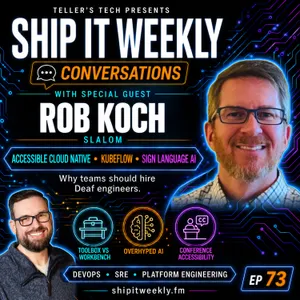
Ship It Conversations: Rob Koch of Slalom on Accessible Cloud Native, Sign Language Recognition with Kubeflow, Overhyped AI, Conference Accessibility, and Why Teams Should Hire Deaf Engineers
This is a guest conversation episode of Ship It Weekly, separate from the weekly news recaps. In this Ship It Conversations episode, I talk with Rob Koch about what accessible cloud native actually looks like, why sign language is still one of the hardest problems in AI, and why the fastest way to make your tooling accessible is to hire deaf engineers. Rob is a senior principal at Slalom, an AWS Hero, and co-chair of the CNCF Deaf and Hard of Hearing Working Group. Rob is Deaf, and his ASL interpreter, Amelia Fruehsamer, voices his answers. Special thanks to Amelia for interpreting the conversation. We start with an analogy Rob comes back to all episode: cloud native is the toolbox, and platform engineering is the workbench. Then we get into what's overhyped about AI, the guardrails it still needs, and what auditable AI observability looks like. A big part of the conversation is accessibility in practice. Rob explains how captions pushed for deaf attendees ended up helping neurodivergent folks too, and what conferences get wrong: accessibility planned at the very end instead of the start, and the real cost of interpreters versus captions. Then we get technical. Rob walks through using Kubernetes and Kubeflow to train models that recognize sign language, and why it's so hard: regional signs, lighting, skin tone and backgrounds, and a camera that can't tell which way a hand is facing. His joke: we don't have AGI until AI understands sign language. The big takeaway: start with people, not a checklist. Hire deaf and hard of hearing engineers, ask them how they want to work, and your tools get more accessible because they're in the room. Highlights • Cloud native as the toolbox, platform engineering as the workbench • What's overhyped about AI, and the guardrails it still needs • What accessible cloud native means in practice • Captions that help far more people than you planned for • What conferences get wrong about accessibility, and what it costs • Kubernetes and Kubeflow for sign language recognition • Gesture-based computing and why speech-to-text had a 30-year head start • Where to start: hire deaf engineers Links Rob Koch on LinkedIn: https://tsn.io/4qmFo Rob Koch on GitHub: https://tsn.io/Mbxrs Amelia Fruehsamer (Rob's ASL interpreter) on LinkedIn: https://tsn.io/UJB88 CNCF Deaf and Hard of Hearing Working Group: https://tsn.io/tB1lS CNCF conference accessibility best practices: https://tsn.io/BZvpv CNCF Merge Forward: https://tsn.io/QPVNQ Kubeflow: https://tsn.io/4OVKf More episodes and show notes: https://tsn.io/NqkdP On Call Brief: https://tsn.io/Gpz2d LMGT Awards: https://tsn.io/lAERA
45 MIN
OCT 17, 2026
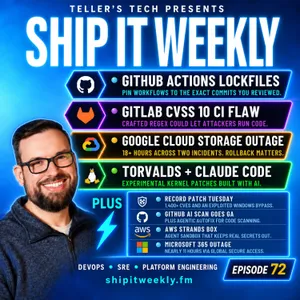
GitHub Actions Lockfiles, GitLab CVSS 10 CI Flaw, Google Cloud Storage Outage & Torvalds Builds Kernel Patches With Claude Code
This week on Ship It Weekly, GitHub Actions workflow lockfiles land in public preview, pinning actions and their dependencies to exact commits. GitLab shipped a critical patch release for CVE-2026-97229, a CVSS 10 CI/CD regex flaw that could let an unauthenticated attacker run code on the server. Google published its final report on two Cloud Storage incidents in us-central1, including a recurrence caused by an incomplete rollback. And Linus Torvalds pushed an experimental kernel branch with page-cache patches built using Claude Code, as maintainers debate dropping the mandatory AI attribution tag. The thread this week: know what you're actually running, from the commit you reviewed to the state a rollback really left behind and code someone can still explain. In the lightning round: a record Patch Tuesday with more than 1,400 CVEs and an actively exploited Windows Shell bypass, GitHub AI Scan for pull requests and agentic autofix going GA, AWS Strands Box, an open-source agent sandbox that keeps real credentials out of the agent's environment, and a Microsoft 365 outage through Global Secure Access. The human closer comes from Paul LaPosta's “Your error budgets don't know AI exists.” AI has split shipping a change from understanding it, and SLOs don't measure comprehension. Your SLO can tell you the service is up. It cannot tell you whether anyone still understands it. Programming note: Ship It Weekly turns one next month, so expect more conversations over the next couple of months, usually two a week, starting Monday with Rob Koch. Links GitHub Actions workflow lockfiles GitLab 19.4.2 / 19.3.5 / 19.2.8 patch release Google Cloud Storage incident report Linus Torvalds and Claude Code (Phoronix) Linux drops the Assisted-by requirement (Phoronix) October 2026 Patch Tuesday GitHub AI Scan for pull requests GA Agentic autofix GA AWS Strands Box Microsoft 365 Global Secure Access outage Your error budgets don't know AI exists (LeadDev) This week's On Call Brief
14 MIN
OCT 12, 2026
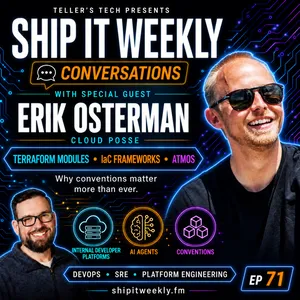
Ship It Conversations: Erik Osterman of Cloud Posse on Terraform Modules, IaC Frameworks, Atmos, Internal Developer Platforms, AI Agents, and Why Conventions Matter More Than Ever
This is a guest conversation episode of Ship It Weekly, separate from the weekly news recaps. In this Ship It Conversations episode, I talk with Erik Osterman of Cloud Posse about Terraform modules, infrastructure as code frameworks, internal developer platforms, and why AI makes conventions more valuable, not less. Erik is the founder and CEO of Cloud Posse, which has published more than 180 open source Terraform modules, and he hosts Cloud Posse's weekly DevOps Office Hours. We start with what AI has done to open source infrastructure projects, then get into what makes a good Terraform module: consistent naming, a consistent interface, not so small that it wraps a single resource, and not so large that it has a hundred inputs nobody can test. We also talk about CloudFormation, Pulumi, and why HCL's constraints helped build the module ecosystem. Erik explains where Crossplane fits, and why accounts, IAM, networking, DNS and certificates all come before the cluster. A big part of the conversation is frameworks. Erik argues that nobody actually runs "vanilla Terraform," because Terraform alone doesn't handle state layout, promotion, authentication, tool installation or repository structure. Every team ends up building its own framework, usually undocumented. We talk about Terragrunt, Atmos, naming conventions, brownfield adoption, and breaking a monolithic root module into services. Near the end, we get into AI and self-service. Erik's team now generates most of its infrastructure work with AI, and it works because the conventions, agent skills, MCPs and pipelines are already in place. Self-service doesn't have to mean another no-code platform. The big takeaway: AI can generate infrastructure code faster than ever, but without conventions it is generating into chaos. Highlights • What makes a good Terraform module • Root modules vs. child modules • CloudFormation, Terraform, Pulumi, and why constraints helped HCL win • Where Crossplane fits, and what has to exist before the cluster • Why internal developer platforms like Backstage come after zero-to-one • Why infrastructure as code needs frameworks, not just modules • Agent skills, MCPs, and self-service without a no-code platform Links Cloud Posse: https://cloudposse.com Atmos: https://atmos.tools Cloud Posse on GitHub: https://github.com/cloudposse DevOps Office Hours: https://tsn.io/2gq7v Erik Osterman on LinkedIn: https://www.linkedin.com/in/osterman More episodes and show notes: https://tsn.io/NqkdP On Call Brief: https://tsn.io/Gpz2d LMGT Awards: https://lmgt.org

39 MIN
OCT 10, 2026
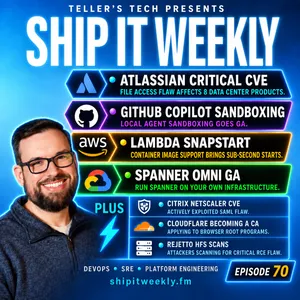
Critical Atlassian CVE Hits Jira, Confluence & Bitbucket, GitHub Copilot Sandboxing Goes GA, AWS Lambda SnapStart for Containers & Google Spanner Omni
This week on Ship It Weekly: Atlassian disclosed a critical arbitrary file access vulnerability affecting eight Data Center products, including Jira, Confluence, Bitbucket, and Bamboo. GitHub Copilot local sandboxing is now generally available, giving teams enforceable controls around filesystem, network, credentials, and local tooling. AWS published a deeper look at Lambda SnapStart for container images, including the operational risks of restoring initialized state. And Google Spanner Omni is now generally available, bringing Spanner outside Google Cloud and putting more of the availability responsibility back on the customer. The bigger theme this week is control. Developer tools are production infrastructure. AI agents need real execution boundaries, not just instructions. Faster startup through snapshots means understanding exactly what state is being restored. And moving a managed database onto your own infrastructure gives you portability, but also gives you the pager. In the lightning round: Citrix has a NetScaler SAML vulnerability under active exploitation. Cloudflare is working toward becoming a publicly trusted certificate authority. And attackers are actively scanning for Rejetto HFS servers vulnerable to a flaw that can lead to account takeover and remote code execution. And the human closer comes from Lorin Hochstein and a recent Google Cloud networking incident. One part of the outage involved someone correctly following an incorrect procedure, while another involved someone incorrectly following a correct one. Training matters, but systems also need guardrails that keep normal human mistakes from turning into large outages. If your system only works when nobody makes a mistake, the system is the problem. Links Atlassian CVE-2026-21589 https://tsn.io/ZlqKv GitHub Copilot Local Sandboxing https://tsn.io/rQngM AWS Lambda SnapStart for Container Images https://tsn.io/uXqkK Google Spanner Omni GA https://tsn.io/GoZZ5 Citrix NetScaler CVE-2026-88779 https://tsn.io/yN5a9 Cloudflare Certificate Authority https://tsn.io/egMN5 Rejetto HFS CVE-2026-61500 https://tsn.io/oQrkU Google Cloud Networking Incident https://www.tellerstech.com/go/s-dc989ad2/ There Was a Light That Never Went Out https://www.tellerstech.com/go/s-cb0bc459/ This Week’s On Call Brief https://tsn.io/8yaIY Ship It Weekly https://tsn.io/NqkdP On Call Brief https://tsn.io/Gpz2d
17 MIN
OCT 1, 2026
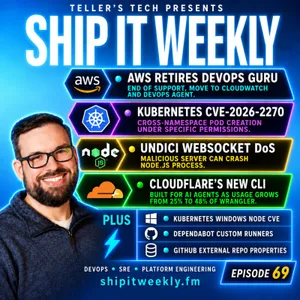
AWS Retires DevOps Guru: What the End of Support Means, Kubernetes Cross-Namespace CVE-2026-2270, Node.js Undici WebSocket DoS & Cloudflare’s New CLI for AI Agents
This week on Ship It Weekly: AWS is retiring Amazon DevOps Guru and pointing customers toward CloudWatch and the newer Amazon DevOps Agent. Kubernetes disclosed a vulnerability where StatefulSet and ControllerRevision permissions can allow cross-namespace pod creation under specific conditions. A vulnerability in Undici can let a malicious WebSocket server crash a Node.js process through compressed data. And Cloudflare launched a new CLI as AI agents grow from 25 percent to 48 percent of Wrangler usage. The bigger theme this week is how the systems around our infrastructure are changing. Managed cloud services still have lifecycles that eventually become migration work. Kubernetes authorization can depend on what controllers do with the resources users are allowed to manipulate. Applications acting as clients still process untrusted data. And infrastructure tooling is starting to treat AI agents as first-class users rather than humans who happen to automate commands. In the lightning round: another Kubernetes vulnerability affecting Windows nodes can expose NetNTLMv2 credentials through NTLM coercion. GitHub now supports custom runners for Dependabot version and security updates. And external systems like a CMDB or internal developer portal can push repository properties into GitHub while remaining the source of truth. And the human closer comes from Lorin Hochstein and SRE Weekly. Some availability risks are probably never going away. Resources are finite, networks fail, security controls can affect availability, and production systems have to change. Preventing individual failures still matters, but incident response is part of reliability engineering too. Sometimes improving reliability means getting better at handling the failures you cannot eliminate. Links Amazon DevOps Guru End of Support - https://tsn.io/GQHN8 Kubernetes CVE-2026-2270: Cross-Namespace Pod Creation - https://tsn.io/BsNs8 Undici CVE-2026-85024: WebSocket Denial of Service - https://tsn.io/LncLd Cloudflare: Introducing the cf CLI - https://tsn.io/Wk3ma Cloudflare Forge - https://tsn.io/bAPJu Lightning Round Kubernetes CVE-2026-76654: Windows NTLM Coercion - https://tsn.io/36Kc3 GitHub: Custom Runners for Dependabot - https://tsn.io/tYl9K GitHub: External Custom Properties - https://www.tellerstech.com/go/s-1fd1396d/ Human Closer Omnipresent Availability Risks in Cloud Software - https://www.tellerstech.com/go/s-076db9dd/ Our Links This Week’s On Call Brief - https://tsn.io/fKB9V Ship It Weekly - https://tsn.io/NqkdP On Call Brief - https://tsn.io/Gpz2d
16 MIN