



Snoozy Space
Mr Snoozy
The Largest Waterfall in the Solar System Isnt on Earth
NOV 24, 2026114 MIN
Description
Mars once had something almost impossible to imagine today: enormous rivers, ancient seas, and catastrophic floods powerful enough to reshape entire regions of the planet.
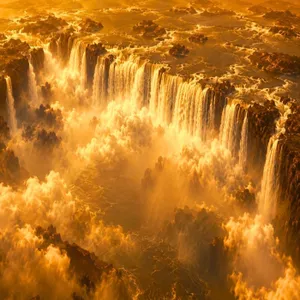
In this Snoozy Space documentary, we explore the largest waterfall in the Solar System, a colossal waterfall that once existed on Mars at the edge of Echus Chasma. The drop may have reached roughly 4 kilometers, or about 2.5 miles, while the resulting floods carved the immense channels of Kasei Valles across the Martian surface.
🌌 But where did all that water come from?
We travel back billions of years to a wetter and more dynamic Mars, exploring the ancient Eridania Basin, enormous bodies of water, volcanic activity, hydrothermal environments, and the catastrophic floods that transformed the planet.
We also examine how Mars changed from a potentially habitable world into the frozen desert we see today. The loss of its global magnetic field, atmospheric erosion, declining internal heat, and the disappearance of stable surface water all played important roles in that transformation.
🔭 Modern missions have allowed scientists to reconstruct parts of this lost world. Mars Reconnaissance Orbiter has photographed ancient channels from orbit, while Curiosity and Perseverance have investigated ancient lakebeds, river deltas, sediments, and organic molecules on the surface.
One of the most fascinating locations is the Eridania Basin, where spacecraft observations have revealed thick mineral deposits associated with ancient hydrothermal activity. These environments are particularly interesting because hydrothermal systems on Earth are considered possible settings for the emergence of early life.
The waterfall is gone.
The water is gone.
But the geological evidence remains.
Ancient channels, mineral deposits, sedimentary rocks, and enormous scars across the Martian landscape preserve a record of a planet that once looked remarkably different.
🌙 Tonight, join Snoozy Space for a calm journey through ancient Mars and discover how a world that once moved oceans of water eventually became the cold, dry planet we know today.
If you enjoy relaxing, factual space documentaries about planets, moons, ancient worlds, and the mysteries of our Solar System, consider leaving a like and subscribing to Snoozy Space. It helps support more late-night journeys into the universe.
Become a supporter of this podcast: https://www.spreaker.com/podcast/snoozy-space--7447041/support.
This episode includes AI-generated content.