


SPILL THE (GREEN) TEA: How to talk about sustainability without getting called out
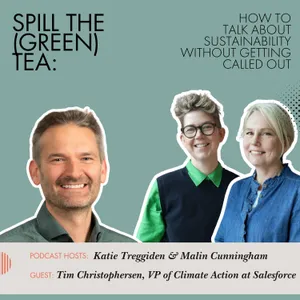
Katie Treggiden, Malin Cunningham
Spill the (Green) Tea with Tim Christophersen
SEP 9, 202660 MIN
Description
A forester by training, Tim left a secure UN career for the private sector in 2022, drawn by Salesforce's reach into 200,000-plus customers, including 60,000 NGOs, and the chance to shape how businesses think about biodiversity, water and climate strategy from the inside. He's also the author of Generation Restoration: How to Fix Our Relationship Crisis with Mother Nature. From a single, disarming admission the conversation opens into what it actually means to rebuild a relationship with nature, and why the language we use to talk about that relationship might matter as much as the science behind it.
In this episode, we cover:
“It's not the cow, it's the how” — livestock grazed well restores soil biodiversity and landscapes at scale, and it's factory farming, not meat itself, that's the problem.
How ecological literacy starts with three questions and answering them is how people rebuild a felt, not just intellectual, sense of being part of nature rather than separate from it.
The “we are nature” dictionary fight — why the Enlightenment-era idea that only humans have the divine spark is the philosophical root of ecological destruction.
What a nature-positive strategy actually means in practice
Rehabilitating carbon credits — how reducing and investing go together rather than being a trade-off, and that inaction, not offsetting, is now the biggest collective risk companies face.
Conditional optimism as a discipline
More from Tim
timchristophersen.com
Generation Restoration by Tim Christophersen
Tim Christophersen | LinkedIn
Resources mentioned:
Braiding Sweetgrass by Robin Wall Kimmerer
Eat More Trees Documentary
Kiss the Ground & Groundswell
Roots So Deep (you can see the devil down there) — 4-part documentary on adaptive grazing
Rewilding the World Podcast with Ben Goldsmith
Restor — Tom Crowther's “Google Maps for nature restoration” platform
Acción Andina — indigenous-led restoration of high Andean cloud forests
Symbiosis Coalition — Salesforce, Google, Meta, Microsoft and others' joint nature-based carbon removal commitment
Taskforce on Nature-related Financial Disclosures (TNFD)
Science Based Targets initiative (SBTi)
We Are Nature campaign — the dictionary-definition campaign Tim references
Carbon Literacy Project
Copenhagen Cloudburst Management Plan — the “sponge city” case study discussed
More from Katie
Green, Not Greenwashed: Get the clarity and confidence you need to talk about your eco-efforts without the fear of greenwashing.
Follow Katie on Instagram @katietreggiden.1
More from Malin
Greenwashing 101: Green or Greenwashed? Essential insights for sales and marketing professionals to make sense of sustainability and avoid falling into greenwashing's trap.
Follow Malin on LinkedIn @malin-cunningham
PS Looking for Brackish? That has a new home at https://brackishbykatietreggiden.substack.com/t/podcast