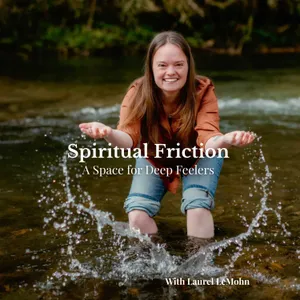
Spiritual Friction: A Space for Deep Feelers

Laurel LeMohn | Trauma Therapist & Spiritual Intuitive

Details

Spiritual Friction: A Space for Deep Feelers is a trauma-informed podcast offering heartfelt, reflective conversations about healing, trauma, spirituality, intuition, relationships, and what it means to be human. Hosted by Laurel LeMohn, trauma therapist and spiritual intuitive, the show explores the experiences that shape our internal worlds — from trauma, burnout, grief, and identity shifts to nervous system healing, self-trust, spiritual awakening, and the quiet work of coming back to yourself. These are conversations for people who experience the world deeply. Rather than rushing to fix, explain, or arrive at a tidy answer, Spiritual Friction makes room for curiosity. For the things we know before we have words for them. For the questions that don't always have easy answers. And for the stories, relationships, and experiences that change how we understand ourselves. Each episode invites you to listen inward, become curious about your own experience, and consider what your body, nervous system, intuition, and internal landscape may be trying to communicate. Because healing isn't always about becoming someone new. Sometimes it's about learning to trust what you've quietly known all along. If you're looking for honest conversations about trauma healing, nervous system regulation, spirituality, intuition, self-discovery, relationships, identity, and personal growth — you're welcome here. Stories held with care. Podcast Disclaimer Spiritual Friction: A Space for Deep Feelers is a storytelling and educational podcast. The content shared is not intended as medical, psychological, or mental health advice and does not establish a therapist-client, coach-client, or healthcare relationship. Listener discretion is advised, as some episodes may discuss sensitive topics. If you are in distress or experiencing a mental health crisis, please seek support from a qualified professional or local emergency services.

Recent Episodes

OCT 6, 2026
Episode 20: Embodiment, Alignment, & Becoming More of Yourself — with Dr. Tina Vitolo
Community & Support If you’ve been listening to Spiritual Friction and wishing you had a place to have conversations like these, I’d love to invite you to join us. The SoulBody Healing Circle is a monthly online gathering for genuine conversations that go deeper than the surface—with room for healing, relationships, spirituality, identity, and what it means to be human. You can learn more and join our email community through SoulBody Wellness. Episode Summary What if becoming more aligned with yourself didn’t require becoming someone new? What if it is actually a process of becoming more of who you already are? In this episode of Spiritual Friction, I sit down with Dr. Tina Vitolo, a licensed clinical social worker and doctor of social work who has spent nearly two decades in the mental health field. Tina is also the founder of The Black Sheep Therapist and the The Innovative Practitioner Accelerator®, communities created for therapists looking for another way to exist within their profession. Our conversation moves through spirituality, clinical work, intuition, burnout, visibility, professional expectations, inner child healing, and the courage it can take to trust a path that doesn’t look like everyone else’s. Tina shares how turning inward and becoming curious changed her relationship with herself: “The more I kind of turned into myself and just was curious, the more I became this version of me that I’m really proud of.” We also talk about Tina’s spirituality and the intuitive experiences that began early in her life. She takes us back to her first interaction with what she describes as her spiritual team at eight years old—an experience in which she suddenly felt as though she had walked into a wall and heard: “Run now.” Rather than separating her spirituality from the rest of who she is, Tina has learned to make room for the many parts of herself. That same process of integration has shaped the way she approaches her work, her relationships, and her own healing. We talk candidly about what happens when the systems we enter no longer feel aligned with who we are becoming, the fear that can come with choosing something different, and why change doesn’t always require one enormous leap. Sometimes it happens through “one manageable, uncomfortable step at a time.” Tina also shares what she has learned about allowing herself to ebb and flow rather than forcing her life or spiritual practice to look like anyone else’s. “I don’t want something I think is beautiful to be now seen as something I’m failing at.” And sometimes alignment means recognizing when it is time to stop pushing altogether. As Tina puts it: “Putting it down does not mean you failed. Putting it down means that you’re pivoting.” This is a conversation about becoming more ourselves, trusting what we know, questioning the systems and expectations we’ve inherited, and finding the courage to follow the breadcrumbs toward a life that feels more aligned. In This Episode, We Explore: What alignment can look like when it becomes something we embody rather than achieve Tina’s first spiritual experience at eight years old Intuition, spirituality, and learning to trust what we experience Becoming more of ourselves through curiosity rather than external validation Being both a clinician and a deeply spiritual person Burnout and questioning conventional paths within the mental health field Visibility, criticism, cyberbullying, and the vulnerability of being seen Inner child healing and responding differently to younger parts of ourselves Giving ourselves permission to ebb and flow Why spiritual practices don’t have to look like anyone else’s Taking one manageable, uncomfortable step at a time Comparison and learning to tend what we have already built Knowing when to keep going—and when putting something down may actually be a pivot Following the breadcrumbs even when the path doesn’t completely make sense yet Key Quotes “The more I kind of turned into myself and just was curious, the more I became this version of me that I’m really proud of.” “My first interaction with my spiritual team was when I was eight.” “I did one manageable, uncomfortable step at a time, and then they added up, and then here the fuck I am.” “I give myself permission to ebb and flow.” “I don’t want something I think is beautiful to be now seen as something I’m failing at.” “Putting it down does not mean you failed. Putting it down means that you’re pivoting.” About Dr. Tina Vitolo Dr. Tina Vitolo is a licensed clinical social worker and doctor of social work who has spent nearly two decades in the mental health field. In 2022, she founded The Black Sheep Therapist and the Innovative Practitioner Accelerator®, creating spaces for therapists who are questioning traditional professional expectations and looking for ways to build careers that feel more sustainable, authentic, and aligned with who they are. Her work makes room for conversations about spirituality, intuition, identity, entrepreneurship, visibility, and what can become possible when clinicians give themselves permission to find another way. Connect with Tina: Website: https://theblacksheepguide.com Instagram: @the_blacksheep_therapist About Your Host Laurel LeMohn is an integrative trauma therapist, founder of Redwood Coast Psychotherapy and SoulBody Wellness, and host of Spiritual Friction: A Space for Deep Feelers. Her work explores trauma, nervous system regulation, embodiment, self-trust, spirituality, relationships, and the stories we have come to believe about ourselves. Across therapy, community, and storytelling, Laurel creates spaces for deeper thinkers and feelers who have spent years searching for language, understanding, and connection. SoulBody Wellness: https://www.soulbodywellness.health Redwood Coast Psychotherapy If you’re looking for a space to explore trauma, relationships, self-trust, identity, or the patterns that keep showing up in your life, Redwood Coast Psychotherapy offers virtual therapy for adults in California and Washington. Learn more or schedule a consultation through Redwood Coast Psychotherapy.
57 MIN
SEP 22, 2026
Episode 19: It Does Get Better. But Slowly: Inner Child Healing, Shame, and the Journey Back to Self — with David Deane Haskell
Community & Support If you’ve been listening to Spiritual Friction and wishing you had a place to have conversations like these, I’d love to invite you to join us. The SoulBody Healing Circle is a monthly online gathering for genuine conversations that go deeper than the surface—with room for healing, relationships, spirituality, identity, and what it means to be human. You can learn more and join our email community through SoulBody Wellness. Episode Summary “It does get better. But slowly.” For more than 40 years, author David Deane Haskell carried profound grief and unearned shame surrounding his mother's death by suicide when he was a child. He tried to escape what he was carrying through addiction, relationships, creativity, and simply trying to keep going. But underneath it all were younger parts of himself that had never stopped carrying loneliness, fear, rejection, and shame. In this episode of Spiritual Friction, David shares his journey through addiction recovery, codependency, inner child healing, spirituality, and learning to relate differently to the parts of himself he once tried to avoid. David describes the different younger parts he has encountered through his healing—the lonely boy, the runaways, and the nine-year-old he calls the “shame shocked boy.” Rather than treating these experiences as something to simply “let go,” he began turning toward them with curiosity, compassion, and care. We also explore the importance of community and being witnessed. For David, connecting with others who understood addiction and codependency offered something he hadn't found elsewhere: the realization that he wasn't alone. “Oh, you feel like that too? Oh, my God.” Together, we talk about why healing doesn't always happen through one breakthrough, how codependency can become intertwined with identity and self-worth, what it means to build a relationship with our inner child, and why some of the smallest acts of self-care can matter when we're struggling simply to make it through the day. David also shares the spiritual awakening he experienced on a beach in Japan after years of addiction and self-destructive behavior. Looking out at the horizon, he was struck by the realization that he had survived—and that he was grateful to still be alive. “I’m here. I’m alive, and I’m glad I’m alive.” This is a conversation about childhood trauma, inner child healing, toxic shame, codependency, addiction, spirituality, loneliness, belonging, and the slow journey back to Self. In This Episode, We Explore: Carrying childhood grief and unearned shame into adulthood Inner child healing and the parts of ourselves that become frozen in earlier experiences Loneliness, rejection, and the need to feel understood Addiction, codependency, and using relationships to feel safe Why familiar relationships can be difficult to leave even when they are no longer healthy Community, peer support, and the experience of realizing “I’m not alone” Why healing may take years rather than one dramatic breakthrough Self-worth beyond what we can do for other people Spiritual awakening, meditation, and discovering something larger than ourselves Self-care as a practice rather than a quick fix Vulnerability and the fear of allowing other people to see our stories Healing through storytelling and being witnessed Finding our way back to ourselves Key Quotes “There wasn’t any singular moment. It’s been a years-long process.” “It does get better. But slowly. And it is beautiful in its own way, but that doesn’t make the pain any less painful.” “Oh, I’m not alone. Oh, you feel like that too? Oh, my God.” “I’m here. I’m alive, and I’m glad I’m alive.” “Don’t give up on yourself.” About David Deane Haskell David Deane Haskell is the author of six books, including Wounded Angels, a deeply personal account of his inner child healing journey. After decades of struggling with trauma, grief, addiction, codependency, and unearned shame surrounding his mother's death, David began documenting his healing in real time. What began as deeply personal inner child work eventually became Wounded Angels. David is also a musician and fiction writer, and his creative life has become intertwined with the healing and transformation he continues to experience. In this conversation, he describes his work not as a prescription for how someone else should heal, but as an honest record of what healing has felt like for him. Connect with David: Website: https://daviddeanehaskell.com Wounded Angels: https://books2read.com/woundedangels About Your Host Laurel LeMohn is an integrative trauma therapist, founder of Redwood Coast Psychotherapy and SoulBody Wellness, and host of Spiritual Friction: A Space for Deep Feelers. Her work explores trauma, nervous system regulation, embodiment, self-trust, spirituality, relationships, and the stories we have come to believe about ourselves. Across therapy, community, and storytelling, Laurel creates spaces for deeper thinkers and feelers who have spent years searching for language, understanding, and connection. SoulBody Wellness: https://www.soulbodywellness.health Redwood Coast Psychotherapy If you’re looking for a space to explore trauma, relationships, self-trust, identity, or the patterns that keep showing up in your life, Redwood Coast Psychotherapy offers virtual therapy for adults in California and Washington. Learn more or schedule a consultation through Redwood Coast Psychotherapy. A Note About This Conversation This episode includes discussion of childhood trauma, addiction, depression, suicide, suicidal thoughts, and the death of a parent by suicide. Please listen with care and take whatever space you need. Spiritual Friction is a storytelling and educational podcast. The experiences and perspectives shared by guests are their own and are not intended as medical, psychological, or mental-health advice. If you are experiencing a mental-health crisis or thinking about suicide in the United States, call or text 9-8-8 to reach the Suicide & Crisis Lifeline. Stories held with care.

45 MIN
SEP 8, 2026
Episode 18: I Just Don’t Wanna Live Scared Anymore: From Childhood Trauma to Embodied Strength — with Nahum Vizakis
Community & Support If you’ve been listening to Spiritual Friction and wishing you had a place to have conversations like these, I’d love to invite you to join us. The SoulBody Healing Circle is a monthly online gathering for genuine conversations that go deeper than the surface—with room for healing, relationships, spirituality, identity, and what it means to be human. You can learn more and join our email community through SoulBody Wellness. Guest Nahum Vizakis is an author, combat veteran, bodybuilder, executive coach, and medicine man whose work draws from his lived experiences, spiritual exploration, and personal transformation. Episode Summary “I was always a scared little kid.” Nahum Vizakis takes us back to being a frightened child with a stutter and how early experiences shaped his relationship with fear, safety, and what it meant to feel strong. In this conversation, Nahum shares the experiences that eventually led him to decide, “I just do not wanna live scared anymore.” His journey has taken him through bodybuilding, military service and combat, plant medicine, spiritual exploration, and profound personal transformation. Along the way, he began discovering that the parts of himself he had spent years suppressing were not necessarily weaknesses. As he reflects: “That part of me that I was suppressing for my entire life ended up being my superpower.” Together, we explore trauma and the body, stored emotional energy, finding enough safety to begin releasing what we’ve carried, and the role of spirituality and self-trust in finding our way back to ourselves. Nahum also reflects on his near-death experiences, his evolving relationship with mortality, and the sense of purpose that has emerged through his life. Rather than arriving at a final destination, he describes learning to trust the direction his life is taking and remaining open to what there is still to learn. This is a conversation about survival, strength, and transformation—and what can become possible when we begin relating differently to the parts of ourselves we once tried to hide. What We Explore Growing up scared, developing a stutter, and entering foster care at 13 Bodybuilding, physical strength, and Nahum’s changing relationship with himself Military service, combat, and the experiences that shaped his understanding of survival Trauma, the nervous system, and stored emotional energy Finding enough safety to begin working with what the body has been carrying Plant medicine, spirituality, and personal transformation The parts of ourselves we suppress and what they may hold Near-death experiences, mortality, and finding purpose Learning to trust yourself and the direction life is taking Why lived experience can become a source of connection, understanding, and service Key Quotes “I was always a scared little kid.” “I just do not wanna live scared anymore.” “That part of me that I was suppressing for my entire life ended up being my superpower.” “The universe is guiding me. I just have to trust it and allow these things to unfold.” “There’s always more to learn and more to grow. The universe is infinite.” Why This Matters Sometimes the things we develop to survive become so familiar that we begin to mistake them for who we are. Fear can become a way of moving through the world. Strength can become something we feel we have to prove. And parts of ourselves may be pushed away because we haven't yet found a place where they feel safe enough to exist. Nahum’s story offers another perspective. What if healing isn't always about becoming someone new? What if part of the work is finding our way back to the parts of ourselves we learned to suppress—and discovering that they may hold something valuable? His experiences also remind us that transformation rarely happens in one moment. It can unfold through the body, through relationships, through spiritual experiences, and through the gradual process of learning to trust ourselves. There is always more to learn. And sometimes, the experiences we never would have chosen become part of how we understand ourselves and connect with others. About Nahum Vizakis Nahum Vizakis is an author, combat veteran, bodybuilder, executive coach, and medicine man. His work explores personal transformation, spirituality, plant medicine, and the relationship between lived experience and healing. Through his writing, coaching, and facilitation, he draws from the experiences that have shaped his own life and the belief that there is always more to learn, grow, and discover. Connect with Nahum: Website: https://www.optimizinghuman.com Instagram:@spiritual_Bodybuilder About the Host Laurel LeMohn is an integrative trauma therapist, founder of Redwood Coast Psychotherapy and SoulBody Wellness, and host of Spiritual Friction. Her work explores the intersection of trauma, nervous system regulation, embodiment, spirituality, and the stories we’ve come to believe about ourselves. Through therapy, community, and meaningful conversations, she helps people make sense of themselves by bringing language to experiences that once felt difficult to name. SoulBody Wellness SoulBody Wellness offers community, resources, and meaningful conversations for deep feelers navigating healing, personal growth, spirituality, and the experience of being human. Explore the podcast, join the email community, and learn more about the monthly Healing Circle through SoulBody Wellness. Redwood Coast Psychotherapy If you’re looking for a space to explore trauma, relationships, self-trust, identity, or the patterns that keep showing up in your life, Redwood Coast Psychotherapy offers virtual therapy for adults in California and Washington. Learn more or schedule a consultation through Redwood Coast Psychotherapy. Disclaimer Spiritual Friction is a storytelling and educational podcast. The content shared is not intended as medical, psychological, or mental health advice and does not establish a therapist-client, coach-client, or healthcare relationship. Guests share their personal experiences and perspectives, which may include discussions of trauma, spirituality, plant medicine, and other sensitive topics. These experiences should not be understood as medical recommendations or guarantees of particular outcomes. Listener discretion is advised. If you are in distress or experiencing a mental health crisis, please seek support from a qualified professional or local emergency services. In the United States, you can call or text 9-8-8 for crisis support.
86 MIN
AUG 25, 2026
Episode 17: It’s Not You: Trauma, Fawning, and Finding the Safety to Trust Yourself — with Laurie Hardie
Community & Support If this conversation stirred something in you, you're warmly invited to join our monthly Healing Circle on the first Tuesday of each month at 6:00 PM PT—a space to slow down, connect, and remember you don't have to navigate life alone. Whether you come to share, listen, or simply be present, you're welcome here. Learn more and join us: https://www.soulbodywellness.health/community Guest Laurie Hardie — Seattle radio personality, author, speaker, certified life and recovery coach, and host of Interrupted: Act II — Reinventing Your Legacy Episode Summary What happens when the things that once kept us safe begin shaping how we move through the world? In this episode of Spiritual Friction: A Space for Deep Feelers, Laurel LeMohn sits down with Laurie Hardie for a deeply personal conversation about trauma, fawning, repressed memories, the inner child, self-trust, and what becomes possible when we finally find safe places to tell our stories. Laurie reflects on the many ways she learned to survive—from fawning and reading the room to staying silent about experiences she didn't yet have language for. She shares what it was like to recognize these patterns not simply as weaknesses, but as responses that helped her survive—and what changed when she began realizing she had choices. Together, Laurel and Laurie explore the deeper layers of healing: acknowledging what's happening, becoming aware of our patterns, getting curious about what our bodies are telling us, and finding connection where we feel safe enough to be seen and understood. They also talk about the reality that healing doesn't always happen in one transformative moment. Laurie remembers hearing other people say, “God healed me from all my abuse,” and wondering why that hadn't happened for her. Why did she have to go from A to Z, slowly moving through one layer after another? Looking back, she recognizes that the process itself became part of her healing. At the heart of the conversation is a message Laurie would give the little girl she once was: “Hold on. It's not you, and someday somebody's gonna believe you.” What We Explore Why what we need is reconnection, not separation Fight, flight, freeze, and the fawn response Fawning and people-pleasing as ways we learn to stay safe The inner child and what changes when we stop abandoning ourselves Repressed memories and experiences we may not initially have language for What happens when our experiences and stories have been silenced Acknowledgment, awareness, and curiosity as first steps toward healing Why healing can happen slowly and in layers Our nervous system's need for safety, belonging, and connection Finding people and places where we feel safe enough to tell our story Why healing doesn't always require retelling every detail of what happened Learning to listen to the body's signals Self-trust, boundaries, and knowing what you bring to the table Why we don't have to heal alone Speaking from our scars rather than our wounds Key Quotes “What we need in this world right now is reconnection, not separation.” “So many things in my life, in circles I was in, silenced me, and so I didn't speak about it.” “Hold on. It's not you, and someday somebody's gonna believe you.” “I want women to speak from their scars, not their wounds.” Why This Conversation Matters Many of us learned how to survive long before we had language for what was happening. Maybe you learned to read the room. Keep the peace. Make sure everyone else was okay. Stay quiet. Do what was expected of you. Or become whoever you needed to be in order to feel safe, connected, or loved. Those patterns can follow us long after the original experience has passed. But healing doesn't necessarily begin by trying to get rid of them. When Laurie asks, “What are first steps of doing this?”, Laurel talks about starting with acknowledgment, awareness, and curiosity. We may not know exactly what we want or where we're going yet. Sometimes we simply begin by recognizing what we don't want anymore and finding people and places where we feel safe enough to be seen and understood. From there, something begins to shift. We can notice when an old survival response is taking over. We can listen to what our bodies are communicating. We can begin making different choices. And we can start recognizing that the very responses we once judged may have helped us survive. For Laurie, that shift changed the way she understood fawning. Instead of seeing it only as something she wished she hadn't done, she could recognize what an extraordinary adaptation it had been: “What an awesome gift it was that I could do that to survive my world.” Healing also happens in relationship. As Laurel reflects later in the conversation, some of what we come to understand isn't learned from a textbook or classroom. It's learned through life experience. And when those experiences are shared, someone else may finally recognize: You don't have to be alone. You're not the only one. Perhaps that's part of why telling our stories matters. Not because what happened has to define us. But because eventually we may be able to speak from our scars rather than our wounds—to say: I learned how to stand up for myself. I learned it was okay to leave. And somewhere, someone who has spent years wondering whether they're the only one may finally hear: It's not you. And someday somebody's gonna believe you. About Laurie Hardie Laurie Hardie is a Seattle radio personality with more than 35 years of experience, author of Did Not See That Coming: Hope for the Single Parent, public speaker, certified life and recovery coach, and host of Interrupted: Act II — Reinventing Your Legacy. Through her coaching, podcasting, speaking, and work in radio, Laurie helps women find their voice, tell their stories, and recognize that it is never too late to begin again. Her work is shaped by both professional experience and her own journey through childhood trauma, single motherhood, recovery, counseling, and learning to understand the survival responses that helped her navigate her life. Website: coachlaurie.com Facebook: Laurie Hardie Podcast: Interrupted: Act II — Reinventing Your Legacy About Your Host Laurel LeMohn is a trauma therapist and spiritual intuitive serving clients in California and Washington, and the founder of SoulBody Wellness and Redwood Coast Psychotherapy. Through Spiritual Friction, Laurel holds space for heartfelt conversations about healing, trauma, spirituality, intuition, the nervous system, self-discovery, relationships, and what it means to be human—without rushing people toward a tidy answer. Explore more episodes, community offerings, and resources at: https://www.soulbodywellness.health If you're seeking individualized support, Laurel offers virtual trauma-informed psychotherapy for adults throughout California and Washington through Redwood Coast Psychotherapy. Learn more: https://www.redwoodcoastpsychotherapy.com Stories held with care. Disclaimer Spiritual Friction: A Space for Deep Feelers is an educational and storytelling podcast and is not a substitute for psychotherapy, medical care, or mental health treatment. Listening to this podcast does not establish a therapeutic relationship. If you are experiencing emotional distress or are in crisis, please contact a qualified mental health professional or your local emergency services.
69 MIN
AUG 11, 2026
Episode 16: Why Is This Happening to Me? Synchronicity, Soul Contracts, & Seeing Behind the Veil — with Ruger Hebert
Community & Support If this conversation stirred something in you, you're warmly invited to join our monthly Healing Circle on the first Tuesday of each month at 6:00 PM PT—a space to slow down, connect, and remember you don't have to navigate life alone. Whether you come to share, listen, or simply be present, you're welcome here. Learn more and join us: https://www.soulbodywellness.health/community Guest Ruger Hebert Founder of MexiSoul Retreats in Mexico and podcast host Episode Summary Have you ever experienced a coincidence so meaningful that you wondered whether it was actually a sign or synchronicity? Or found yourself in the middle of a painful or confusing chapter asking, “Why is this happening to me?” In this episode of Spiritual Friction, Laurel LeMohn sits down with Ruger Hebert for a conversation about synchronicity, mysticism, ayahuasca, soul contracts, spiritual awakening, generational patterns, and finding meaning after difficult or life-changing experiences. Ruger shares the remarkable story of encountering the same doctor who had cared for his father eight years earlier—a moment that left him wondering about timing, interconnectedness, and whether some of the experiences we call coincidences might carry deeper meaning. He also shares his experience with ayahuasca and the profound shift in perception that followed—what he describes as seeing “behind the veil.” Together, Laurel and Ruger explore some of the bigger questions that can emerge during healing and spiritual growth: How do I know if something is a sign? Why do certain experiences keep showing up in my life? What if I don't understand what's happening to me? What is this trying to teach me? And perhaps most importantly: What changes when we stop asking, “Why is this happening to me?” and begin wondering, “What is this here for?” What We Explore Synchronicity and coincidences that feel too meaningful to ignore Why certain experiences can feel like signs from the universe—and how to stay curious without needing certainty Mysticism and experiences we can't always explain Ruger's ayahuasca experience and what he describes as seeing “behind the veil” Spiritual awakening and shifts in perception Soul contracts and the possibility that some experiences may have meaning beyond what we immediately understand Breaking generational patterns and inherited ways of living Finding meaning after painful or difficult life experiences Moving from “Why is this happening to me?” toward “What is this here for?” Learning to trust yourself and listen inward Becoming the hero of your own story Why curiosity can create space when we don't have the answers Key Quotes “Whatever is happening is happening for you and not to you.” “Every single thing that comes into our life is meant to just teach us something or to remind us something.” “You can look at yourself as, ‘Why is this happening to me?’ and the victim of your own story, or you could look at it as, ‘I can be the hero of my own story.’” “Try to have at least a curiosity about what you're experiencing and why. You don't have to find the answer.” Why This Matters So much of healing involves learning to trust ourselves again. We may spend years looking outside ourselves for the right answer, wondering whether we're making the right choice, questioning what we're feeling, or trying to make sense of experiences that don't fit neatly into a rational explanation. Sometimes we know something before we have language for it. And sometimes an experience simply leaves us wondering whether there might be something more happening beneath the surface. This conversation isn't about finding the right spiritual explanation for everything that happens. It's an invitation to listen inward. To become curious about our experiences rather than immediately judging, rejecting, or trying to fix them. Because perhaps we don't always need an answer. Sometimes curiosity is enough. What is this here for? What might this be trying to teach me? About Ruger Hebert Ruger Hebert is the founder of MexiSoul Retreats in Mexico and a podcast host. His work and personal experiences explore transformation, spirituality, expanded states of consciousness, and what becomes possible when we begin looking at our lives through a different lens. Website: mexisoulretreats.com Instagram: https://www.instagram.com/mexisoulretreats YouTube: www.youtube.com/@mexisoul Podcast: Remember Who You Are About Your Host Laurel LeMohn is a trauma therapist and spiritual intuitive serving clients in California and Washington, and the founder of SoulBody Wellness and Redwood Coast Psychotherapy. Through Spiritual Friction, Laurel holds space for heartfelt conversations about healing, trauma, spirituality, intuition, the nervous system, self-discovery, relationships, and what it means to be human—without rushing people toward a tidy answer. Explore more episodes, community offerings, and resources at: https://www.soulbodywellness.health/ If you're seeking individualized support, Laurel offers virtual trauma-informed psychotherapy for adults throughout California and Washington through Redwood Coast Psychotherapy. Learn more: https://www.redwoodcoastpsychotherapy.com/ Stories held with care. Disclaimer Spiritual Friction: A Space for Deep Feelers is an educational and storytelling podcast and is not a substitute for psychotherapy, medical care, or mental health treatment. Listening to this podcast does not establish a therapeutic relationship. If you are experiencing emotional distress or are in crisis, please contact a qualified mental health professional or your local emergency services. This episode includes discussion of ayahuasca and altered states of consciousness based on a guest's personal experience and is not intended as medical advice or an endorsement or recommendation of psychedelic substance use.
62 MIN