



Starts With A Bang podcast
Ethan Siegel
Starts With A Bang #134 - Stellar streams and the dark universe
OCT 24, 202691 MIN
Description
When the general public speaks about dark matter, most of the discussion centers on the topic of whether dark matter exists or not: on whether it's real. But in astrophysical circles, we're overwhelmingly confident of dark matter's existence, as we've indirectly detected it through an enormous number of independent lines of evidence. Instead, the conversation normally focuses on how to identify and characterize it, with a particular interest in what sorts of measurements can help reveal its underlying nature.
We can learn a whole lot about dark matter's nature simply by observing the luminous signatures of the normal matter within galaxies. Matter follows a path dictated by gravity, and so if you can find a signature within a galaxy that will lead to very different observables depending on the shape, profile, and clumpiness of a dark matter halo, that can help teach you which models of dark matter remain viable and which ones are disfavored by the observations. While simulations can help us in many ways, the key is data: in novel places and in the most precise laboratories of all.
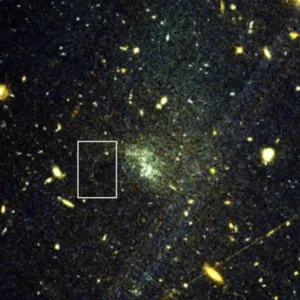
That's why it's so exciting that we've just discovered our very first globular cluster stellar stream in an ultra-diffuse galaxy. Not only is it our first extragalactic globular cluster stellar stream, but it happens to be located in a galaxy that's exceptionally rich in dark matter and poor in normal matter: an ideal laboratory for probing the gravitational nature and distribution of dark matter. Joining us on this episode of the podcast is its discoverer: PhD candidate Julie Kiel Holm of the Niels Bohr Institute at the University of Copenhagen. You won't want to miss this one!
(This image shows an ultra-diffuse galaxy as imaged with the Hubble Space Telescope, and, in an inset box, a globular cluster and a curved stellar stream associated with it. This marks the very first discovery of a globular cluster stellar stream outside of the Milky Way galaxy. Credit: J.K. Holm et al., Nature, 2026)