


State of Streaming Podcast
State of Streaming
Why Ad-Free Streamers Need Live Sports and How to Monetize It | Simeon McMillan & Scott Young
NOV 19, 202624 MIN
Description
Have a question? Send us a text!
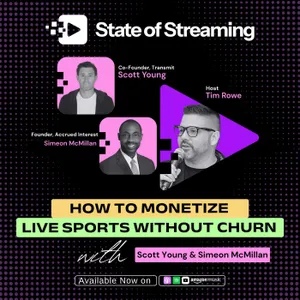
Tim sits down with Simeon McMillan, Principal at Accrued Interest, and Scott Young, Chief Product Officer at Transmit, to map the collision course between ad-free streaming growth and the ad-heavy nature of live sports — and how platforms can monetize without triggering subscriber churn.
Ad-free streaming growth hits a wall while SVOD giants dive into live sports.
Ad-supported TV viewership share dropped to 72%, and ad-free streaming accounted for a massive 71% of recent growth. Yet Netflix and Disney+ are diving headfirst into live sports. Netflix is approaching this with precision: rather than bidding billions for a full global NFL season, they target the World Baseball Classic in Japan or the 2030 World Cup in Spain. It's about serving ads to all tiers while driving engagement through calculated, regional tentpoles.
0:07 – The data: ad-free streaming accounted for 71% of growth, yet platforms are diving into sports
1:37 – How SVOD giants introduce advertising without triggering massive subscriber churn
2:20 – Simeon on Netflix's targeted rights strategy: Japan's World Baseball Classic and Spain's 2030 World Cup
Don't change the game for ads, change the ads for the game.
Fox proved you can make incremental revenue ($290 million) during the World Cup by adding 30-second spots, but they changed the rules with hydration breaks, causing fans in the stadium to boo. Transmit's approach? Use the 40 minutes of natural dead ball time in a soccer broadcast. By identifying 15 to 20 monetizable moments for picture-in-picture or L-bar overlays, platforms can generate an incremental $410 million without ever interrupting the action or alienating the audience.
4:40 – What Fox did right (revenue) and wrong (hydration breaks) during the World Cup
7:04 – Scott on using L-bars and sponsored picture-in-picture overlays instead of standard ad breaks
9:14 – How shoulder programming and docuseries (like Starting 5 and Drive to Survive) expand premium ad space
The programmatic problem? Dropped impressions and a widening ad load gap.
Streaming ad loads (4 to 6 minutes) are drastically lower than linear TV (13 to 15 minutes). While streamers are leaving money on the table, they also drop massive amounts of potential impressions due to reliance on duplicated programmatic demand. Transmit fixes this using AI to evaluate timing, context, and creative, filling dead space (like the 91% of an NFL broadcast where the ball isn't in play) with contextually relevant, direct-demand ads.
10:23 – The ad load gap between streaming and linear, and who is leaving money on the table
13:55 – Why streaming platforms need to move away from programmatic for marquee live events
19:23 – Scott breaks down Transmit's AI workflow for real-time live ad delivery based on timing, context, and creative
The biggest mistakes streamers make: right fragmentation and second-tier sports.
Looking toward 2030, the biggest threat to profitability isn't just the ad tech—it's overpaying for the wrong rights. Simeon warns against buying secondary properties (like Fandango acquiring Bundesliga rights) assuming sports fans are interchangeable. Meanwhile, Scott sees the industry finally moving past the 80-year-old mindset of traditional breaks, synchronizing creative across the game, the overlays, and the shoulder programming.
16:03 – How digital-first streamers have an inherent advantage over linear broadcast affiliates for the Super Bowl
21:29 – Simeon on the financial trap of overpaying for second and third-tier sports leagues
22:54 – Scott on what the live sports ad experience will actually look like by 2030
Connect with Simeon McMillan on LinkedIn · Accrued Interest
Connect with Scott Young on LinkedIn · Transmit