



State of Streaming Podcast
State of Streaming
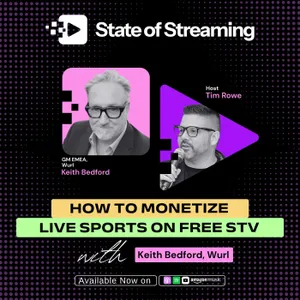
Why Live Sports FAST Monetization Is Broken and How to Fix It | Keith Bedford, GM EMEA at Wurl
SEP 24, 202627 MIN
Description
Have a question? Send us a text!
Tim sits down with Keith Bedford, GM of EMEA at Wurl, to map the infrastructure gaps standing between live sports and FAST monetization — and what Wurl is building to close them. Recorded ahead of Sportel and Mipcom, with a Part Two already locked in.
Live sports on FAST went from less than 3% of viewing to an entire content category in <12 months.
A year ago, live sports made up less than 3% of all FAST viewing compared to nearly 20% on traditional television. That gap is closing fast — Man City launched a channel going live on match days, UEFA landed on Tubi with highlights and women's Champions League content, the Bundesliga kept a Friday night game for Samsung TV Plus while selling Saturday rights to Sky. The rights model is diversifying. The platforms are filling up. The ad infrastructure hasn't caught up yet.
1:37 – Man City's live match day channel and why it's unprecedented in the UK market
2:10 – UEFA on Tubi: highlights, women's Champions League, and what rights they kept
4:48 – The Bundesliga case study: Saturday rights to Sky, Friday nights to Samsung TV Plus
The programmatic problem? If nobody knows it's live, nobody bids like it's live.
In a programmatic bid stream, a live Champions League match and a three-year-old highlights reel look identical without metadata. The CPM is the same. The opportunity isn't captured. Wurl has spent most of the year building a live event API that pre-sends event IDs, metadata, and timing into the bid stream — essentially a sports TV guide for media buyers and planners that tells the market what's live, when, and what content surrounds it. It's not live yet. But it's close.
7:57 – Why FAST ad monetization is still a mixture of pre-sold sponsorships and programmatic
9:30 – Why walled garden OEM data creates fragmentation for advertisers trying to reach across platforms
16:23 – Wurl's live event API: pre-sending event IDs and metadata so planners can actually plan against it
Someone still has to press the ad button - what about AI?
All this technology and AI, and the best way to insert an ad break into a live sports stream is still a human being pressing a button in real time. Wurl uses AI to model when game breaks should happen, but the final call is manual — because if it's live and the game overruns, an automated system gets it wrong. The investment they've made is in making that human intervention smarter, faster, and more frequent so more ad slots get filled at better rates.
12:50 – What Wurl does: playout, channel distribution, and AdPool across every major platform
14:22 – Why live ad insertion still requires a human in the loop
15:10 – How Wurl's ad break model creates more inventory and better metadata in the same workflow
The three reasons FAST live sports channels fail: the TV, the home screen, and the cross-marketing.
Keith's honest diagnosis of why good content still doesn't find its audience. First: consumers don't know the free channels exist when they buy the TV. Second: if the content isn't on the home screen, it might as well not exist — and getting home screen placement requires an active marketing strategy with the platform. Third: almost nobody is cross-marketing their FAST channel across social, YouTube, and Instagram, which is the only place to find the audiences who aren't already looking. Two tiers exist: brands that understand marketing, and brands that ignore it entirely. There's no middle.
19:39 – Why consumers don't know they have 300 free channels when they buy a new TV
20:30 – Why home screen placement requires an active strategy, not just distribution
22:01 – Why cross-platform marketing is the missing piece for almost every FAST sports channel
Connect with Keith Bedford on LinkedIn · Wurl
Thanks to Looper Insights for sponsoring today’s show! Ready to unlock your streaming strategy edge? Head over to mystreamingvalue.com to compare CTV home screens and find out which spaces are worth the most. You’ll even learn exactly why Fox was willing to pay $22 billion for Roku. Stop guessing and start scaling—visit mystreamingvalue.com to get your free insights today!