Stories From The States

States Newsroom

Details

A weekly podcast focused on one theme in the news. Host and States Newsroom publisher Chris Fitzsimon, with producer Mallory Cheng, will explore one issue with the help from local journalists, experts and community members who are experiencing the fallout of sweeping changes happening across the country. By zooming into one story each week, Stories From The States contextualizes what is happening now. New episodes every Friday. For more information visit, https://www.newsfromthestates.com/podcast/stories-states.  Subscribe to Stories From the States on Apple Podcasts, Spotify and Youtube.

Recent Episodes

NOV 25, 2026
How states can alleviate residents’ headaches over services
There are many experiences that a lot of Americans find frustrating or annoying: going to the DMV, figuring out an online portal to pay for a parking ticket, applying for unemployment benefits. Some states are looking at how they can make accessing government services less aggravating. A recent study from McKinsey, a global strategy and management consulting firm, examined how residents experience state government services across the country, why some states are outperforming others and what matters most to residents when interacting with the government. The study authors say the results come at an opportune time, as 21 states prepare for new governors and at least 24% of state legislators will be new to the job. In Episode 56, Ashka Dave, a partner in McKinsey’s Tech & AI Practice, joins the podcast to discuss what her team found and how incoming state leaders can make a difference. Episode produced and edited by Mallory Cheng. Music for Stories From The States composed by David Singer. Click here for the full transcript. Relevant reading from States Newsroom outlets and partners: Republican lawmaker files bill to replace Arkansas’ Medicaid expansion program (Arkansas Advocate) Maine’s projected $1 billion budget gap shrinks after latest update (Maine Morning Star) Pennsylvania considers whether to delay enforcing Medicaid work requirements (Pennsylvania Capital-Star) Nearly 5K helped by state-funded legal aid program for immigrants, NJ says (New Jersey Monitor) Got questions? An episode idea? Email us at [email protected] Photo: The Idaho State Capitol is reflected in the Joe R. Williams building on March 21, 2021. (File photo by Otto Kitsinger for Idaho Capital Sun)
29 MIN
NOV 20, 2026
The push for a national popular vote has its best chance in years
There’s renewed interest in shifting to a national popular vote in presidential elections after Democrats’ major midterm victories. Presidents are chosen by the Electoral College, through which states decide how to award their share of 538 electors. Most states use a winner-take-all method that awards all of their electors to one candidate, even in tight races. Five of the nation’s 47 presidents took office without winning a majority of votes nationally. The National Popular Vote Interstate Compact has advocated for reform since 2006. The compact is an agreement among participating states and the District of Columbia to award all of their Electoral College votes to the presidential candidate who wins the overall national popular vote. The compact does not abolish the Electoral College, and would only take effect once states with at least 270 electoral votes sign on. Eighteen states and the District of Columbia have joined the compact, but more states could opt in soon to get to that majority. With Democrats holding “trifectas” — unified control of the governor’s office and both legislative chambers — in 22 states next year, the possibility is high. In Episode 55, Christopher Pearson, secretary of the advocacy group National Popular Vote, joins the podcast. He’ll address some misconceptions about the proposal, and why he thinks a popular vote for president could bolster voter turnout and make every vote equal. You’ll also get a weekly news wrap-up from Evening Wrap newsletter writer Danielle Gaines and Daybreak newsletter writer Madyson Fitzgerald. They’ve got you covered with the latest on: measles in the states, infant and maternal mortality and data center moratoriums. Episode produced and edited by Mallory Cheng. Music for Stories From The States composed by David Singer. Click here for the full transcript. Relevant reading from States Newsroom outlets and partners: Democrats are within reach of neutering the Electoral College’s role in presidential elections — but political and legal hurdles remain (VoteBeat) Pennsylvania’s Democratic trifecta renews calls to join National Popular Vote compact (Pennsylvania Capital-Star) Maine joined a pledge to ditch the Electoral College. Dems’ national wins could make it reality. (Maine Morning Star) Incoming Democratic Congress fuels hope of more federal dollars for elections (States Newsroom D.C. Bureau) Photo: People emerge from the Besse Building after casting their ballots in Albion, Maine on Tuesday, November 5, 2024. (Photo by Michael G. Seamans/Maine Morning Star)
29 MIN
NOV 13, 2026
Is ranked choice voting the future of American elections?
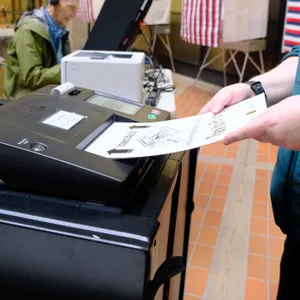
Alaska’s contentious U.S. Senate race and Maine’s 2nd Congressional District runoff have put ranked choice voting back in the national spotlight. Under this election system, voters rank their candidates in order of preference, and whoever ultimately gets more than half of the first-preference votes wins. Ranked choice voting is used statewide in Alaska and Maine, but there’s growing interest in jurisdictions across the country to adopt the practice. However, many states are still cautious about using ranked choice voting. In Episode 54, Meredith Sumpter, president and CEO of the advocacy group FairVote, joins the podcast to talk about what we can learn from Alaska’s elections, about why voters are drawn to ranked choice voting, and whether the system could curb partisanship. You’ll also get a weekly news wrap-up from Evening Wrap newsletter writer Danielle Gaines and Daybreak newsletter writer Madyson Fitzgerald. They’ve got you covered with the latest on: how states are trying to curb Kalshi, vaccine guidelines for our pets and an archival project that could help investigators search for missing U.S. service members and civilians. Episode produced and edited by Mallory Cheng. Music for Stories From The States composed by David Singer. Click here for the full transcript. Relevant reading from States Newsroom outlets and partners: Peltola extends lead over Sullivan in Alaska’s U.S. Senate race as ballot-counting continues (Alaska Beacon) Despite Dunlap’s concession, 2nd District race still headed to ranked choice runoff (Maine Morning Star) ‘I didn’t expect it at all’: The blue wave hit a portion of red Utah County (Utah News Dispatch) Election denialism losing steam as Trump flip flops on accepting midterm results (States Newsroom D.C. Bureau) Got questions? An episode idea? Email us at [email protected] Photo: A voter casts their ballot on the first day of early in person voting in Juneau on Oct. 19, 2026. (Photo by Corinne Smith/Alaska Beacon)
28 MIN
NOV 6, 2026
Democrats won big on Tuesday. What’s next for American democracy?
An enormous blue wave crashed over all levels of government this midterm cycle. Congressional seats, governor’s mansions and state legislatures flipped from Republican to Democrat, some in surprising fashion. Democrats claimed “trifecta” power in some state capitals, broke supermajorities in others and won other influential statewide offices. For months, the Trump administration tried to assert federal control over the election process to bolster Republicans’ chances of maintaining power. President Donald Trump pushed GOP-led states to gerrymander their congressional districts, demanded state voter rolls through legal challenges and threatened to send armed federal agents to the polls. Despite fears about possible interference or intimidation heading into Election Day, voters turned out en masse and have shifted the course of policymaking over the next several years in their states and on Capitol Hill. In Episode 53, we’re reflecting on the state of American democracy, election integrity and what Tuesday’s results could mean for policymaking in reshaped statehouses. States Newsroom democracy reporter Jonathan Shorman and Evening Wrap newsletter writer Danielle Gaines will chat about the major trends from this election, what surprised them and what could be next. Episode produced and edited by Mallory Cheng. Music for Stories From The States composed by David Singer. Click here for the full transcript. Relevant reading from States Newsroom outlets and partners: Trump’s gerrymandering push flops as Democrats win redrawn seats (States Newsroom D.C. Bureau) What will Pennsylvania Democrats do with a trifecta in Harrisburg? (Pennsylvania Capital-Star) Shomari Figures wins reelection in AL-02, overcoming Republican gerrymander (Alabama Reflector) Democrats flip Texas House amid generational wave (Texas Tribune) In blue wave, Democrats flipped legislatures, won trifectas and toppled GOP supermajorities (Stateline) Got questions? An episode idea? Email us at [email protected] Photo: Attendees celebrate as results roll in at the Democratic-Farmer-Labor (DFL) Party’s watch party, Tuesday, Nov. 3, 2026 in St. Paul, Minnesota. Every Minnesota House district voted more blue than in 2024, leading to a DFL trifecta in the state government. (Photo by Nicole Neri/Minnesota Reformer)

28 MIN
OCT 30, 2026
Reporters roundtable: Ballot measures are top draw in some states
In some states, ballot measures are expected to be the main force driving voters to the polls in November. Across the country, voters will decide 145 questions during the midterms. Reproductive rights are on the ballot in four states. In California, residents will decide on a “billionaire’s tax,” among other issues. Elsewhere, ballot questions could determine who has the power to initiate future questions and whether lawmakers have the power to overturn them. There’s a lot on the line. In Episode 52, States Newsroom journalists discuss the questions before some voters and how interest in the issues might affect state-level races. Joining the conversation are Rudi Keller, deputy editor of the Missouri Independent; Kelcie Moseley-Morris, a national reproductive rights reporter at Stateline; and Anna Claire Vollers, a staff writer at Stateline. Episode produced and edited by Mallory Cheng. Music for Stories From The States composed by David Singer. Click here for the full transcript. Relevant reading from States Newsroom outlets and partners: News From The States Full Election Coverage Voters to decide fate of state taxes this fall (Stateline) Amendment 6 could make another Missouri congressional gerrymander much harder (Missouri Independent) 2 states, 2 abortion ballot measures, and the effort to win over Gen Z voters (Stateline/The 19th) Got questions? An episode idea? Email us at [email protected] Photo: Volunteers pass boxes full of signed ballot initiative petitions through the Idaho Capitol on July 2, 2026. The proposed Reproductive Freedom and Privacy Act would restore abortion access “without government interference” until fetal viability, and would protect fertility treatments and other reproductive care such as contraception. (Photo by Kelcie Moseley-Morris/Stateline)
29 MIN