


Tacit Knowledge
Renaissance Philanthropy
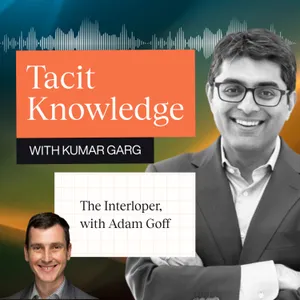
The Interloper with Adam Goff
NOV 13, 202634 MIN
Description
In this episode, host Kumar talks to Adam Goff, Director of Origination at Renaissance Philanthropy. Adam is a self-described dilettante with a polymath’s nose for big-if-true opportunities, who keeps digging until he finds areas that are high leverage and under-explored.
Adam talks about cardiovascular disease as the single largest cause of death, cheap and proven fixes like adding potassium to salt and breeding more nutritious crops, and why the world is fundamentally slow at moving on opportunities. He dives into how an interloper operates in the gaps left by experts’ constraints, and how he has used AI agents to industrialize the search for big and easy ideas.
Adam reflects on the lessons that shape his approach: work for incredible people early on, build on strengths, find what compounds over time, and ask good questions that turn expert lectures into joint problem solving.
*Tacit Knowledge *
Hosted by Kumar Garg
Presented by Renaissance Philanthropy
Subscribe to our Substack
Produced by All Together Now
KEY QUESTIONS AND TAKEAWAYS
What does a Director of Origination at Renaissance Philanthropy actually do?
Adam Goff helps design and develop new thesis-driven philanthropic funds — scanning a huge range of topics to find problems that are both big in scale and genuinely tractable, then building the case for a fund around them.
What is Adam's pitch for an overlooked cardiovascular disease intervention?
Cardiovascular disease causes over a quarter of all deaths globally, yet some of the cheapest ways to reduce it — like reformulating salt to include more potassium relative to sodium — get far less attention than infectious disease research or novel drug development, despite proven philanthropic playbooks (fortification, crop breeding) that already exist to deliver them.
Is there real evidence that a salt substitute reduces deaths?
Yes. The Salt Substitute and Stroke Study (SSaSS), a large randomized controlled trial in rural China, found that replacing regular salt with a reduced-sodium, potassium-added substitute reduced stroke risk by about 14%, major cardiovascular events by about 13%, and death by about 12%, with no increase in serious adverse events.
Why would a solution this well-evidenced still be neglected?
Adam points to a structural "silo problem": the people positioned to act — doctors, RCT researchers, mechanism scientists — don't see commercializing or scaling food fortification as their job. He argues the world is fundamentally slow to act even on fixes we know work, meaning tens of millions of preventable deaths can occur in the gap between proof and adoption.
What is the "big and easy" framework Adam uses to find opportunities?
A filtering approach that scans across many problems for ones that are both high-impact ("big") and genuinely tractable ("easy") rather than politically or technically intractable — distinguishing real opportunities, like fixing salt composition, from ones that only look simple, like a carbon tax.
How does Adam use AI in this process?
AI lets him systematize searches that used to depend on personal intuition and scattered reading — for example, running parallel research agents across millions of nutrition papers to flag which interventions are proven, how many people would benefit, and what the next step would be — freeing up his limited hours for direct conversations with experts.
What is the "interloper" role Adam describes playing?
Acting as a connective, non-expert integrator across philanthropy, nonprofits, universities, and companies — gaps that exist because, unlike in markets, there's no built-in financial incentive pushing someone to coordinate across those silos and speed up adoption of what already works.
What historical example does Adam cite for compressing timelines on hard problems?
Dan Wattendorf's 2011 pitch to DARPA asking whether a vaccine could be built in under a year — work that became DARPA's ADEPT program and fed into the rapid development pathway later used for mRNA Covid-19 vaccines.
On mentorship, reading, and asking better questions
Adam credits his early career at the ClearPath Foundation, working alongside founder Jay Faison and executive director Rich Powell, with teaching him the practical mechanics of policy and advocacy — and says he only later realized how unusually effective that environment was.
His advice on good questions: get on "we-framing" footing with an expert rather than interviewing them, let them talk to you as a peer even though you aren't one, then specifically probe what would change if their real-world constraints — money, people, regulation — were removed.
He holds two things as simultaneously true: the more you learn about any system, the more you realize how little is actually understood, and you should still act under that uncertainty rather than being paralyzed by it — because areas with the most uncertainty often carry the largest upside if they work.
On compounding: he treats both reading broadly (even outside your field) and building custom tools as investments that compound over time, and says building personal AI tools has become easy enough now that technical background isn't required.
Special Guest: Adam Goff.
Links:
Adam Goff
— Director of Origination at Renaissance Philanthropy, where he researches and designs new thesis-driven philanthropic funds.
Renaissance Philanthropy
— The organization presenting the Tacit Knowledge podcast, where Adam leads origination work on new funds.
All Together Now
— The content studio and production company who developed and produces Tacit Knowledge.
ClearPath Foundation
— A conservative clean-energy policy nonprofit founded by Jay Faison, where Adam worked early in his career alongside founding executive director Rich Powell.
Jay Faison
— Technology entrepreneur and founder of the ClearPath Foundation, which advances free-market clean energy policy.
Rich Powell
— ClearPath's founding executive director (later CEO), where Adam worked early in his career; he later became CEO of the Clean Energy Buyers Association.
Salt Substitute and Stroke Study (SSaSS)
— A large randomized controlled trial in rural China finding that a reduced-sodium, potassium-added salt substitute significantly cut stroke, major cardiovascular events, and death — the evidence base behind Adam's cardiovascular disease pitch.
Jennifer Doudna
— Biochemist and co-inventor of CRISPR gene-editing technology, which Adam cites as a tool that could make crop breeding for nutrition more targeted.
Dan Wattendorf
— Clinical geneticist and DARPA program manager who, in 2011, proposed building a vaccine in under a year — work that became DARPA's ADEPT program and influenced the rapid mRNA vaccine development pathway used during Covid-19.
RCT (Randomized Controlled Trial)
— A study design in which participants are randomly assigned to an intervention or control group to test whether an effect is real rather than coincidental; the "gold standard" evidence type Adam and Kumar reference throughout the episode (e.g., the SSaSS salt substitute trial).