



Back Hurts Standing But Not Walking? This Pain Pattern Changes EVERYTHING
OCT 8, 20268 MIN
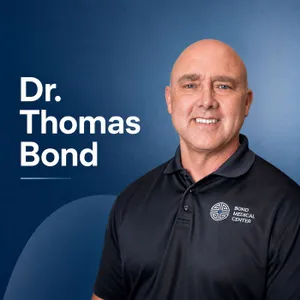
Description
📌 Learn more about IROM procedures at https://www.BondMedicalCenter.com
Your back feels fine while you walk, shop, or cut the grass. Then you stand still for five minutes and the pain hits hard, right between your shoulder blades or low in your spine. That is not random, and it is not in your head. There is a specific mechanical reason your spine behaves this way, and most doctors never explain it.
In this episode, I'm going to explain why standing still can trigger back pain even when movement does not, and what this pain pattern reveals about spinal instability.
TIMESTAMPS
0:00 Why standing still hurts more than walking
0:36 Meet Dr. Tommy Bond
1:06 What your muscles do every time you move
2:12 Why your spine needs stabilizing muscles
3:03 The cocktail party syndrome explained
4:12 Why doctors dismiss this pain pattern
5:33 What this pattern says about instability
6:14 Why MRI misses this problem
7:03 Flexion extension X-rays explained
7:52 When instability becomes a surgical problem
QUESTIONS ANSWERED
Why does my back hurt when standing still but not when walking?
Walking uses repeated muscle contractions that actively stabilize an unstable spinal segment, bracing it with every step. Standing still removes that dynamic support, so gravity slowly pulls the loose segment out of position until the surrounding tissue signals pain.
Can an MRI detect this type of back instability?
Usually not, because an MRI is taken lying down, which eliminates gravity's pull and lets an unstable segment settle back into a normal looking position. Flexion and extension X-rays taken while standing and bending are far better at catching this kind of slippage because they capture the spine under real load.
What is spondylolisthesis and how does it relate to this pain pattern?
Spondylolisthesis means one vertebra has slipped forward or backward compared to the one next to it, and it is graded one through five based on how far it has moved. Lower grades often respond to stabilization and regenerative treatment, while higher grades can eventually require surgical fusion if the instability keeps worsening.
RESOURCES
Website: https://www.BondMedicalCenter.com
🔔 If this helped you understand your MRI report, subscribe for more episodes on spinal pain, orthopedic pain, and regenerative alternatives to surgery.
ABOUT DR. THOMAS BOND
Dr. Thomas Bond, MD, MS, is a board certified sports medicine and regenerative medicine physician with over 20 years of experience treating chronic back, neck, and joint pain. After being told he needed multi level spinal fusions himself, he sought out alternatives and became one of the first five physicians in the Regenexx Physician Network. He was the first physician in Louisiana to perform ultrasound guided PRP and BMAC procedures, has treated over 100,000 patients, and has trained physicians in a dozen countries across three continents. He created the IROM (Interventional Regenerative Orthopedic Medicine) approach to help patients heal and avoid unnecessary surgery whenever possible.
#DegenerativeDiscDisease #BackPainRelief #RegenerativeMedicine #SpineHealth #AvoidSurgery