The British Broadcasting Century with Paul Kerensa

Paul Kerensa

Details

100 Years of the BBC, Radio and Life as We Know It. Be informed, educated and entertained by the amazing true story of radio’s forgotten pioneers. With host Paul Kerensa, great guests and rare archive from broadcasting’s golden era. Original music by Will Farmer. www.paulkerensa.com/oldradio

Recent Episodes

NOV 15, 2026
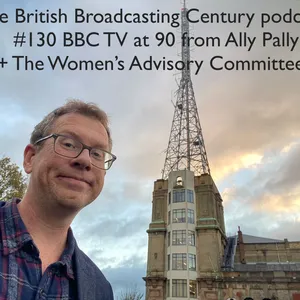
#130 BBC TV at 90 from Ally Pally + The Women's Advisory Committee
#130 BBC TV at 90 from Ally Pally + The Women's Advisory Committee 2 November 1936: Television comes to Alexandra Palace, and the BBC launch the world's first 'high definition' television service. I was at Ally Pally for the big birthday (with a bigger one to come in ten years), as was our guest: archivist for the Alexandra Palace Television Society, Simon Vaughan. + 7-14 December 1923: In our moment-by-moment timeline, back in the days of wireless: comedian John Henry recalls his first moment meeting the microphone... the Women's Advisory Committee is launched (and Dr Kate Murphy tells us all about it)... and the BBC advertises in a magazine - the licence fee: treat yourself this Christmas! We feature two top tunes from covers album The Next Programme Follows Shortly by Gavin Sutherland and The Fast Tunes Orchestra: 'Here's Looking at You' (first song on experimental television, August 1936) and 'Television' (from the first night at Alexandra Palace, 2 November 1936) - both sung here by Mandy Dunstall. Details below of how to get the full fantastic album. SHOWNOTES: Simon Vaughan has recently uploaded these 3 videos, containing pretty much all the pre-war film footage of BBC television: early Alexandra Palace/BBC Television footage by John Bliss, Television of the 1930s & 40s from lighting master Desmond Campbell, and early footage from D.H. Munro. It's new, and it's old, and it's well worth your time. Dr Kate Murphy's books are Behind the Wireless: A History of Early Women at the BBC and Hilda Matheson: A Life of Secrets and Broadcasts (affiliate links - I might get a shiny penny if you buy through them) The Next Programme Follows Shortly is the superb TV theme/ident covers album by Gavin Sutherland and The Fast Tunes Orchestra. On Bandcamp, Apple Music etc. Thanks Andrew Barker, our Newspaper Detective, for most of the December 1923 items. Copyright belong to any of those (mostly defunct) newspapers, or whoever bought the newspaper since. This podcast is not made by today's BBC. It's just about the old BBC. I post on Substack: paulkerensa.substack.com Email the podcast at: https://paulkerensa.com/contact.php Review the podcast on Apple Podcasts etc? Thanks! Find us on BlueSky: bsky.bbcentury.social Join Paul's mailing list Paul's show is on old radio is on tour and available for booking - book it!: paulkerensa.com/tour Original podcast music is by Will Farmer. Unoriginal music is by someone else. Soon: A talk on the origins of the BBC at Guildford Institute: https://www.guildford-institute.org.uk/event/from-the-pips-to-the-proms-how-the-bbc-began-t425/ Support us on Patreon? £5/mth, and get extra videos, writings, readings etc: patreon.com/paulkerensa - thanks! Or support this project with a one-off tip: ko-fi.com/paulkerensa - thanks too! Please share/rate/review this podcast if you like - it all helps. Next time, Episode 131: The First Christmas Radio Times. More on this broadcasting history project at paulkerensa.com/oldradio
48 MIN
OCT 30, 2026
#129 Orson Welles' War of the Worlds and a 1930s BBC Ghost Story
30 October 1938 - 88 years ago precisely before this podcast lands - something else landed too, according to Orson Welles. US radio listeners were terrified as his adaptation of HG Wells' War of the Worlds brought Martians to American ears, via fake news reports and other immersive drama. But how terrified were they, and had they heard the show? Our guest Dr A Brad Schwartz is author of Broadcast Hysteria: Orson Welles's War of the Worlds and the Art of Fake News (Hill and Wang, 2015), shining a new light on one of the most famous moments of radio history - but perhaps one of the most misunderstood? Oh but it does mean that for one episode only, we jump the Atlantic, so The British Broadcasting Century becomes The American Broadcasting Century. We even look at the next moment of our chronological timeline - December 1923 - by seeing what American radio was up to then, with the first presidential address via radio thanks to Calvin Coolidge. And the spooky season seemed the perfect time to tell you a ghost story that we've been sitting on for some time. Not read out on air (that we know), but a personal reminiscence from a 1930s BBC announcer, this is Uncle Ajax (TCL Farrar) recounting a strange encounter while introducing the BBC Symphony Orchestra from the pre-Maida Vala home at No 10, Big Tree Wharf. Thanks for this to Carina Saner, great-granddaughter of first radio dramatist Phyllis Twigg. Phyllis met Ajax at a function post-WW2, and he told her this tale then gave her a copy of it, which gladly Carina found in Phyllis' shoebox of correspondence. (Look out for a biography of Phyllis Twigg by Carina and myself, coming soon!) I'll post Ajax's text to Substack soon - link below. Copyright is certainly not mine, and will belong to the estate of TCL Farrar - whoever they may be! Farrar family: get in touch if you like, especially if you have issues with us using this... but what a tale. So thank you, without reaching you. SHOWNOTES: Brad's book Broadcast Hysteria: Orson Welles's War of the Worlds and the Art of Fake News is a great read, or listen on Audible. (That's an affiliate link, you click, you buy, I get a shiny sixpence or something) Hear the entire War of the Worlds broadcast from 30 Oct 1938 Witness History on BBC Sounds - Orson Welles broadcasts The War of the Worlds Read on Substack, soon, the text of Ajax's ghost story: paulkerensa.substack.com More on the BBC's (haunted?) studio at No 10, Big Tree Wharf Email the podcast at: https://paulkerensa.com/contact.php Review the podcast on Apple Podcasts etc? Thanks! Find us on BlueSky: bsky.bbcentury.social Join Paul's mailing list Paul's show is on old radio is on tour and available for booking - book it!: paulkerensa.com/tour This podcast is not made by today's BBC. It's just about the old BBC. Any clips from War of the Worlds are copyright CBS Radio Network, and used minimally as a fair use excerpt. Or something like that. Original podcast music is by Will Farmer. Unoriginal music is by someone else. Soon: A talk on the origins of the BBC at Guildford Institute: https://www.guildford-institute.org.uk/event/from-the-pips-to-the-proms-how-the-bbc-began-t425/ Support us on Patreon? £5/mth, and get extra videos, writings, readings etc: patreon.com/paulkerensa - thanks! Or support this project with a one-off tip: ko-fi.com/paulkerensa - thanks too! Please share/rate/review this podcast if you like - it all helps. Next time, Episode 130: BBC TV at Alexandra Palace Turns 90. More on this broadcasting history project at paulkerensa.com/oldradio
47 MIN
OCT 14, 2026
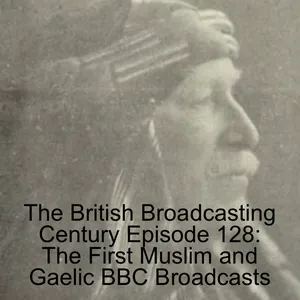
#128 The First Muslim and Gaelic BBC Broadcasts
In the first week of December 1923, the one-year-old British Broadcasting Company gave us two notable firsts, from different cultures: Its first Gaelic broadcast, and its first Muslim broadcast. Neither are widely reported, but they offer a glimpse into an early BBC that might be more diverse and eager to share different voices than it's often thought. We've done some digging, and although there are no clips, we've found a few details - including some of the text. Plus when do you think the BBC first broadcast the Muslim call to prayer? Earlier than you might think... Here in our moment-by-moment timeline, we share what we know about these landmark moments, with guest Remona Aly joining us to cast her eye over the recently rediscovered text of that earliest known broadcast about the Islamic faith. It was by high-profile Muslim convert Shaikh Rahmatullah al-Farooq, aka Lord Headley, aka Rowland George Allanson Allanson-Winn (yes, posh white British nobleman seems to have been the acceptable voice of minority religion at this point). First we meet Rev John Bain, from the High United Free Church in Aberdeen, a native Gaelic speaker from Big Sand, Gairloch, Wester Ross. He gave a 15 minute sermon in Gaelic on Sunday 2 December 1923. (It may even have been the BBC's first church service, contrary to the historical record that St Martin-in-the-Fields began such services under Rev Dick Sheppard in early 1924.) Meanwhile Wireless Weekly magazine discuss English-speaking announcers struggling to introduce songs like Mo Ribhinn Chaoimhneil. Two days later on Tuesday 4 December 1923, according to the Radio Times listing: "The Rt Hon Lord Headley, the famous Moslem Peer, will Talk on his recent experiences at Mecca." We've found a write-up in the RT of his 'Pilgrimage to Mecca' - enlightening about the man himself and his travels, as guest of King Hussein of Hejaz. See the show notes below to read the full text, and hear some of it on the podcast. And hear of other early Muslim BBC broadcasts, including the 'Call from the Minaret' in July 1925 and a reading from the Qur'an ten years later. Journalist and broadcaster Remona Aly guides us through his experiences and gives her thoughts on reconnecting with a century-old tale of the Hajj pilgrimage. And we have a bit of a chuckle at how he kept fumbling his Magic Lantern show at his live events - yes, the Powerpoint fail of 1923. Oh indeed, the early BBC wasn't all Christian sermons - whether in English or in Gaelic... Plus we pay tribute to broadcast historian Tony Currie and TV presenter Dame Esther Rantzen, daughter of Harry... Who? Hear more here. Plus a newly uploaded gramophone record parodying the early BBC, Paul's PhD is underway at Loughborough University, and we've been nominated for Best History Podcast at the Independent Podcast Awards. Aw, thanks! SHOWNOTES: The text of that first Muslim broadcast, as published in the Radio Times on 18 April 1924, can be seen on our Facebook page. Richard Jeffrey-Gray, aka Hoxa on Youtube, has polished and uploaded to Youtube 'London and Daventry Calling, 1926' by The Savoy Orpheans with Norman Long. We play a little on the podcast, and find the rest online. Email the podcast at: https://paulkerensa.com/contact.php Review the podcast on Apple Podcasts etc? Thanks! Read free posts on Substack: paulkerensa.substack.com Find us on BlueSky: bsky.bbcentury.social Join Paul's mailing list Paul's show is on old radio is on tour and available for booking - book it!: paulkerensa.com/tour This podcast is not made by today's BBC. It's just about the old BBC. Original podcast music is by Will Farmer. Support us on Patreon? £5/mth, and get extra videos, writings, readings etc: patreon.com/paulkerensa - thanks! Or support this project with a one-off tip: ko-fi.com/paulkerensa - thanks too! Please share/rate/review this podcast if you like - it all helps. Next time, Episode 129: Orson Welles' War of the Worlds broadcast + an early BBC ghost sto

41 MIN
SEP 15, 2026
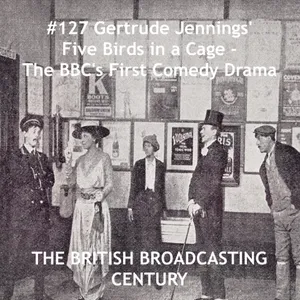
#127 Gertrude Jennings' Five Birds in a Cage - The BBC's First Comedy Drama
The BBC's first: in-house drama for adults non-Shakespeare drama comedy drama studio production of a modern stage play drama to be reviewed on air writer to be on two channels at once ...however you phrase it, Gertrude Jennings' Five Birds in a Cage deserves far more attention than it's had for the past century and a bit. In our moment-by-moment British broadcasting timeline it's 29 November 1923 when the BBC set the template for the modern radioplay with this adaptation of Jennings' satirical stageplay about five Tube passengers trapped in a lift. Will they get out? Will they throttle each other first? What does it have in common with Blackadder Goes Forth? The BBC had broadcast a drama aimed at children (The Truth about Father Christmas by Phyllis Twigg - see episode 72 of this podcast), some Shakespeare plays (see episode 55 of this podcast), an excerpt of GK Chesterton and the occasional on-location panto. But the in-house modern radio drama was a new idea. Although Richard Hughes' A Comedy of Danger from 1924 is credited as the first original radio play for adults, Five Birds in a Cage was an impressive adaptation of Gertrude Jennings' 1915 stage play of the same name - and it was reviewed on air too. In this episode, three experts bring you everything you never knew you needed to know about Jennings and her work. Professor Tim Crook is Emeritus Professor at Goldsmiths University of London, and author of Writing Audio Drama among many other books, as well as the superb blog at kulturapress.com. Nicola Morgan and Dr Caroline Rance host the excellent and vital She Wrote Too podcast, elevating and amplifying under-appreciated female writers from the early twentieth century. Plus hear that first review of a radio play by Archibald Haddon the first BBC drama critic. We tell of other forgotten radio drama moments, including Howard Rose's recollections of a dramatic broadcast on 2 September 1922, pre-BBC. And you'll hear Peter Eckersley and Rolls Wynn on their Cyrano de Bergerac broadcast from 17 October 1922. Plus the bizarre quirk that makes her the first writer to have two different productions on two different channels at the same time... for five minutes anyway. Gertrude Jennings wrote quite a play - a social satire, a farce, a character comedy, with sound effects and a point to make. We're delighted to shout about it here - and see our shownotes below for She Wrote Too's podcast about her too, as well as Tim Crook's writing about her and other forgotten female writers. SHOWNOTES: She Wrote Too podcast on Gertrude Jennings: https://shewrotetoo.substack.com/p/five-birds-in-a-cage Tim Crook's blog about Gertrude Jennings: https://kulturapress.com/2022/08/10/gertrude-e-jennings-bbcs-pioneering-one-act-playwright/ Tim Crook's academic article 'Rewriting the Beginning of BBC Audio Drama History- Three Women Playwrights and Their Contribution to British Radio Drama Culture': https://www.tandfonline.com/doi/full/10.1080/19376529.2023.2257184 Sutton Elms website on Howard Rose: https://www.suttonelms.org.uk/dspenser9.html Alan Beck's 'The Invisible Play' on Gertrude Jennings: https://www.savoyhill.co.uk/invisibleplay/body/3a1.html (some of his website is missing/broken - help in finding the missing pages would be appreciated!) Listen to The Truth about Phyllis Twigg on BBC Sounds: https://www.bbc.co.uk/sounds/play/m002ntmx Catch out first interview with Tim Crook, on Phyllis Twigg, on episode 72 of this podcast: https://bbcentury.podbean.com/e/the-first-radio-dramatist-the-truth-about-phyllis-twigg/ Email the podcast at: https://paulkerensa.com/contact.php Review the podcast on Apple Podcasts etc? Thanks! Our latest Substack is on: What have BBC promos ever done for us?... paulkerensa.substack.com Find us on BlueSky: bsky.bbcentury.social Join Paul's mailing list Paul's show is on old radio is on tour and available for booking - book it!: paulkerensa.com/tour This podcast is not made by today's BBC. It's just abo
46 MIN
AUG 22, 2026
#126 The BBC Goes Transatlantic… and Shortwave Radio
26 November-2 December 1923, and the BBC and the USA had a little conversation. Well, a big conversation, across an ocean, across a week, heard by listeners east and west of the Atlantic. Our moment-by-moment timeline of British broadcasting has reached this momentous moment (aren't all moments momentous?) when British ears heard America, and American ears heard Britain, via radio. It was all Radio Broadcast magazine's fault/idea. Its co-owner, Frank Doubleday of Doubleday, Page and Co, thought it would be nice for the two countries to hear each via some organised tests - and while US radio had reached the UK, the time difference made it trickier for the signals to be heard the other way around. It meant BBC staff setting their alarms for a few days of 3am broadcasts, and Biggin Hill Aerodrome proved the ideal place for the engineers to pick up what America was sending. So this episode comes live (well, recorded) from Biggin Hill Aerodrome. You can even hear the odd plane. It was here that BBC Deputy Chief Engineer Captain West and team listened for US radio - and ate Mrs West's fried sausages. Oh yes, we bring you all the details, including Reith and Eckersley singing God Save the King... ...and we bring you a guest: BBC producer and presenter Josephine McDermott has made an Archive on 4 documentary on international shortwave radio - The Sound of Soft Power. Link below, have a listen, and hear her tell us of the joy of finding such archive. A second part of the 1923 experiments came after Christmas that year, so a second part of this story will be on the podcast in a few episodes time - around ep 132, when Prof Simon J Potter will enlighten us on the BBC's global reach, linked to the Pittsburgh and Paris broadcasts heard on the BBC in late 1923. SHOWNOTES: Hear Josephine McDermott's Radio 4 documentaries for Archive on 4: The Sound of Soft Power - https://www.bbc.co.uk/programmes/m002wskb - and https://www.bbc.co.uk/programmes/m0026tw0 Research this episode is thanks to a variety of places, inc. Andrew Barker our Newspaper Detective (see his daily posts on our Facebook group), Thomas H white's website https://earlyradiohistory.us/, Myles Eckersley's book Prospero's Wireless, and Edward Pawley's book BBC Engineering 1922-1972. Email the show at: https://paulkerensa.com/contact.php Review the show on Apple Podcasts etc? Thanks! Our latest Substack is on: What have BBC promos ever done for us?... paulkerensa.substack.com Find us on BlueSky: bsky.bbcentury.social Join Paul's mailing list Paul's show is An Evening of (Very) Old Radio: The BBC Then and Now - and in late 2026 it plays Gloucester, Hartley Wintney and more: paulkerensa.com/tour This podcast is not made by today's BBC. It's just about the old BBC. Original podcast music is by Will Farmer. Support us on Patreon? £5/mth, and get extra videos, writings, readings etc: patreon.com/paulkerensa - thanks! Or support this project with a one-off tip: ko-fi.com/paulkerensa - thanks too! Please share/rate/review this podcast if you like - it all helps. Next time, Episode 127: Early radio drama from Gertrude Jennings. More on this broadcasting history project at paulkerensa.com/oldradio
49 MIN