



The Crude Truth
The Crude Truth
Jeff Krimmel Explains Rising Diesel Prices, $100 Oil & the Future of U.S. Energy
NOV 20, 202626 MIN
Description
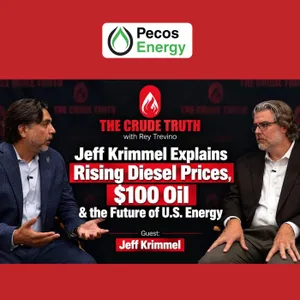
In this episode of "The Crude Truth," host Rey Trevino sits down with Jeff Krimmel, founder of Krimmel Strategy Group and energy market analyst, to unpack the turbulent global energy landscape of early 2026. With crude oil hovering around $100 per barrel and diesel prices reaching record highs, the conversation explores the disconnect between paper prices and what consumers actually pay at the pump. From geopolitical flashpoints in Iran and Ukraine to Venezuela's re-emergence as a major oil player, from OPEC's fracturing alliance to America's outsized role in stabilizing global energy markets, Krimmel and Trevino dissect the complex web of supply chains, refining constraints, and capital discipline that define today's energy economy—and what it means for investors, operators, and energy security worldwide.
Connect with Jeff on his LinkedIn: https://www.linkedin.com/in/jeffkrimmel/
1. Current Oil Market Dynamics & Pricing
The podcast opens with discussion of oil prices hovering around $100+ per barrel for the second week under President Trump's administration. A key insight is that while crude oil is at $100, fuel prices (especially diesel) feel much higher due to historically wide crack spreads (the difference between crude oil prices and refined product prices). This disconnect means downstream consumers feel more pain than upstream producers.
2. Geopolitical Tensions & Supply Disruptions
Multiple conflicts are impacting global energy markets:
Iran conflict: Affecting tanker insurance costs and shipping routes, with tankers charging $35-40 premiums per barrel
Ukraine-Russia war: Specifically, the debate over Ukraine bombing Russian refineries and its impact on global diesel supply
Strait of Hormuz: While never officially closed, insurance costs made transit prohibitively expensive, forcing trade flows to reroute through alternative pathways
3. Capital Discipline in the Energy Industry
Unlike the 2015-16 boom when companies aggressively drilled to grow, today's operators (majors like Exxon and independents like Pecos) are exercising strategic capital discipline—sticking to planned budgets rather than ramping up spending during price spikes, knowing the market is cyclical.
4. Venezuela's Oil Potential & Geopolitical Shift
The administration is encouraging investment in Venezuela's vast oil reserves. Chevron, already with a footprint there, is positioned to move more aggressively. The key question is whether E&Ps will commit capital long-term and whether service companies will deploy their best personnel for the rejuvenation work needed.
5. U.S. Oil Dominance & Energy Security
A critical finding: The U.S. is responsible for ~75% of global oil production growth since 2019. Without U.S. production, oil prices would likely be $150-200+ per barrel. U.S. oil offers predictability and energy security that geopolitically unstable regions cannot, making it increasingly valuable.
6. OPEC's Fragmentation
The traditional OPEC alliance is weakening—UAE and Qatar are considering leaving, Iraq has flirted with departure, and Venezuela (a founding member) is now aligning more with the U.S. This shift strengthens American oil's position globally.
7. Refining Capacity & Diesel Crisis
U.S. refineries are operating at 98-100% capacity. The diesel shortage is acute because:
Refineries are already maximizing diesel production over gasoline due to higher crack spreads
The Defense Production Act might be needed to compel new capacity online
Producing more diesel would push gasoline prices higher—a complex trade-off
8. Investment Thesis for U.S. Oil & Gas
Despite Venezuela coming online, investing in U.S. oil remains attractive because of capital discipline, long-term investor confidence, and the industry's commitment to sustainable returns over 3-10 year horizons rather than short-term price spikes.
Subscribe to The Crude Truth for more conversations about energy, business, technology, and the future of Texas. https://pecoscrudetruth.substack.com/
For More information on Tax-Advantaged Investments: https://pecos.energy/info/
Check out LFS Chemistry, sponsor of the Crude Truth, here: https://lfschemistry.com/
Air Compressor Solutions https://acsir.com/
Follow Rey on his LinkedIn: https://www.linkedin.com/in/reytrevinoiii/
Also, Pecos Operating Website:https://pecos.energy/