


We need poets in the era of AI with Lucio Lamberti
NOV 3, 202638 MIN
Description
In this episode of The Curiosity Current, Stephanie Vance and Molly Strawn-Carreño sit down with Lucio Lamberti, Full Professor at Politecnico di Milano, to explore the relationship between neuroscience, consumer behavior, marketing, and artificial intelligence. Drawing on his work across marketing, analytics, UX, and immersive technology, Lucio challenges the traditional view of the brain as a reactive system, explaining why human perception is shaped by expectations and how this changes the way researchers should think about attention, advertising, and consumer experience.
Lucio introduces the idea of the predictive brain, which continually anticipates what will happen next and checks incoming information against existing expectations. Through schema congruency theory, he explains why experiences that challenge our expectations can encourage learning and memory, provided the difference is not so great that it becomes difficult to understand. He also explores how AI could change consumer behavior through four possible scenarios: brand flattening, selective focus, hyper-personalization, and extreme “experientialization”. As consumers delegate more decisions to AI, brands may need to rethink how they differentiate themselves and create experiences that remain meaningful.
The conversation also examines what neuroscience can add to traditional self-reported research. Lucio explains how physiological measurements can capture responses over time, while cautioning that signals from EEG or skin conductance do not directly reveal a person's emotions. He challenges researchers to reconsider the say-do gap, arguing that contradictions between reported attitudes and observed behavior may reflect poorly designed questions, social desirability, or post-hoc rationalization rather than dishonesty. Finally, he explains why prediction without understanding leaves researchers unable to identify the changes that could influence behavior, adapt when circumstances change, or distinguish correlation from causation. His closing message is that as AI becomes more capable, researchers must continue observing people, asking why, and drawing inspiration from the humanities.
What You’ll Learn:
Why the human brain is predictive rather than simply reactive, and how expectations shape perception and attention
How schema congruency theory explains why appropriately challenging expectations can encourage learning and memory
The four scenarios Lucio identifies for consumer behavior as AI takes on more purchasing decisions
Why brand differentiation depends on business models and customer experiences, not just product categories
How applied neuroscience can complement self-reported research through measurements collected throughout an experience
Why neuroscience measurements must be interpreted carefully rather than treated as direct evidence of emotions
How ambiguous questions, social desirability, and post-hoc rationalization can contribute to the say-do gap
Why contradictions in research can be valuable sources of insight rather than data to discard
Why prediction alone cannot explain the causes of behavior or identify the levers needed to change it
Why human observation, critical thinking, and insights from poetry and philosophy remain valuable in an AI-driven world
About the Guest:
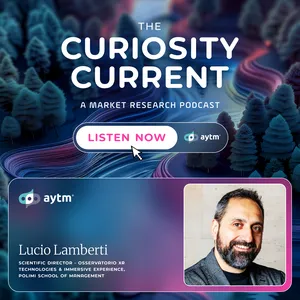
Lucio Lamberti is a Scientific Director - Osservatorio XR Technologies & Immersive Experience at POLIMI School of Management. His work combines marketing analytics, consumer behavior, user experience, immersive technology, and applied neuroscience. With an engineering background, he brings an interdisciplinary perspective to understanding how people perceive, experience, and respond to products, advertising, and emerging technologies. His research explores the psychological mechanisms behind consumer decisions, the use of neuroscience to complement traditional market research, and the implications of AI for consumer behavior and brand strategy. In this conversation, Lucio explains why understanding human behavior requires more than predictive models, why researchers should approach neuroscience claims with scientific rigor, and why keeping people at the center of technological progress is essential.
Episode Resources:
Lucio Lamberti on LinkedIn
POLIMI School of Management Website
Stephanie Vance on LinkedIn
Molly Strawn-Carreño on LinkedIn
The Curiosity Current: A Market Research Podcast on Apple Podcasts
The Curiosity Current: A Market Research Podcast on Spotify
The Curiosity Current: A Market Research Podcast on YouTube
The Curiosity Current: A Market Research Podcast is handcrafted by our friends over at: fame.so