



The FAKTR Podcast
Jessica Riddle, Todd Riddle
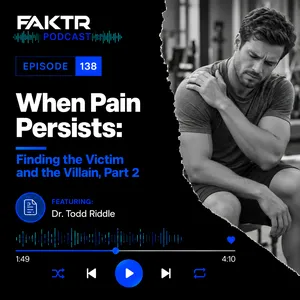
Episode 138 - When Pain Persists: Finding the Victim and the Villain with Dr. Todd Riddle, Part 2
NOV 13, 202619 MIN
Description
Why do some patients continue experiencing pain long after an injury should have healed? And why can seemingly minor movements or stimuli trigger significant discomfort, even when structural findings don't fully explain the symptoms?
For healthcare providers treating persistent musculoskeletal pain, these questions can present some of the greatest challenges in clinical practice.
In Part 2 of our series, FAKTR Director of Education Dr. Todd Riddle takes us deeper into the science of pain, exploring central sensitization and the complex relationship between the nervous system, pain perception, and patient recovery.
Building on the biopsychosocial framework introduced in Part 1, Dr. Riddle examines how changes in nervous system processing can contribute to heightened pain sensitivity, why pain intensity doesn't always correlate directly with tissue damage, and how these mechanisms can influence a patient's response to treatment.
In This Episode, You'll Learn:
Understanding central sensitization: How increased sensitivity within the central nervous system can contribute to persistent or amplified pain.
Pain versus tissue damage: Why the intensity of a patient's symptoms doesn't always correspond directly to the extent of structural injury.
The relationship between pain and movement: How fear, protective behaviors, and changes in activity can contribute to ongoing challenges during recovery.
Recognizing complex pain presentations: Why persistent symptoms may require clinicians to reconsider their initial assessment and treatment strategies.
Knowing when to refer: How recognizing psychological and other contributing factors can help clinicians determine when additional professional support may be appropriate.
The Clinical Takeaway→ Don't stop at identifying where it hurts. Ask why it hurts.
When patients experience persistent or disproportionate pain, focusing exclusively on the site of symptoms may overlook important contributing factors.
Understanding the role of nervous system sensitization can help clinicians develop more informed clinical hypotheses, communicate more effectively with patients, and recognize when an individualized or multidisciplinary approach may be beneficial.
Resources Mentioned:
Dr. Riddle references the work of pain science educators and researchers whose contributions have helped advance our understanding of pain processing, central sensitization, and rehabilitation.
Explain Pain — David Butler and Lorimer Moseley. An educational resource exploring pain neuroscience and how understanding pain can support patient education and rehabilitation.
Graded Motor Imagery Handbook— G. Lorimer Moseley, David Butler, Timothy Beames, and Thomas Giles. A resource examining graded motor imagery approaches used in selected complex and persistent pain presentations.
A World of Hurt - A Guide to Classifying Pain – Annie O’Connor and Melissa C. Kolski
A practical, evidence-informed guide to understanding and treating persistent pain through pain neuroscience education, graded exposure, and strategies that address the complex relationship between the nervous system, movement, and pain.
🔗 SPECIAL OFFERS FROM OUR SPONSORS:
Try a five-day welcome kit from our sponsor Immunotec here: https://tinyurl.com/ep137-immunotec
This episode is sponsored by Genetic Lifespan. Learn more about how to become a healthcare provider here: https://tinyurl.com/ep137-GLP
🎙️ SUPPORT THE SHOW: Visit our website at faktrpodcast.com to leave a review or comment.