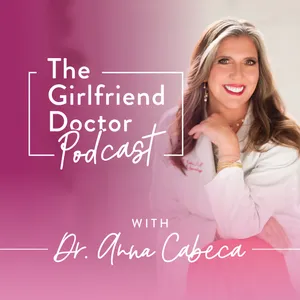
The Girlfriend Doctor w/ Dr. Anna Cabeca

Dr. Anna Cabeca OB/GYN

Details

Dr. Anna Cabeca is America's top menopause doctor. Known most widely as The Girlfriend Doctor, Dr. Anna is the first call for the woman who has questions she would only ask her best girlfriend if her girlfriend were a triple-board-certified OB-GYN. This top health podcast is all about helping women live better lives — before, during, and after menopause.

Recent Episodes

OCT 22, 2026
A Harvard Doctor on the Menopause Education Gap and How to Advocate for Yourself | Dr. Deborah Kwolek
You finally get the appointment. You tell your doctor you're not sleeping, the weight is climbing, and your moods feel like someone else's. You walk out with a prescription for an antidepressant, or with nothing at all. Dr. Deborah Kwolek, assistant professor of medicine at Harvard Medical School and director of Harvard's Women's Health and Menopause course, joins me to talk about why so many doctors were never taught menopause care and what she's doing to change it. We cover the exact questions to bring to your next appointment, your estrogen by the numbers, the labs to know, who may need to think harder about hormone therapy, and what to do when your doctor says, "I don't believe in hormones." Key Timestamps: 00:00 - Meet Dr. Deborah Kwolek 02:48 - Why Harvard had no menopause course 07:00 - Why most doctors were never trained in menopause 08:10 - Is the fear of hormone therapy out of proportion? 11:23 - 3 questions to ask your doctor 17:35 - Your estrogen levels, by the numbers 25:15 - Can you stay on hormones after 65? 33:46 - Who should think twice about hormone therapy? 50:08 - What to do when your doctor says no Memorable Quotes: "The fear among the providers and the fear among the patients. That's really out of proportion to the data." – Dr. Deborah Kwolek "You don't say that about anything else. I don't believe in statin drugs." – Dr. Deborah Kwolek "Almost every cell has estrogen receptors." – Dr. Deborah Kwolek "We don't stop someone's insulin at sixty-five. We don't stop their thyroid hormone at sixty-five. Where did that come from?" – Dr. Anna Cabeca "It's not hard. It's just unfamiliar." – Dr. Anna Cabeca "Your body is always speaking to you. Listen with curiosity, not criticism." – Dr. Anna Cabeca Connect With Guest: LinkedIn: http://www.linkedin.com/in/dkwolekmd Harvard Women's Health and Menopause course (for clinicians): https://learn.hms.harvard.edu/programs/primary-care-medicine Mass General Brigham: https://www.massgeneralbrigham.org/en/doctors/k/deborah-kwolek-3001790 Connect With Dr. Anna: Website: Dranna.comInstagram: https://www.instagram.com/thegirlfrienddoctor/ YouTube: https://www.youtube.com/@thegirlfrienddoctor TikTok: https://www.tiktok.com/@drannacabeca Facebook: https://www.facebook.com/thegirlfrienddoctor This episode is for educational purposes only and is not medical advice. Talk with your healthcare provider before making changes to your medications, supplements, or hormone therapy. Guest views are her own.
54 MIN
OCT 15, 2026
Brain Defenders: How Hormones and Metabolism Shape Your Brain's Future | Dr. David Perlmutter
Your brain has its own immune cells, and the way you live each day helps decide whether they protect you or turn on you. Two-thirds of Americans living with Alzheimer's are women. Living longer doesn't explain that gap, girlfriend. So what does? I'm so happy to welcome back my dear friend Dr. David Perlmutter, board-certified neurologist and author of the New York Times bestseller Brain Defenders. He explains microglia, the immune cells that make up about 10% of your brain. On a good day, they're like firefighters in the firehouse, quietly repairing the blood-brain barrier and helping your brain build new connections. Under pressure from high blood sugar or inflammation, they can flip into what he calls the evil twin. Dr. Perlmutter walks me through what happens in the brain when estradiol drops in perimenopause and menopause, and how estrogen and your mitochondria, the energy makers inside your cells, keep each other going. He makes the case for caring about metabolic health in your 30s and 40s, long before memory changes show up. He shares the labs he wants on your radar, including hemoglobin A1C, homocysteine, fasting insulin, vitamin D and the p-tau217 blood test, plus why normal isn't the same as optimal. You'll hear why carrying the APOE4 gene is a predisposition, not a destiny, and exactly where he stands on hormone therapy for women. My favorite part was how oxytocin, my Queen Mother hormone, and time with the people you love help keep your brain's immune cells in their supportive state. You get to be the architect of your brain's destiny. This conversation shows you where to start. This episode is for educational purposes only and is not medical advice. Guest views are their own. Talk with your healthcare provider before making changes to your health routine or medications. Key Timestamps 00:00 Welcome back Dr. David Perlmutter and Brain Defenders 05:25 How blood sugar and inflammation create the evil twin 10:25 Falling estradiol and the loss of brain connections 12:50 How mitochondria and estrogen support each other 14:50 Blood sugar and brain risk 15:55 Why brain health starts in your 30s and 40s 16:45 Common medications and brain health 18:30 The labs you can ask for 20:05 A1C and why normal isn't optimal 22:55 The p-tau217 blood test 23:40 APOE4 is a predisposition, not a destiny 31:35 Oxytocin, connection and your brain's immune cells 33:20 Where Dr. Perlmutter stands on hormone therapy 38:10 Cortisol, sleep and your daily rhythm 41:35 What FSH may be telling you after menopause Memorable Quotes 1. "It's really all about agency, about each of us being the architect of our brain's destiny." — Dr. David Perlmutter 2. "Hormone imbalances and mood disorders are metabolic until proven otherwise." — Dr. Anna Cabeca 3. "It's time that we re-message what's going on with this genetic predisposition, and not a predetermination." — Dr. David Perlmutter 4. "One of the biggest threats for brain decline is isolation." — Dr. David Perlmutter 5. "Some is good. Too much is bad. The devil is in the dose." — Dr. David Perlmutter Connect With Dr. David Perlmutter Instagram: @davidperlmutter LinkedIn: David Perlmutter, MD YouTube: @DavidPerlmutterMD X: @DavidPerlmutter Facebook: David Perlmutter, MD Podcast: The Empowering Neurologist Brain Defender Link: http://braindefenders.com/ Connect With Dr. Anna Website: Dranna.com Instagram: https://www.instagram.com/thegirlfrienddoctor/ YouTube: https://www.youtube.com/@thegirlfrienddoctor TikTok: https://www.tiktok.com/@drannacabeca Facebook: https://www.facebook.com/thegirlfrienddoctor If you loved this conversation, share it with a girlfriend who's been worried about her memory, and leave us a review on Apple or Spotify. It helps more women find these conversations.
53 MIN
OCT 8, 2026
The Hidden Stress Behind Your Hormone Imbalance | Dr. Sue Morter
A divorce. A layoff. A season where you held everything together for everyone. Your body flipped into fight or flight to protect you, exactly the way it was built to. But what happens when the stress passes and your nervous system never gets the message? Bioenergetic medicine expert Dr. Sue Morter, author of The Energy Codes and The Anatomy of Awakening, explains the hidden stress your body can keep carrying for years. She shows how that old emergency ripples through your adrenals, your thyroid, and your hormones in midlife. Then she walks me through her first two steps. The wise belly breath, which helps engage the calming side of your nervous system. And pratyahara, an ancient practice for calling your energy back from the people and situations that drain you. Dr. Sue and I also get into what releasing anger means (hint, it's not dumping it on someone), how to work with a feeling without needing the whole story, and why meditation can feel impossible at first. If you've been doing everything right and still feel wired, tired, and on edge, Gorgeous, this one is for you. Key takeaways Your nervous system can stay locked in fight or flight long after a stressful event ends, because it never received the signal that the danger passed. That hidden stress keeps your adrenals pumping out cortisol, and Dr. Sue describes the thyroid stepping in to compensate until your whole hormonal system starts to roller-coaster. Your body works on a priority basis, so survival comes before repair, detox, and renewal. A slow belly breath, low first and then rising into the chest, is Dr. Sue's simplest first step for telling your body the coast is clear. Pratyahara means drawing your senses back onto yourself, so you can stay in a hard conversation without handing over your energy. Releasing anger means feeling and moving the energy in your body, not unloading it on someone else. If meditation feels impossible, build body awareness first so stillness becomes easier. Key Timestamps 01:00 Growing up with a pioneer of energy medicine 03:05 Root cause versus symptom care 05:00 The hidden stress keeping you in fight or flight 06:15 The trap door between the thalamus and hypothalamus 09:25 Step one, the belly breath 13:15 Why your belly is wise 14:15 The doorway exercise 18:20 What if you're the one who triggers someone 26:15 The two systems that run your body 31:30 What releasing anger means 40:00 When meditation feels impossible 42:30 Take it to the body practices Memorable quotes "It's doing the right thing, but it's doing it at the wrong time." Dr. Sue Morter "Work with the energy instead of the label, work with the energy instead of the story." Dr. Sue Morter "We are the CEO of our body, and the best years of our lives are not behind us. They are waiting for us." Dr. Anna Cabeca Resources mentioned The Energy Codes by Dr. Sue Morter The Anatomy of Awakening by Dr. Sue Morter Dr. Sue's courses and classes at drsuemorter.com The Girlfriend Doctor on YouTube CTA: Listen to the full conversation Connect with Dr. Sue Morter Website: www.drsuemorter.com Instagram: www.instagram.com/drsuemorter Facebook: www.facebook.com/drsuemorter Dr. Sue's Newest Book: https://www.theanatomyofawakeningbook.com/ Free Meditation Gift for listeners: https://drsmorter.com/girlfrienddr Connect with Dr. Anna Website: https://drannacabeca.com Facebook: https://www.facebook.com/DrAnnaCabeca Instagram: https://www.instagram.com/thegirlfrienddoctor YouTube: https://www.youtube.com/thegirlfrienddoctor TikTok: https://www.tiktok.com/@drannacabeca Podcast: https://drannacabeca.com/blogs/podcast Loved this one? Send it to the friend who's been running on empty, then tell me in the comments which practice you're trying first. I read every one.
53 MIN
OCT 1, 2026
What Caused Your Cancer? The Question Nobody Asked Dr. Nasha Winters
When a woman sits across from Dr. Anna after a breast cancer diagnosis, she asks one question. What did your oncologist say caused it? Almost every time, the answer is a blank stare. Dr. Nasha Winters has lived that silence from the inside. By 19, she had collected a decade of diagnoses, including PCOS, endometriosis, IBS, anxiety, and thyroid trouble. Then she landed in the ER with a grapefruit-sized tumor and was told she was too ill for treatment. In this conversation, she shares the three things she credits with changing her path. She also explains how childhood trauma can shape the immune system and why she sees the body as a garden to tend rather than a battlefield. Dr. Nasha is a naturopathic doctor and the author of The Metabolic Approach to Cancer. She walks through the ten areas of terrain she evaluates, the neutrophil-to-lymphocyte ratio hiding in a standard CBC, and her inflammation "trifecta" of CRP, sed rate, and LDH. She explains why ringing the bell after treatment is the beginning of rebuilding. She also shares the four S's she sees as common threads in breast health. Key takeaways Recurring symptoms and diagnoses can be signals worth investigating, not just labels to manage. Dr. Nasha looks at ten areas of terrain and now starts with mental and emotional health. A standard CBC can reveal your neutrophil to lymphocyte ratio. She prefers it closer to 2 to 1. She tracks CRP, sed rate, and LDH together as a picture of inflammation and metabolic health. In her view, finishing treatment is when the work of rebuilding healthy cells begins. Research links a balanced microbiome with a better response to immunotherapy. Her four S's for breast health are sugar, stress, sleep, and sex. Timestamps 00:00 The question most women are never asked 05:45 A terminal ovarian cancer diagnosis at 19 12:15 The three "accidents" she credits 17:00 Dr. Anna on the 13-hour overnight fast 19:00 The ACE score and psychoneuroimmunology 37:45 The 10 areas of terrain 44:40 The neutrophil to lymphocyte ratio 48:15 CRP, sed rate, and LDH 53:30 Why ringing the bell is the beginning 56:00 The microbiome and immunotherapy 61:30 Saliva vs. urine pH and your body's capacity 71:00 The four S's of breast health Memorable quotes "So I thought I was pre-med. Cancer had another story for me." Dr. Nasha Winters "They were trying to be a guidepost of, hey, there's something wrong here that needs our attention." Dr. Nasha Winters, on her early diagnoses "It's very simple. Test, assess, address, don't guess." Dr. Nasha Winters "What I tell folks is that's actually just the beginning." Dr. Nasha Winters, on ringing the bell after treatment "Your body is always speaking to you." Dr. Anna Cabeca "The best years of your life aren't behind you. They're waiting for you." Dr. Anna Cabeca Resources mentioned Dr. Nasha Winters at drnasha.com, which has her books, terrain questionnaire, podcast, Substack, and free resources on what to do after a diagnosis The Metabolic Approach to Cancer by Dr. Nasha Winters Mistletoe and the Emerging Future of Integrative Oncology by Dr. Nasha Winters The Adverse Childhood Experiences (ACE) questionnaire The 2016 JAMA Oncology study on overnight fasting and breast cancer recurrence The Girlfriend Doctor community [TEAM TO ADD LINK] Connect with Dr. Nasha Winter Website: https://drnasha.com Podcast: https://www.youtube.com/@drnashawinters Instagram: https://www.instagram.com/drnashawinters Facebook: https://www.facebook.com/drnashawinters LinkedIn: https://www.linkedin.com/in/drnashawinters Connect with Dr. Anna Website: Dranna.com Instagram: https://www.instagram.com/thegirlfrienddoctor/ YouTube: https://www.youtube.com/@thegirlfrienddoctor TikTok: https://www.tiktok.com/@drannacabeca Facebook: https://www.facebook.com/thegirlfrienddoctor Share the love If this conversation moved you, share it with a woman who needs to hear it. Women heal in community. Your ratings, reviews, and shares help keep conversations like this going. This episode is for educational purposes only and is not medical advice. It is not intended to diagnose, treat, cure, or prevent any disease. Please talk with your healthcare provider before making changes to your care.
67 MIN
SEP 24, 2026
Leptin Resistance in Menopause: The Hormone Nobody Tests | Sarah Kleiner
Tell me if you've heard this before. You're sleeping. You're eating the way you were told to eat. Your labs come back normal, and you still know something is off. That's the woman I had in mind for this conversation. After twenty years in hormone and longevity medicine, here's what I keep coming back to. Most of what supports your hormones comes down to the foundations, like light, darkness, and when you eat, and so many of them cost you nothing. My guest, Sarah Kleiner, is board-certified through the Quantum Biology Institute and the creator of My Circadian App. She came to this work the hard way. In her forties, she went through two pregnancy losses and two rounds of IVF with no viable embryos. Then a single conversation with Jack Kruse pointed her toward leptin and circadian biology. When she asked her fertility doctor to test her leptin, she was told it was an insignificant hormone. Her levels came back very low. She rebuilt her rhythm with morning sunlight, dark evenings, and a shift in how and when she ate, and she later got pregnant with her son without IVF. We get specific. Sarah explains what leptin does while you sleep and why she sees leptin resistance show up before insulin resistance. She covers the early hunger signals that something may be off and how to test leptin so the result means something. We talk through yellow versus orange and red blue light blockers, and why an incandescent bulb on your desk is worth it. We also cover why sitting in the shade still counts and why the same meal lands differently at 8 AM than at 8 PM. I also share why I built MenuPause around rotating eating patterns, especially if you've been doing carnivore, keto, or Keto-Green for a long time. Most of the women who find Sarah's work are in perimenopause and menopause. These small, consistent shifts give your body clearer instructions to work with. And the best years of your life are waiting for you. KEY TAKEAWAYS Leptin works like your body's accountant. Overnight, it reports to your brain how much stored energy you have, then passes instructions along to your thyroid, your sex hormones, and your metabolism. Blue light at night, eating close to bed, or staying up late can interrupt that nightly conversation. In Sarah's experience, leptin resistance shows up before insulin resistance. It's rarely tested, which is one reason "normal" labs can miss what you're feeling. Some early signs your leptin signaling may be off are feeling hungry again soon after you eat, never feeling satisfied, or having no appetite in the morning at all. Sarah skipped breakfast for about ten years and felt nauseous at the thought of eating in the morning. If you test leptin, do it fasted in the morning, 12 to 14 hours after your last meal. Eating beforehand skews the result, and so does fasting too long. Your morning reset is simple. Go outside soon after you wake up, before your phone and before the overhead lights. After sunset, keep your home dim and switch to orange or red light. Use yellow-tinted blue blockers during the day at screens, and orange or red ones after dark. When you eat matters, not only what you eat. Research we discuss shows your body handles the same meal better earlier in the day, which is why I encourage breaking your fast by 10 AM. You don't need to overhaul your house. An incandescent bulb on your desk, a seat by the window, and working outside when you can, even in the shade, are where Sarah tells people to start. Time Stamps 00:00 Why the foundations matter more than hacks and peptides 04:02 Sarah's path from corporate America to circadian biology 07:22 Two IVF rounds and a wall with conventional care 10:04 What a morning circadian reset looks like 22:09 Yellow, orange, or red? Choosing blue light blockers 24:48 What leptin is and why Sarah calls it a master hormone 28:10 Sarah's own low leptin, and the doctor who dismissed it 29:42 Early signs your leptin signaling is off 39:31 Why "calories in, calories out" misses timing 42:48 The underrated habit of working in the shade 46:14 Where to find Sarah and how My Circadian App works 49:20 MenuPause and why I rotate eating patterns Memorable Quotes "You can't out supplement the sun and nature." (Dr. Anna Cabeca) "I always say consistency over perfection every single day of the week." (Sarah Kleiner) "The best years of your life are not behind you. They are waiting for you." (Dr. Anna Cabeca) RESOURCES MENTIONED From Sarah Leptin Master Plan: https://www.sarahkleinerwellness.com/a/2147833508/9omoaj6i 21 Day Leptin Reset: https://www.sarahkleinerwellness.com/a/2147833508/9omoaj6i People and research referenced Jack Kruse, an early influence on Sarah's circadian and leptin work Dr. Gerald Pollack, for his research on exclusion zone water and infrared light Dr. Glen Jeffery, for his research on red and infrared light and mitochondrial function From Dr. Anna MenuPause, my book of rotating six-day meal plans, including Carb Up, Autoimmune Paleo, Keto-Green, Carnivore, and Vegan options: https://drannacabeca.com/products/menupause Keto-Green 16: https://drannacabeca.com/pages/offers-keto-green-16-challenge Connect With Sarah Kleiner: Website - https://www.sarahkleinerwellness.com Substack - https://substack.com/@sarahkleinerwellness Instagram - https://www.instagram.com/sarahkleinerwellness Podcast - https://www.sarahkleinerwellness.com/podcast YouTube - hhttps://www.youtube.com/@SarahKleinerWellness Free ebooks: https://www.sarahkleinerwellness.com/all-free-resources Connect with Dr. Anna: Website: dranna.com Instagram: instagram.com/thegirlfrienddoctor YouTube: youtube.com/@thegirlfrienddoctor TikTok: tiktok.com/@drannacabeca Facebook: facebook.com/thegirlfrienddoctor If someone you love keeps saying "my labs are normal, but I don't feel like me," send her this episode. And subscribe on YouTube so you catch the shorts from this conversation. Disclaimer This episode is education, not medical advice, so please talk with your own physician before making changes to your health routine.

42 MIN