The Lagging Team

Devon Morris

Details

Most teams don't fall behind because people stopped caring. They fall behind because the job changed and the team's operating agreement didn't. The Lagging Team is for leaders whose teams got left behind — by a reorg, a new boss, a technology that rewrote the playbook overnight, or a change nobody explained. Host Dr. Devon Morris is a doctor whose research focuses on teams: goal commitment, learning agility, resilience, and how groups adapt when the ground moves. He's also a Certified Scrum Trainer, Board Certified Coach, and PMP, and he runs 8typical. Tuesdays — conversations with practitioners who were in the room when it happened. Thursdays — short research episodes. One finding, stated plainly, in under twenty minutes. No blame, no jargon, no pretending the team should have known. Just what changed and what to do about it. thelaggingteam.com

Recent Episodes

NOV 19, 2026
Standing Still Isn't Safe
When a team is behind, standing still feels like playing it safe. It isn't. Playing it safe means you looked at the risk of every option, including the one you're already on, and picked the smallest. Standing still means you only priced the risk of moving, and the current way got a free pass. From the outside they look the same: same plan, same process, same date. But one is a decision and the other is a default. This Sidebar takes one line from Tuesday's conversation with Dr. Dave Cornelius, the team that's "just standing still, hoping that things won't go bad," and goes all the way into it. The same move shows up three times. The option already in place wins more often than it should, just because it's already there. Doing nothing doesn't feel like a choice, so nobody gets blamed for it, and the person who suggests the experiment carries all the risk. And the way out isn't a big swing. It's a bet small enough to lose, set up so you learn either way, plus a ritual for owning the loss out loud. Then three things to try next week, and a check for whether standing still is costing you. The full conversation: 0021, The Calculated Bet, with Dr. Dave Cornelius https://thelaggingteam.com/podcast/0021-the-calculated-bet Dr. Dave Cornelius: Author, Elastic Minds: What Are You Thinking? and Generative Leadership to Thrive · Host, KnolShare with Dr. Dave Go deeper: Standing still vs. playing it safe William Samuelson and Richard Zeckhauser, "Status Quo Bias in Decision Making," Journal of Risk and Uncertainty 1(1), 1988, 7–59 https://ideas.repec.org/a/kap/jrisku/v1y1988i1p7-59.html Why nobody gets blamed for standing still Ilana Ritov and Jonathan Baron, "Reluctance to Vaccinate: Omission Bias and Ambiguity," Journal of Behavioral Decision Making 3(4), 1990, 263–277 https://doi.org/10.1002/bdm.3960030404 Bet small, lose small Sim B. Sitkin, "Learning Through Failure: The Strategy of Small Losses," Research in Organizational Behavior 14, 1992, 231–266 https://scholars.duke.edu/individual/pub913886 Karl E. Weick, "Small Wins: Redefining the Scale of Social Problems," American Psychologist 39(1), 1984, 40–49 https://homepages.se.edu/cvonbergen/files/2013/01/Small-Wins_Redefining-the-Scale-of-Social-Problems.pdf From Tuesday's guest His books on Audible, including Elastic Minds: What Are You Thinking? https://www.audible.com/author/Dave-Cornelius/B01DQFFQBS The eight tenets: Dave Cornelius, Generative Leadership to Thrive (2023) https://www.audible.com/pd/Generative-Leadership-to-Thrive-Audiobook/B0CMBZY3T9 His show: KnolShare with Dr. Dave https://podcasts.apple.com/us/podcast/knolshare-with-dr-dave/id1038749797 Talk about your team: https://thelaggingteam.com/start?episode=0022-standing-still-isnt-safe&utm_source=podcast&utm_medium=shownotes&utm_campaign=standing-still-isnt-safe

15 MIN
NOV 17, 2026
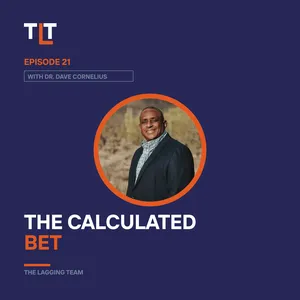
The Calculated Bet
There are two kinds of minds on a team that has fallen behind. One is standing still, hoping things won't go bad. The other makes a small, calculated bet: test a hypothesis, learn from the failure, take the next small step. Dr. Dave Cornelius, author of Elastic Minds: What Are You Thinking? and host of KnolShare, has watched both for decades, from a bank whose loan-processing app broke every month-end because nobody in leadership would take the downtime to fix it, to a client whose senior vice president let the stagnant teams go and promoted the people who kept learning. The bet is smaller than it sounds: an extra hour tonight learning the language, the product or the customer. From there the conversation covers what a stagnant leader does to the people under them (bitterness, backbiting, and the good ones leave), Dave's 4 H's (head, heart, hands and habit, plus the one Devon adds: hope), his Generative Adaptive Practice (eight tenets, trust first, fun and joy last), why leaders get in the way when they want control, what AI replaces and what it doesn't, why scarcity is a space of fear, and the failure bow he teaches his high-school cybersecurity students: I failed, and now I'm going to learn and do better. What? So what? Now what? Go deeper: His books on Audible, including Elastic Minds: What Are You Thinking? and Can You Help Me Tie My Shoes? (with Venita Freeman) https://www.audible.com/author/Dave-Cornelius/B01DQFFQBS The eight tenets: Dave Cornelius, Generative Leadership to Thrive (2023) https://www.audible.com/pd/Generative-Leadership-to-Thrive-Audiobook/B0CMBZY3T9 His show: KnolShare with Dr. Dave https://podcasts.apple.com/us/podcast/knolshare-with-dr-dave/id1038749797 Dr. Dave Cornelius: Author, Elastic Minds: What Are You Thinking? and Generative Leadership to Thrive · Host, KnolShare with Dr. Dave Talk about your team: https://thelaggingteam.com/start?episode=0021-the-calculated-bet&utm_source=podcast&utm_medium=shownotes&utm_campaign=the-calculated-bet
69 MIN
NOV 12, 2026
Behind Compared to What?
"Behind" is never a fact on its own. It's a comparison. Behind means you were measured against a fair benchmark, at a fair time, and came up short. Measured early means you were compared before the comparison was fair: before you had the time, the tools, the reps or the birthday. From the outside they look exactly the same. This Sidebar takes one question from Tuesday's conversation with Satyavrat Nirala, "Behind what? What is the benchmark?", and goes all the way into it. The same move shows up three times. When the benchmark is the calendar, the youngest kids in a class get measured early, and it doesn't wash out the way you'd hope. When the verdict is wrong, it lands hardest on whoever got labeled first. And once a rank is on the page, the comments that follow stop working, most of all for the person ranked lowest. Then three things to try next week, and a simple check for whether your team is behind or just compared. The full conversation: 0019, Behind What?, with Satyavrat Nirala https://thelaggingteam.com/podcast/0019-behind-what Satyavrat Nirala (he/him): Chief author, the Agile Education Manifesto https://agileeducationmanifesto.org Go deeper: Behind vs. measured early Kelly Bedard and Elizabeth Dhuey, "The Persistence of Early Childhood Maturity: International Evidence of Long-Run Age Effects," Quarterly Journal of Economics 121(4), 2006, 1437–1472 https://ideas.repec.org/a/oup/qjecon/v121y2006i4p1437-1472..html Who pays when the verdict's wrong Lee Jussim and Kent D. Harber, "Teacher Expectations and Self-Fulfilling Prophecies: Knowns and Unknowns, Resolved and Unresolved Controversies," Personality and Social Psychology Review 9(2), 2005, 131–155 https://www.researchwithrutgers.org/en/publications/teacher-expectations-and-self-fulfilling-prophecies-knowns-and-un/ The rank drowns the comment Ruth Butler, "Enhancing and Undermining Intrinsic Motivation: The Effects of Task-Involving and Ego-Involving Evaluation on Interest and Performance," British Journal of Educational Psychology 58(1), 1988, 1–14. With caveats: Thomas R. Guskey, "Grades Versus Comments: What Does the Research Really Tell Us?" Education Week, June 2019 https://edweek.org/education/opinion-grades-versus-comments-what-does-the-research-really-tell-us/2019/06 The earlier study: Ruth Butler, "Task-Involving and Ego-Involving Properties of Evaluation," Journal of Educational Psychology 79(4), 1987, 474–482 https://cris.huji.ac.il/en/publications/task-involving-and-ego-involving-properties-of-evaluation-effects/ Talk about your team: https://thelaggingteam.com/start?episode=0020-behind-compared-to-what&utm_source=podcast&utm_medium=shownotes&utm_campaign=behind-compared-to-what
16 MIN
NOV 10, 2026
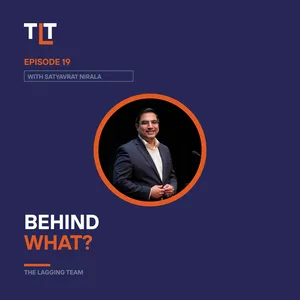
Behind What?
There is a difference between a learner who is behind and a learner who is being measured against a benchmark nobody checked. Satyavrat Nirala learned that difference as a kid in a village in Assam with no electricity, in a school where reading was the hard part and his brother was the one at the top of the class. He never caught the benchmark. He invented his own ways to learn, and years later he wrote the Agile Education Manifesto: four values and six principles for students, teachers, professors and parents, so a classroom can run like a team instead of a ranking. Satya's word for the kid everyone calls slow is slow-focused, not lagging. From there the conversation covers why values and principles have to come before any framework, why his classrooms use feedforward (a practice he credits to Marshall Goldsmith) instead of feedback, why competitiveness gives you tactical knowledge and only collaboration gives you strategic knowledge, the day a class connected the heart's principles to the value they serve, who resists first when a room stops ranking, and what to tell a leader whose team is behind right now. His one sentence for anyone who has been told they are behind: behind what? Who put that box? Go deeper: The manifesto: Agile Education Manifesto, four values and six principles for learning https://agileeducationmanifesto.org Feedforward: Marshall Goldsmith, "Try Feedforward Instead of Feedback" https://www.marshallgoldsmith.com/post/try-feedforward-instead-of-feedback The original: Manifesto for Agile Software Development (2001) https://agilemanifesto.org Satyavrat Nirala (he/him): Chief author, Agile Education Manifesto · https://agileeducationmanifesto.org/?utm_source=podcast&utm_medium=shownotes&utm_campaign=behind-what Talk about your team: https://thelaggingteam.com/start?episode=0019-behind-what&utm_source=podcast&utm_medium=shownotes&utm_campaign=behind-what
68 MIN
NOV 5, 2026
The Courage to Care
Discomfort is what the truth costs the person hearing it. Harm is what it costs them when you don't say it, or when you say it with pressure. When a team is behind and tired, the kind instinct is "now's not the time to push." This Sidebar takes one line from Tuesday's conversation with Bart Bailey, "I don't have any problem with discomfort. I do have a problem with harm," and goes all the way into it. The same move shows up three times. Urgency is attention on the process; pressure is attention on the person, and it raises the error rate even on work you do every day. Teamwork is having somebody's back; collaboration is letting an idea you didn't have change your plan. Then three things to try this week, and one test for whether your hard conversations land as discomfort or as harm: do people speak up more afterward, or go quiet? The full conversation: 0017, Fear Is Data, with Bart Bailey https://thelaggingteam.com/podcast/0017-fear-is-data Bart Bailey (he/him): Owner, Courage to Care LLC · Author, It's in Our Bones Go deeper: Discomfort vs. harm Amy C. Edmondson and Michaela J. Kerrissey, "What People Get Wrong About Psychological Safety," Harvard Business Review, May–June 2025 https://hbr.org/2025/05/what-people-get-wrong-about-psychological-safety Julia Rozovsky, "The five keys to a successful Google team," Google re:Work, Nov. 17, 2015 (180+ teams; archived copy) https://www.michigan.gov/documents/mdhhs/Google-and-Psychological-Safety_684425_7.pdf Kim Scott on Radical Candor and ruinous empathy, Stanford GSB Insights, Sept. 5, 2023 https://www.gsb.stanford.edu/insights/radical-candor-communication-shift-can-transform-your-career Urgency vs. pressure John P. Kotter, A Sense of Urgency (Harvard Business Press, 2008); excerpt: "Complacency and False Urgency Impede Change" (AMA) https://www.amanet.org/articles/complacency-and-false-urgency-impede-change/ Teresa M. Amabile, Constance N. Hadley and Steven J. Kramer, "Creativity Under the Gun," Harvard Business Review, Aug. 2002 (9,000+ daily diary entries) https://www.hbs.edu/faculty/Pages/item.aspx?num=12846 U.S. Department of Energy, Human Performance Improvement Handbook, Vol. 1 (DOE-HDBK-1028-2009) https://www.energy.gov/documents/doe-hdbk-1028-2009volume1pdf Teamwork vs. collaboration Anita Williams Woolley, Christopher F. Chabris, Alex Pentland, Nada Hashmi and Thomas W. Malone, "Evidence for a Collective Intelligence Factor in the Performance of Human Groups," Science 330 (2010), 686–688 (699 people in 192 groups) https://doi.org/10.1126/science.1193147 Google re:Work, as above: "Who is on a team matters less than how the team members interact." Talk about your team: https://thelaggingteam.com/start?episode=0018-the-courage-to-care&utm_source=podcast&utm_medium=shownotes&utm_campaign=the-courage-to-care
20 MIN