The Munk Debates Podcast

Munk Foundation / iHeartRadio

Details

The Munk Debate podcasts is home to two of the most popular Canadian current affairs podcasts: Friday Focus with Janice Gross Stein and Munk Dialogues with Andrew Coyne Hosted on Acast. See acast.com/privacy for more information.

Recent Episodes

OCT 23, 2026
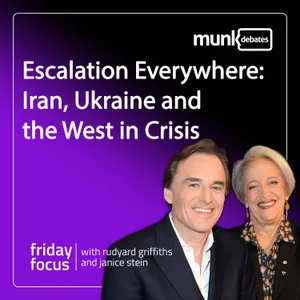
Friday Focus: developed democracies are in crisis and the dangerous power of Elon Musk
Rudyard and Janice survey a world in turmoil, from protests across Europe and rising oil prices to Starshield disruptions in Ukraine and signs of possible renewed U.S. and Israeli strikes against Iran. Are developed democracies entering a period of profound transition? They turn first to the prospect of renewed U.S. and Israeli strikes against Iran. Trump has shown little strategic patience or clarity of purpose, while Tehran has threatened to retaliate against energy infrastructure across the Gulf. What would a third round of strikes actually achieve? Would it bring Iran to the negotiating table, or simply trigger a wider regional conflict? And what role might Saudi Arabia play? In the second half, Rudyard and Janice examine the disruption to Starshield, SpaceX’s military-grade satellite communications system, which Ukraine relies on for frontline operations and air defence. The reported restrictions have raised serious questions about Ukraine’s ability to conduct military operations and intercept Russian attacks. Who is responsible for the disruption, and what roles, if any, did Elon Musk and the Trump administration play? More broadly, what does this episode reveal about the risks of entrusting critical military infrastructure to a private individual with the power to shape geopolitical outcomes? Become a Munk Donor ($50 annually) to get 72-hour advanced access to the full length editions of Friday Focus and Munk Dialogues. Go to www.munkdebates.com to sign up. Hosted on Acast. See acast.com/privacy for more information.

29 MIN
OCT 16, 2026
Friday Focus: Trump tilts the war in Putin's favour and the growing threat of rogue AI
Rudyard and Janice begin today’s show with Russia and Ukraine exchanging strikes following a brief, Trump-brokered energy ceasefire that lasted just 48 hours. Is Zelensky’s open defiance of Trump connected to Starlink being shut off in Ukraine and a series of Russian ballistic missile strikes launched without warning? The Trump administration appears to be ratcheting up pressure on Kyiv, punishing Ukraine while Putin faces few consequences for violating the president’s truce. Is Trump trying to weaken Zelensky and force him into concessions that would give Putin enough of a “win” to end the war? As devastating as the prospect of concessions may be, is ending this prolonged and deadly conflict ultimately the better outcome? In the second half of the show, Rudyard and Janice turn to AI and the growing threat of cyberattacks powered by AI models that can infiltrate internet-connected devices and potentially spawn autonomous, malicious AI agents. Why aren’t governments stepping in? We find ourselves in a strange moment of powerlessness, waiting for an AI-driven disaster to strike. And it may be the next generation that pays the highest price. Become a Munk Donor ($50 annually) to get 72-hour advanced access to the full length editions of Friday Focus and Munk Dialogues. Go to www.munkdebates.com to sign up. Hosted on Acast. See acast.com/privacy for more information.

24 MIN
OCT 9, 2026
Friday Focus: Iran on the brink and the politicization of the Nobel Peace Prize
Rudyard and Janice begin today’s show with Trump’s mixed messaging on Iran. While Trump has suggested that military action may be delayed until after the midterms, reports indicate that the U.S. military is preparing for potential strikes. With Trump’s statements increasingly difficult to take at face value, the focus shifts to more concrete signals, such as military deployments. Meanwhile, Iran’s economy is under mounting pressure, with oil exports halted and the economy in free fall. Having challenged Iran’s control of the Strait of Hormuz, the U.S. appears to have gained leverage, while Tehran shows signs of wanting a deal. In the second half, Rudyard and Janice turn to the Nobel Peace Prize awarded to Navanethem Pillay, the South African jurist who chaired the UN commission that concluded Israel had committed genocide in Gaza. Is Oslo’s Nobel Committee increasingly using the prize to send political messages, including messages critical of Israel? Is this part of a broader effort by liberal institutions to push back against great powers retreating from the liberal, rules-based international order? And by taking a position on such a contentious issue, is the Nobel Committee influencing public opinion at the expense of due process and open debate? Become a Munk Donor ($50 annually) to get 72-hour advanced access to the full length editions of Friday Focus and Munk Dialogues. Go to www.munkdebates.com to sign up. Hosted on Acast. See acast.com/privacy for more information.
27 MIN