The Origination Podcast

Zest AI

Details

Every loan starts with a story. So does every lender. Origination is where the leaders of consumer lending come to tell their story. Each episode unpacks the origin story behind a leader's progression in lending, and the industry challenges they're working on right now. They’ll dive into topics like growth strategies, modernizing legacy processes, how to adapt to changing borrower expectations, and competing in an evolving lending landscape. If you make lending decisions for a living, or are building the technology behind them, this show is for you. Origination is brought to you by Zest AI who provides AI-driven underwriting, fraud detection, and lending intelligence for credit unions and banks. Learn more at zest.ai.


Recent Episodes

NOV 17, 2026
From “No” to “How”: Jessica Jones on Member-First Lending and Authentic Leadership
Jessica Jones, President and CEO of Universal 1 Credit Union, joins Rodney Hood on The Origination Podcast to discuss the relationships, leadership decisions and technology investments shaping her credit union’s next chapter. After more than 20 years in aviation, Jessica moved into credit unions seeking a stronger connection to people and a healthier balance between work and family. She shares how trusted mentors helped her move beyond human resources into finance, marketing, compliance and ultimately the CEO role—and why creating room for people to be themselves is central to her leadership. The conversation explores Universal 1’s three-year core conversion, open APIs, safer access to internal data and the role of AI in researching member needs, potential partners and new lending products. Jessica explains why lending diversification and small-business relationships matter for a credit union that had long concentrated on indirect auto lending. At the heart of the episode is a member who could not initially qualify for a mortgage. Rather than stopping at “no,” his loan advisor worked with him for a year and a half until he could buy his first home. Jessica connects that story to financial literacy, community development and a simple question: how can the credit union help members move forward? Chapters 00:00 Introduction 01:10 From aviation to credit union CEO 04:02 Mentors and negotiables vs. non-negotiables 06:54 Using AI and a new core to grow lending 13:06 Financial literacy and saying “how” instead of “no” 16:35 Small business lending and staying rooted in Dayton 25:40 Lessons from a three-year core conversion 30:05 The metrics that matter and a question-asking culture 35:11 Authentic leadership and life outside work 41:34 What Washington should know about credit unions Key Takeaways - Start with member needs, not a technology shopping list. - Treat core modernization as a strategic change-management project, with employee input, clean data and clear member communication. - Use AI as a research and questioning tool while keeping sensitive data within appropriate safeguards. - Measure the member experience as well as financial stability: satisfaction, application turnaround and where people walk away. - Diversify lending thoughtfully, aligning new products with community relationships and concentration risk. - Authentic leadership means being honest about what you know, what you don’t know and when you need help. Connect with the guest Jessica Jones — President and CEO, Universal 1 Credit Union https://www.linkedin.com/in/jessica-jones-u1/ https://www.u1cu.org/ Sponsor The Origination Podcast is brought to you by Zest AI, which provides AI-driven underwriting, fraud detection, and lending intelligence for credit unions and banks. Learn more at zest.ai.
47 MIN
NOV 10, 2026
How Citadel Credit Union scales growth without compromising risk
Summary What does it take to grow a credit union while keeping member onboarding simple, knowing your customers, and staying ahead of increasingly sophisticated fraud? On The Origination Podcast, host Rodney Hood, former NCUA chairman, welcomes Chris Palumbo, Chief Risk Officer at Citadel Credit Union, to discuss how technology, thoughtful controls, and a member-first culture can work together. Drawing on experience at Capital One, JPMorgan Chase, the Federal Reserve Bank of Richmond, and KPMG, Chris explains Citadel's move toward streamlined digital account opening with Alloy, its use of layered fraud defenses including BioCatch, and the need to evaluate borrowers beyond a single credit score. The conversation also covers the differences between consumer and commercial lending, regulatory efficiency, and the leadership skills required to balance technical rigor with people. Chapters 00:00 Meet Chris Palumbo and The Origination Podcast 01:12 From the Marine Corps to chief risk officer 03:02 Mentorship and people leadership 05:30 Lessons from a regulatory turnaround 07:29 The modern origination challenge 08:55 Digital account opening with Alloy 10:31 Charter expansion and member growth 12:09 Keeping KYC central to onboarding 14:18 Fraud threats and layered defenses 15:13 BioCatch and behavioral risk signals 17:08 Consumer and commercial lending 20:48 Looking beyond a credit score 23:01 Risk metrics and the ability to repay 24:40 What makes credit unions member-first 26:39 Making regulation more efficient 28:30 Leadership and the skills business schools miss 35:55 Using AI in everyday life Takeaways -Automation can reduce onboarding friction without removing identity checks or exception review. -Fraud prevention works best as a layered, risk-sensitive process, with additional verification when signals warrant it. -Credit scores remain useful, but lenders can also consider cash flow, debt-to-income and other product-specific information. -Commercial lending relies heavily on community relationships alongside underwriting data. -Credit unions reinvest earnings in members and communities; regulatory clarity can free teams to focus on service. -Technical expertise and people leadership are complementary skills for managing a highly regulated organization. Connect with the Guest LinkedIn: linkedin.com/in/chrisjpalumbo Citadel Credit Union: citadelbanking.com Sponsor The Origination Podcast is brought to you by Zest AI, which provides AI-driven underwriting, fraud detection, and lending intelligence for credit unions and banks. Learn more at zest.ai.

40 MIN
NOV 3, 2026
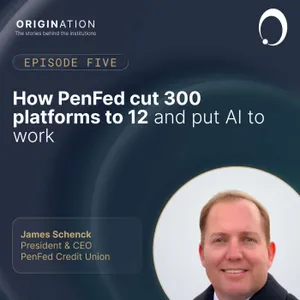
How PenFed grew the credit union from $4.1 billion to $30 billion
Summary James Schenck, President and CEO of PenFed Credit Union, joins host Rodney Hood to share how a career that ran from West Point and 13 years as an Army aviator to 25 years at PenFed shaped the way he leads a credit union that has grown from $4.1 billion to about $30 billion. James explains why PenFed consolidated more than 300 technology platforms down to fewer than 12, how that took the credit union from 5 big changes a year to 6,000 a quarter, and how it now runs 76 AI use cases, from automatic call summaries to real-time coaching for loan officers. He and Rodney also cover the Second Chance Initiative, why net promoter score is PenFed's number one metric and asset growth is overrated, how selling loans into the capital markets lets PenFed say yes to more members, and his advice for new NCUA Chairman John Crews: fewer, objective metrics focused on capital and liquidity. Chapters 00:00 Welcome James Schenck of PenFed Credit Union 01:28 From West Point and Army aviation to PenFed 02:42 Mass where it matters: economics and leadership 04:23 People helping people and a lesson from his father 05:52 The Second Chance Initiative in Philadelphia 08:23 Consolidating 300 platforms down to 12 10:51 From 5 changes a year to 6,000 a quarter 12:25 Getting employees on board with AI and ending the donkey work 15:10 Hiring for curiosity and AI coaching for loan officers 17:42 Net promoter score as the number one metric 19:17 Why asset growth is an overrated metric 21:36 Capital markets: selling loans to say yes to more people 22:32 It's easy to say yes, harder to collect 24:02 Using AI to tie marketing dollars to funded loans 25:50 Advice for NCUA Chairman John Crews 27:19 Lightning round: gratitude, David Rubenstein, aviation and books Takeaways - PenFed consolidated more than 300 platforms down to fewer than 12, built on Snowflake, Salesforce, Microsoft and AWS, so it can go deep with a few partners. - Simplifying the stack took PenFed from 5 big changes a year to 6,000 changes a quarter. - AI adoption started with town halls and real use cases, framed as removing "donkey work" rather than cutting jobs; PenFed now has 76 AI use cases. - Automatic call summaries save about 3 minutes on each of 10,000 daily calls, and AI coaches loan officers in real time. - Net promoter score is PenFed's number one metric; asset growth for its own sake is not. - Selling loans through asset-backed securitizations frees capital so PenFed can say yes to more members. Connect with the Guest James Schenck LinkedIn: https://www.linkedin.com/in/james-schenck-b41b9a1/ Company Website: https://www.penfed.org Sponsor The Origination Podcast is brought to you by Zest AI, which provides AI-driven underwriting, fraud detection, and lending intelligence for credit unions and banks. Learn more at zest.ai.

35 MIN