


The Secret World of Human Trafficking
DAVID J. STORY
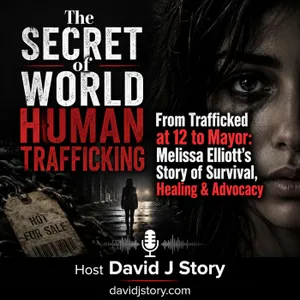
From Trafficked at 12 to Mayor: Melissa Elliott’s Story of Survival, Healing & Advocacy
OCT 8, 202636 MIN
Description
Let Me Know Your Thoughts and Question.
In this powerful episode of The Secret World of Human Trafficking, host David J. Story speaks with Melissa Elliott, a human trafficking survivor, author, educator, advocate, and mayor of Henderson, North Carolina.
Melissa’s story began in 1981 when she was just 12 years old. After running away from home, she went to stay with people she believed she could trust. Instead, she says she was groomed and trafficked by two young women who controlled her, isolated her, and repeatedly delivered her to men for sexual exploitation.
Her story challenges one of the biggest misconceptions about trafficking: that traffickers are always strangers or men. In Melissa’s case, the people exploiting her were women she initially trusted.
Melissa describes being locked inside a room, threatened, controlled, and psychologically manipulated. Her traffickers told her that nobody loved her, nobody cared about her, and nobody was coming to help her. She explains that grooming was not just about makeup or clothing. The deepest damage came from the emotional manipulation and constant messages designed to destroy her sense of worth.
Her mother never stopped looking for her.
Melissa recalls the painful moment when her mother came to the house where she was being held with law enforcement and a private investigator. Melissa was inside, but the people holding her denied knowing her. She could hear her mother outside, but she was unable to call for help.
Months later, investigators found her again. Melissa saw them while walking to a store and ran toward them. She was finally taken to safety.
One sentence from that day stayed with her:
“Melissa, you’re going home.”
But Melissa explains that rescue was only the beginning.
After returning home, she struggled with trauma, substance abuse, anxiety, relationships, domestic violence, and memories of what happened to her. She describes wearing mirrored sunglasses because they allowed her to see other people while feeling that they could not see her.
That feeling became the word she later used to describe her trafficking experience:
Invisible.
For decades, Melissa did not talk openly about what happened to her. She says she did not fully understand that her experience would now be recognized as human trafficking.
Later in life, she connected with advocates, began therapy, participated in a North Carolina human trafficking documentary, and wrote her book, From Trauma to Triumph.
Melissa speaks openly about the importance of mental health treatment. Although faith remains central to her life, she emphasizes that prayer does not replace professional counseling and support.
One of the most meaningful moments in her healing came when her therapist told her she did not want to speak to the mayor, the preacher, the nonprofit founder, or the successful adult Melissa had become. She wanted to speak to the little girl who had survived.
The interview also explores why trafficking can remain hidden in small towns and rural communities.
Melissa discusses vulnerable youth, housing insecurity, immigrants, agricultural communities, and people who may be exploited because they have nowhere else to go. She believes education is one of the strongest tools communities have to identify trafficking.
She encourages law enforcement, healthcare workers, teachers, churches, community health workers, utility employees, and others who enter homes or interact with vulnerable people to recognize the warning signs.
Sometimes the biggest clue is not what someone says.
It is what they are afraid to say.
Melissa encourages people to watch for fear, unusual control by another person, isolation, sudden changes in behavior, and situations where someone does not appear free to speak or make decisions independently.
Today, Melissa uses her experience to help others.
She trains professionals, works with human trafficking organizations, teaches community health workers, speaks with young people, supports survivor education, and uses her public platform to promote mental health, housing, wellness, and community support.
Her message to survivors is simple:
You are not what happened to you.
Get help.
Find support.
Never give up.
This episode is a reminder that human trafficking can happen in plain sight and that victims do not always fit the image society expects.
Sometimes the person who needs help is already standing in front of us.
The question is whether we recognize the signs and whether we are willing to act.
For more episodes, educational resources, articles, and information about the Omega Book Series, visit DavidJStory.com.
Always watch your six—and others too.
Support the show
Go to DavidJStory.com for more information about the Host/Author and more episodes. Or if you want to be on the show.