



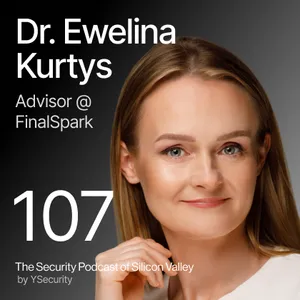
107. Programming living neurons in Python (with Ewelina Kurtys)
NOV 3, 202628 MIN
Description
FinalSpark is trying to build computers out of living neurons, and Ewelina Kurtys, a strategic advisor there, explains why in terms of energy. Current artificial intelligence systems use a lot of it and are already expensive to run, and she thinks many models are underpriced while they're in their adoption phase, so prices might go up. FinalSpark's mission is a biocomputer that uses 1 million times less energy than silicon.
She's careful about how far along it is. When Jon recorded this, the team had managed to store 1 bit of information, and she puts a final product another 10 years out, because neurons encode information so differently from silicon that the programming has to be worked out from scratch. For now the team writes Python to send the neurons electrical and chemical signals and measure what comes back. The neurons start as stem cells that come from human skin, which she says you can buy commercially and which biomedical research often uses.
Jon suggested it was a contest with quantum computing, and she turned that down, because she thinks they'll be good at different things and that many kinds of hardware will end up complementary. Jon expects quantum to have a huge impact on security, since the traditional asymmetric key algorithms go out the window once there's a powerful enough quantum computer. Asked what biocomputing changes for security, she says it's too early to tell. At least for now, everything in their lab talks to the outside world through silicon, so she thinks maybe not many things change from a security point of view.
Ewelina has a doctorate in neuroscience and moved to London as a postdoctoral researcher before leaving academia for startups. Her first job after that was with a medical imaging company, which is where she learned about artificial intelligence, and she later met FinalSpark's founders, Fred Jordan and Martin Kutter, at a summit on artificial intelligence in London. FinalSpark was founded in 2014. She says the founders did a lot of fundamental research in digital artificial intelligence before realizing that great models cost a lot to make, and that competing there maybe wasn't the best choice for a small independent startup. Their first employee already had experience with living neurons, so they tried programming those and had to learn biology from scratch.
There's also her answer when Jon asks whether there's a problem she'd pay another company to solve, which is that she'd start that company herself, and the advice she'd give her younger self, which is to be more confident.
Episode page and transcript: ysecurity.io/podcast/107-programming-living-neurons-in-python/
Brought to you by YSecurity, the security team that works next to yours. Your first 8 hours of chief information security officer work are free at ysecurity.io/startups.