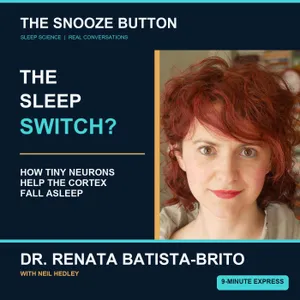
The Sleep Switch? Tiny Neurons, Big Influence — Dr. Renata Batista-Brito | EXPRESS
NOV 16, 20269 MIN
Description
How can a tiny handful of cortical neurons influence a large part of the brain - and even promote sleep? Dr. Renata Batista-Brito explains her team's research into an unusual type of long-range inhibitory neuron in mice, how those cells help coordinate cortical activity, and why the findings challenge the idea that the cortex is merely a passive follower of deeper sleep-control centers.
In this focused EXPRESS edition, Neil Hedley explores the discovery, its possible implications, and an important limitation: the experiments do not demonstrate a new treatment for human insomnia.
Hear the full conversation in the main The Snooze Button podcast feed or at thesnoozebutton.com.
Research: Ratliff and colleagues, Nature (2026): Read the published study.