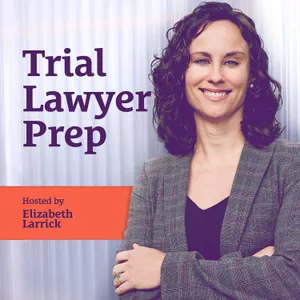
Trial Lawyer Prep

Elizabeth Larrick | Trial Consultant

Details

Trial Lawyer Prep is a biweekly podcast about the craft of building successful plaintiff cases — from the moment a case walks in the door to the outcome that closes it, whether that's a jury verdict or settlement. Each episode is a how-to: focus group methodology, witness preparation, persuasion and case themes, trial tactics, deposition strategy, and case preparation that delivers the best possible outcome for your client. Hosted by Elizabeth Larrick — a former plaintiff personal injury attorney turned trial consultant — the show pulls back the curtain on the work that happens behind the scenes to build stronger cases. Episodes alternate between solo deep-dives on specific tactics and conversations with trial lawyers who are doing the work.

Recent Episodes

NOV 4, 2026
AI Jurors v. Real Jurors: How 3 Tools Influenced a $3.4M Verdict [Ep 178]
AI valued this case at $1.6 million. Live focus groups said $3 million. The jury returned $3.4 million. So what is AI actually good for before trial? In today's episode, Elizabeth builds on Episode 173, the team's $3.4 million verdict, and puts three tools side by side: AI digital jury surveys, live Zoom focus groups, and custom jury bots. She shows where each one helped and where each one fell short. We also frame the comparisons through Daniel Kahneman's concept from his book, Thinking, Fast and Slow. AI behaves like System 2: analytical, risk-averse and conservative. Live jurors bring System 1: gut and emotional reactions. That difference matters when half the brain is processing visuals and your case depends on storytelling. Our takeaway: use AI to find confusion and weak spots in your evidence, not to predict a number. Prompts are very sensitive, and live focus groups are more forgiving and capture the emotional response a story creates. Focus groups can change how you build a case, and build a case frame. Learn more about Elizabeth's Focus Group Services: Which Virtual Focus Group Does Your Case Actually Need? In this episode, we cover: How 500 AI-created digital jurors, built from venue demographics, reviewed our text, photos and case-specific questions. How the digital jurors exposed "holes in the boat," including confusion around the expert's opinions. How jury bots, built in BoodleBox from jury questionnaires and fed daily trial transcripts, flagged confusion about how the valuation expert reached his opinions. What causes the bots ultimately stayed in the middle as far as valuation. You can also watch today's episode on my YouTube Channel: AI Jurors v. Real Jurors: How 3 Tools Influenced a $3.4M Verdict [Ep 178] And refer to Episode 173, Trial Prep Under Pressure, for more of the back story on this $3.4m verdict, a trial that came together in three days! Further links and resources: https://boodlebox.ai/ Follow and Review: We'd love for you to follow us if you haven't yet. Click that purple '+' in the top right corner of your Apple Podcasts app. We'd love it even more if you could drop a review or 5-star rating over on Apple Podcasts. Simply select "Ratings and Reviews" and "Write a Review" then a quick line with your favorite part of the episode. It only takes a second and it helps spread the word about the podcast. Have a trial or mediation coming up and want to test with a focus group? Book a free consultation call with Elizabeth to learn more: www.calendly.com/elizabethlarrick
21 MIN
OCT 21, 2026
Structuring Your Story and Your Case for the Jury's Brain [Ep 177]
You've learned about the impacts of attention deficits and cognitive friction on juries, now, how do you structure your presentation so that jurors can follow it? In part two of our series on working memory and case presentation, we focus on making the story easier to remember, reducing confusion, and using visuals that support persuasion instead of competing with it. We look at three practical techniques lawyers can apply immediately: chunking their information together, sequencing, and the three-second rule for visuals. Capture your jurors' attention and keep them with you from start to finish, leaving them with just enough mental energy to understand and grasp your argument. It's better for them, but it also makes your work more focused and efficient too! If you want more trial prep strategies just like this, but in more depth and delivered straight to your inbox, grab my email newsletter I send out each month: https://www.larricklawfirm.com/newsletter In this episode, we cover: How jurors (like all people) are built for stories, and a case needs recognizable story elements like a problem, victor, villain, struggle, and resolution. Instead of piling on five to seven lead-ups, choose the three or four strongest points and leave the rest out. The brain naturally wants events in order. Disorganized storytelling increases mental strain and weakens memory. A visual should communicate its point quickly enough for jurors to understand it within about three seconds. If a visual requires jurors to focus on a specific area, highlight or direct attention to it. If that takes too much work, consider a different visual. You can also watch today's episode on my YouTube Channel: Structuring Your Story and Your Case for the Jury's Brain [Ep 177] And refer to part one (Why Jurors Stop Listening Even IF You Grab their Attention [Ep 176]) and Episode 169 (Juror Attention Spans: The Science Every Trial Lawyer Needs to Know)for more fascinating insights on brain science and juries! Follow and Review: We'd love for you to follow us if you haven't yet. Click that purple '+' in the top right corner of your Apple Podcasts app. We'd love it even more if you could drop a review or 5-star rating over on Apple Podcasts. Simply select "Ratings and Reviews" and "Write a Review" then a quick line with your favorite part of the episode. It only takes a second and it helps spread the word about the podcast. Have a trial or mediation coming up and want to test with a focus group? Book a free consultation call with Elizabeth to learn more: www.calendly.com/elizabethlarrick Don't miss out on the Trial Lawyer Prep Newsletter that is delivered right to your email with extra tips and 'how to' information. Join the newsletter here: www.larricklawfirm.com/newsletter

16 MIN
OCT 7, 2026
Why Jurors Stop Listening Even IF You Grab their Attention [Ep 176]
Why do jurors lose track of a trial presentation even when the evidence is strong? In part one of this two-part series, we look at how attention deficits, mental fatigue, and working memory shape what jurors can absorb. We find practical ways to reduce cognitive friction in openings, direct examinations, and cross-examinations. And we discuss the idea of a juror's limited cognitive budget, how to build in cognitive breaks, and a simple 20-minute rule for pacing testimony and presentations. The goal: make complex material easier to follow, so jurors can stay with the story and make a better connection with you. And stay tuned for part two, where we'll focus on structuring presentations that are designed for short-term memory. Have a trial or mediation coming up and want to test with a focus group? Book a free consultation call with Elizabeth to learn more: www.calendly.com/elizabethlarrick In this episode, we cover: How to use clear language and well-structured testimony help preserve jurors' cognitive capacity. Why pauses, movement, and visual transitions can act as cognitive breaks and help regain attention. Mark Lanier's "three points plus a conclusion" approach, which can give jurors a mental reset and improve retention. How to break an hour-long direct examination into smaller segments, to help jurors and the judge follow the progress. What physical signs to look for in jurors, such as furrowed brows or visible disengagement. You can also watch today's episode on my YouTube Channel: Why Jurors Stop Listening Even IF You Grab their Attention [Ep 176] And refer to Episode 169 (Juror Attention Spans: The Science Every Trial Lawyer Needs to Know) for more fascinating insights on brain science and juries! Follow and Review: We'd love for you to follow us if you haven't yet. Click that purple '+' in the top right corner of your Apple Podcasts app. We'd love it even more if you could drop a review or 5-star rating over on Apple Podcasts. Simply select "Ratings and Reviews" and "Write a Review" then a quick line with your favorite part of the episode. It only takes a second and it helps spread the word about the podcast. Have a trial or mediation coming up and want to test with a focus group? Book a free consultation call with Elizabeth to learn more: www.calendly.com/elizabethlarrick Don't miss out on the Trial Lawyer Prep Newsletter that is delivered right to your email with extra tips and 'how to' information. Join the newsletter here: www.larricklawfirm.com/newsletter

13 MIN
SEP 23, 2026
How to Get Better Feedback From Your Focus Groups [Ep 175]
Make your next focus group actually reveal the weaknesses, blind spots, and sticky points in your case, before the defense does! Long, compound questions will kill the conversation. Keep the flow moving with shorter prompts. Silence is one of the most useful tools you have when you want honest reactions instead of rehearsed answers. These are just some of the detailed tips we cover in today's episode, which helps you make the most of a focus group to get accurate, realistic data and feedback. The greatest strength of focus groups is their ability to reveal real weaknesses, not just reinforce what you already believe. So give your groups the tools to deliver what you need, and remember: set aside that lawyer's instinct to advocate and instead, just listen. Focus groups can change how you build a case, and build a case frame. Book a free call with me and learn more about my online focus groups for plaintiff personal injury lawyers: https://www.calendly.com/elizabethlarrick In this episode, we cover: Why short, neutral questions get you better participation from every person in the room How to use devil's advocate questions without drifting into vague hypotheticals The open-ended wrap-up questions that reveal what jurors actually remember Keeping information chunks short so the group can actually absorb and discuss them Using silence intentionally, especially in Zoom settings, to give people time to think You can also watch today's episode on my YouTube Channel: How to Get Better Feedback From Your Focus Groups [Ep 175] Follow and Review: We'd love for you to follow us if you haven't yet. Click that purple '+' in the top right corner of your Apple Podcasts app. We'd love it even more if you could drop a review or 5-star rating over on Apple Podcasts. Simply select "Ratings and Reviews" and "Write a Review" then a quick line with your favorite part of the episode. It only takes a second and it helps spread the word about the podcast. Have a trial or mediation coming up and want to test with a focus group? Book a free consultation call with Elizabeth to learn more: www.calendly.com/elizabethlarrick Don't miss out on the Trial Lawyer Prep Newsletter that is delivered right to your email with extra tips and 'how to' information. Join the newsletter here: www.larricklawfirm.com/newsletter
18 MIN
SEP 9, 2026
Focus Groups Before Discovery: Vishal Shah on Case Development Strategy [Ep 174]
How does a small law firm evaluate whether to conduct a focus group? The expense, the planning and organization, the time it takes: the stakes feel higher when you have a more nimble organization. Vishal Shah is a plaintiff-side employment lawyer in Boston, MA, who left big law to open his own boutique firm in 2023. He thus knows first-hand the importance of balancing the bottom line and making smart choices for how his firm operates. And he's here to tell you: you rarely get a better bang for your buck than through a focus group. Because it's not just about the value to that particular case, but the strategies, language, vocabulary, and human insight that can be applied to future cases and situations. The feedback from focus groups helps Vishal and his team spot hidden assumptions, shape depositions, and improve mediation strategy. Best of all, Vishal walks us through his own process of running a focus group from start to finish: the logistics, planning, advertizing, expenses and implementation. If you've been on the fence about whether a focus groups are worthwhile, today's conversation presents a very compelling case. Are you ready to learn more about how focus groups can improve your firm's efficiency and case presentation? Book a free consultation through the link below: https://larricklawfirm.com/litigation-consulting/trial-consulting/focus-groups/ In this episode, we cover: Why focus groups in big law were often treated as a late-stage trial tool after summary judgment. How a small plaintiff practice can use focus groups earlier, including before a complaint is filed. Why early focus groups help identify weak points, buried assumptions, and themes jurors actually care about. How Vishal uses focus groups to test defense themes before opposing counsel ever argues them in court. How he keeps the process cost-conscious with virtual sessions, Craigslist recruiting, surveys, and tight case selection. You can also watch today's episode on my YouTube Channel: Focus Groups Before Discovery: Vishal Shah on Case Development Strategy [Ep 174] Learn more about my guest Vishal Shah: https://shahlitigation.com/ Email: [email protected] LInkedIn: https://www.linkedin.com/in/shahlitigation/ Follow and Review: We'd love for you to follow us if you haven't yet. Click that purple '+' in the top right corner of your Apple Podcasts app. We'd love it even more if you could drop a review or 5-star rating over on Apple Podcasts. Simply select "Ratings and Reviews" and "Write a Review" then a quick line with your favorite part of the episode. It only takes a second and it helps spread the word about the podcast. Have a trial or mediation coming up and want to test with a focus group? Book a free consultation call with Elizabeth to learn more: www.calendly.com/elizabethlarrick Don't miss out on the Trial Lawyer Prep Newsletter that is delivered right to your email with extra tips and 'how to' information. Join the newsletter here: www.larricklawfirm.com/newsletter
40 MIN