Tudor History with Claire Ridgway

Claire Ridgway

Details

Step back into a world of intrigue, passion, and ruthless ambition — welcome to Tudor England. Join historian and bestselling author Claire Ridgway as she uncovers the riveting stories of the Tudor dynasty. From the scandalous love affairs of King Henry VIII to the tragic fall of Anne Boleyn, the fierce reign of Elizabeth I, and the lesser-known secrets of Tudor court life, this podcast brings history to life in vivid detail. Hear dramatic tales of betrayal, execution, forbidden love, and political manoeuvring that shaped England forever. Discover daily Tudor history with fascinating “On This Day” episodes — unique insights you won’t find in typical history books. Get behind-the-scenes stories from Claire’s own research trips to historic sites like the Tower of London, Hampton Court Palace, Hever Castle, and more. Enjoy interviews with top historians and experts in Tudor studies, plus lively Q&A sessions tackling listeners’ burning Tudor questions. 🖋 Who is Claire Ridgway? Claire is the author of the bestselling On This Day in Tudor History series and numerous other Tudor books loved by readers around the world. She founded The Tudor Society, connecting enthusiasts with experts through live online events, and runs the hugely popular history websites The Anne Boleyn Files and www.ClaireRidgway.com. Her mission: to uncover the human stories behind the crown — the hopes, fears, and triumphs of not only kings and queens but also the courtiers, rebels, and ordinary people who lived under the Tudor rose. What can you expect? Gripping accounts of famous events like the Field of Cloth of Gold, the Dissolution of the Monasteries, or the Babington Plot. Intimate portraits of Tudor figures: Anne Boleyn’s charm and downfall, Thomas Cromwell’s rise and brutal fall, Elizabeth I’s cunning survival. Dark mysteries and unsolved deaths Who really killed Amy Robsart? Was Katherine Howard truly guilty? Special episodes on Tudor fashion, food, medicine, and the day-to-day lives of Tudor men and women. Join thousands of Tudor fans worldwide Never miss an episode — subscribe now and become part of a global community that can’t get enough of Tudor drama. Explore more with Claire’s books, free resources, and live historical events at www.ClaireRidgway.com. Ready to travel back 500 years? Press play and let the adventure begin.

Recent Episodes

OCT 20, 2026
Did Henry VIII Really Smell THAT Bad? Claire Investigates...
Got something to say to this podcast? Send a voicemail, and you might hear yourself on the next episode! Could people really smell Henry VIII coming from three rooms away? You may have heard the story that Henry VIII's leg ulcers were so awful that people could smell him coming from several rooms away. It's certainly a horrible thought, isn't it?But where does this story actually come from? Who first wrote about it? Was it someone at Henry's court, one of the ambassadors, or perhaps one of his physicians? After doing all that research into Henry VIII's troublesome legs for my previous video, I decided to do a bit more digging and see if I could find the original source for this claim. And I have to admit that I've repeated this story myself in the past, without questioning where it came from! I've been looking through contemporary accounts, biographies, medical articles and Tudor surgical treatments to see what evidence there actually is. Could Henry's leg ulcers have produced such a terrible smell? What treatments might his physicians have used? And, most importantly, did anyone who knew Henry actually write about his legs smelling? In my latest video, I share what I've found, including some interesting details about Tudor medicine and where this rather unpleasant story might have come from. I'd love to know what you think, particularly if you've come across a contemporary account that I've missed! Watch my investigation into Henry VIII's leg problems: https://youtu.be/1J4mEb_tOoY
15 MIN
OCT 14, 2026
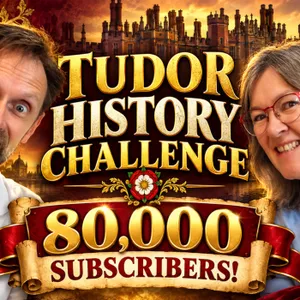
How Well Do You REALLY Know Tudor History? - Our 80K Subscriber Challenge!
Got something to say to this podcast? Send a voicemail, and you might hear yourself on the next episode! To celebrate 80,000 subscribers, Tim takes on my Tudor History Challenge! Play along with five rounds of Tudor trivia and tell us your score out of 45 in the comments. Did you beat Tim? Thank you for being part of The Anne Boleyn Files community. Subscribe for more Tudor history, mysteries and research. QUESTIONS Round 1: Fact or Fiction? Henry VIII banned football. Henry VIII nearly drowned after falling headfirst into a ditch. Elizabeth I restricted meat on Wednesdays because she thought it was unhealthy. Elizabeth I sentenced a man to death for writing about her marriage prospects. Mary I was England's first crowned queen. Round 2: Who Am I? (Clues) Imprisoned under Elizabeth I; secretly married Lady Katherine Grey, sister of Lady Jane Grey. Witnessed the 1572 St Bartholomew's Day Massacre; Elizabeth's ambassador to France; organised her intelligence network. A learned Cooke sister, famed for Greek and her library; married William Cecil, Lord Burghley. Claimed to be a Prince in the Tower; supported by foreign rulers; rebelled against Henry VII and was executed in 1499. Powerful under Edward VI; tried to prevent Mary succeeding; executed in August 1553. Round 3: What Happened Next? Anne Askew refused to implicate Catherine Parr's circle. What did her interrogators do? As Henry Grey, Duke of Suffolk, was about to be beheaded, what did a man in the crowd demand? What was found beneath Mary, Queen of Scots' clothing after her execution? At the Field of Cloth of Gold, Henry VIII and Francis I wrestled. What happened? What happened when Henry VIII's army met French cavalry near Thérouanne in 1513? Round 4: Who Said That? "I have the body of a weak and feeble woman, but I have the heart and stomach of a king." "Some be too stiff in their old mumpsimus, others be too busy and curious in their new sumpsimus." "I am alreadie maried to this common weale, & the faythful membres of the same." Who described a clergyman as "Sometimes the beautiful temple of God, but now the stinking and filthy kennel of Satan"? Who reportedly told his executioner, "Pluck up thy spirits, man, and be not afraid to do thine office; my neck is very short"? Round 5: The 80K Challenge Which of Henry VIII's wives was married to him for the shortest time? Who crowned Edward VI? Which pretender impersonated the Earl of Warwick and challenged Henry VII? Which niece of Henry VIII was imprisoned in 1536 after secretly becoming betrothed? Which Archbishop of Canterbury died on the same day as Mary I? ANSWERS R1: 1 Fact (football restricted by a 1541 law); 2 Fact (Edmund Moody rescued him); 3 Fiction (naval and fishing interests); 4 Fiction (John Stubbs lost his right hand); 5 Fact. R2: 1 Edward Seymour, Earl of Hertford; 2 Sir Francis Walsingham; 3 Mildred Cooke Cecil; 4 Perkin Warbeck; 5 John Dudley, Duke of Northumberland. R3: 1 She was racked, then burned for heresy; 2 He wanted money owed to him; 3 A little dog; 4 Francis I threw Henry; 5 The French fled (the Battle of the Spurs). R4: 1 Elizabeth I; 2 Henry VIII; 3 Mary I; 4 Lady Jane Grey; 5 Sir Thomas More. R5: 1 Anne of Cleves; 2 Thomas Cranmer; 3 Lambert Simnel; 4 Lady Margaret Douglas; 5 Cardinal Reginald Pole. #TudorHistory #Tudors #HistoryQuiz #AnneBoleyn #HenryVIII #ElizabethI
39 MIN
OCT 12, 2026
What REALLY Happened to Henry VIII's Legs?
Got something to say to this podcast? Send a voicemail, and you might hear yourself on the next episode! What was wrong with Henry VIII's legs? Was it a jousting injury, chronic ulcers, an infection, or even syphilis? And did that famous jousting accident in 1536 really cause the leg problems that plagued the Tudor king for the rest of his life? I've been digging into the contemporary accounts of Henry VIII's health, and some of the things I've discovered have made me question stories I've read, and even repeated myself, over the years! In this video, I'm looking at when Henry's leg problems actually began, what Tudor ambassadors reported about his painful sores and leg ulcers, and just how serious his condition became. In 1538, Henry was reportedly dangerously ill when one of the fistulas in his legs stopped draining, and by 1544 his legs were being described as the "worst legs in the world"! I'll also be investigating the evidence for the 1536 jousting accident, the story of Tudor surgeon Thomas Vicary supposedly curing Henry's sore leg, and the medical explanations that have been suggested, including chronic venous disease, infection and syphilis. And what about Henry's personality? Could years of chronic pain have contributed to the changes we associate with the king in his later years? As always, I'll be going back to the original Tudor sources to see what we actually know, what we can reasonably suggest, and where the evidence simply isn't there. Want to explore the evidence further? I've also been doing some extra research into Henry VIII's leg problems for my YouTube channel members, including a closer look at Thomas Vicary, the surgeon who supposedly cured Henry's sore leg, and an investigation into syphilis in Tudor England, the treatments available and what George Constantine's recommendation of guaiacum might actually tell us. Depending on your membership tier, you'll have access to these additional Evidence Room videos and other exclusive Tudor history content. Just click the Join button to explore the different levels and see what's included. And a huge thank you to everyone who's already supporting my research through channel membership! I'd love to know what you've always believed about Henry VIII's leg problems. Did you think they were caused by the 1536 jousting accident? Let me know in the comments! If you enjoy Tudor history, Henry VIII, the six wives of Henry VIII and investigating the stories behind the familiar history, do subscribe to The Anne Boleyn Files for more Tudor history videos. #HenryVIII #TudorHistory #AnneBoleyn

18 MIN
OCT 3, 2026
Can You Steal History? Plagiarism, Research and the Tudors
Got something to say to this podcast? Send a voicemail, and you might hear yourself on the next episode! Can you steal someone else's historical research? And does publishing something first mean you own the idea? I've been researching Anne Boleyn for nearly twenty years, but that doesn't mean I own her story, the historical sources I've used or the questions I've asked! I've seen quite a few accusations recently about people stealing historical ideas, theories and research, and it's got me thinking about where we actually draw the line. I've had my own work plagiarised over the years, so I know how horrible that is, but I also think we need to be careful about accusing people of stealing research simply because they've reached the same conclusion as somebody else. In this video, I'm talking about plagiarism, independent research, giving other historians credit and why I think we should be able to disagree with each other's interpretations without things getting personal. I'm also looking at the rather entertaining academic exchanges between Anne Boleyn historians Eric Ives and G. W. Bernard, and why I think being willing to change our minds is an important part of researching history. And, of course, there may be a few Tudor research rabbit holes along the way! I'd love to know what you think. Where do you draw the line between independently reaching the same conclusion and using somebody else's work? Have you ever thought you'd made an exciting historical discovery, only to find that somebody wrote about it over a hundred years ago? Do share your thoughts in the comments. If you enjoy Tudor history, going back to the original sources and questioning some of the stories we've been told, please do subscribe to The Anne Boleyn Files and join me for more Tudor history. #AnneBoleyn #TudorHistory #HistoricalResearch #History #TheAnneBoleynFiles
13 MIN
SEP 22, 2026
A Viewer Told Me to Cover Up - Anne Boleyn Had the PERFECT Response
Got something to say to this podcast? Send a voicemail, and you might hear yourself on the next episode! A viewer recently emailed me with some well-meaning professional advice: she found my bare arms, flushed skin and tattoos distracting from my history content, and suggested that I might consider wearing a blouse or even a turtleneck when filming. There was just one rather wonderful irony...The two visible tattoos she suggested I cover up are both connected to Anne Boleyn - and one of them seemed to provide the perfect response from nearly 500 years ago:"Ainsi sera, groigne qui groigne." Or, as I like to translate it: "Let them grumble. That's the way it's going to be." In this video, I'm exploring the fascinating history behind Anne Boleyn's defiant motto, why she had it embroidered on her servants' livery during Henry VIII's Great Matter, and its possible connection to the court of Margaret of Austria. I'm also sharing the very personal reason I had those words tattooed on me in 2021, after years of allowing online criticism to affect my confidence. And the viewer's email raised another interesting question: are women still judged differently from men when it comes to appearance and professionalism? Can bare shoulders or tattoos really distract from someone's expertise? And would we react in the same way to a male historian? I'd love to know what you think in the comments.And as for whether I'll be filming my videos in a turtleneck from now on...Ainsi sera, groigne qui groigne.Let them grumble! #AnneBoleyn #TudorHistory #Tudors #HenryVIII #History
12 MIN