



Your Tech Makeover
Frank Bravo
📞 AI Voice Cloning Scams: The Fake Family Emergency Call
NOV 10, 202610 MIN
Description
An AI voice cloning scam can make a phone call sound exactly like your daughter, your son, or your grandchild, crying, scared, and asking for help. It is the old "grandparent scam" with one new and very effective twist: the voice on the line really does sound like someone you love.
Frank Bravo explains how little it takes to pull this off. Researchers at McAfee found that a free online tool could produce about an 85% voice match from just three to four seconds of someone talking. That is a graduation clip, a church livestream, a voice note in a group chat, or the first few seconds of an Instagram post. Teenagers and young adults are the most exposed, because their voices are already in dozens of public places.
That is why the usual advice to "listen for something off" no longer holds up. People cannot reliably pick out a cloned voice even in a quiet room, and these calls are built to create panic: an emergency, a family member, a police officer or lawyer on the line, and instructions not to hang up or tell anyone else.
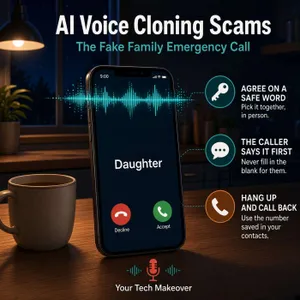
The fix is old-fashioned and free. The FBI recommends that families create a secret word or phrase to verify each other's identity. Frank adds the rule that makes it work: the caller has to produce the word, and you never fill it in for them. He also walks through exactly what to do if the call comes before your family has set one up.
In this episode, you will learn:
How AI voice cloning scams work, and where scammers get a recording of your family member's voice
Why your ear can no longer be trusted to spot a fake voice
How the fake family emergency call uses panic, authority, and secrecy to keep you on the line
How to set up a family safe word, and the one rule that keeps scammers from getting it out of you
How to choose a safe word that cannot be researched, and why you should share it only in person
What to do if you get the call before you have a safe word: hang up, call back on the saved number, and call someone else
Why any demand for gift cards, wire transfers, cryptocurrency, or a payment app means it is a scam
Resources:
FBI public service announcement on criminals using generative AI for fraud (December 2024; includes the "secret word or phrase" advice)
Report a scam to the FTC at ReportFraud.ftc.gov
Related episodes:
Gift Card Scams: How to Spot Them Before You Get Hooked (the earlier episode Frank mentions on air, covering the pay-with-gift-cards scam and the grandparent scam)
Dark Web Explained: Should You Actually Be Worried? (where the personal details in these calls often come from)
Stop the Spam: Cut Down Junk Calls and Emails (how to reduce scam calls in the first place)
Chapters:
(00:00) - Cold open: the call at nine at night
(00:57) - Welcome and what we are covering
(01:40) - Where scammers get your family's voice
(01:53) - How little audio it takes
(02:35) - Why teens and young adults are most exposed
(02:56) - Why you can't trust your ear anymore
(03:15) - The real weapon is panic
(04:00) - Support message
(04:26) - The fix: a family safe word
(04:55) - The rule that matters most: the caller says it first
(05:42) - How to pick and share a safe word
(06:20) - If the call comes before you have a safe word
(07:12) - Listen for the ask: how scammers want to be paid
(07:52) - Coming up in two weeks: gift card scams
(08:05) - Wrap up: what to do this Thanksgiving
(09:10) - Listener question
(09:36) - Outro
★ Support this podcast ★