


ADHD Women's Wellbeing Podcast
Kate Moryoussef
The ADHD Food Permission Slip: Stop Trying to Feed Everyone Perfectly and Why Good Enough Really is OK!
NOV 5, 202655 MIN
Description
Feeding yourself and your family shouldn’t feel like another daily test you’re somehow failing.
Especially when you already know what you “should” be eating — but your ADHD brain, energy and capacity aren’t always able to make it happen.
This episode is your permission slip to release the nutritional perfectionism and let “good enough” genuinely be good enough.
You're understanding your ADHD. But what happens when you’re ready to actually live differently?
Join me live in Manchester this December for The Next Chapter — an immersive event for women ready to move beyond understanding their ADHD and explore what comes next with more confidence, self-compassion and permission to be themselves.
All surrounded by like-minded neurodivergent women who truly get it. Ready for your next chapter? Find out more: Book your place here.
________________________________________
You know you probably need more protein. You know eating regularly helps. You might even have plenty of food in the house.
But then it’s 6pm, everyone needs feeding, you’re exhausted, you’ve made approximately a thousand decisions already that day and suddenly dinner feels like an emergency.
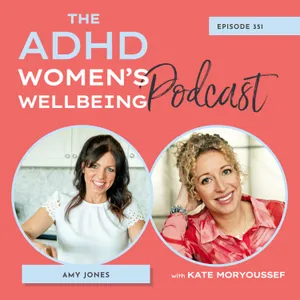
In today’s episode of The ADHD Women’s Wellbeing Podcast, I sit down with Amy Jones, Certified Functional Nutrition Practitioner, Certified ADHD Life Coach, Ontario Certified Teacher and MSc Applied Neuroscience candidate.
And this conversation is really about everything that happens in the gap between knowing what might help us and actually being able to do it.
Because for ADHD women, food isn’t simply about nutrition.
There’s executive function. Decision fatigue. Sensory needs. Hormones. Parenting. Working memory. Energy. Our nervous systems. And the fact that our capacity can look completely different from one day to the next.
Amy was diagnosed with ADHD at 45 after her youngest son’s diagnosis prompted her to look more closely at her own experiences. She now brings together nutrition, ADHD coaching, neuroscience and lived experience to help neurodivergent adults make food and self-care feel more manageable.
We talk about why traditional meal planning can ask far too much of an already depleted brain, why Amy believes we should plan for our lowest-capacity days rather than our ideal ones, and some wonderfully simple ways to reduce the number of decisions food requires from us.
There’s also a lot of permission in this conversation.
Permission to assemble dinner instead of cooking it.
To use convenience food.
To order the takeaway.
To make the fridge work for your ADHD brain.
And to stop believing that nourishing yourself or your family has to look perfect to count.
In this episode, we cover:
Amy’s late ADHD diagnosis and how her son’s diagnosis changed her understanding of herself
Why knowing what to eat and actually being able to do it are two very different things
The executive-function load hidden inside meal planning, shopping and making dinner
Why ADHD women can know exactly what would support them and still struggle to follow through
Reducing decision fatigue and building food around the life you actually have
Planning for low-capacity days rather than relying on your most motivated self
Using visibility and your fridge as a practical working-memory support
Consistent eating, hunger cues and making food easier to access
Parenting neurodivergent children, food, sensory needs and after-school overwhelm
Letting go of perfection, “shoulds” and shame around convenience food and takeaway
Timestamps:
00:00 - Welcome and introducing Amy Jones
02:15 - Amy’s late ADHD diagnosis and her family’s experience of neurodivergence
04:30 - How nutrition became part of Amy’s ADHD work
05:20 - “I know what I should do, but I can’t do it”
07:00 - The gap between knowledge and behaviour
08:20 - Why meal planning is an executive-function problem
09:00 - Mapping food around your actual life
10:00 - The hidden steps involved in making dinner
11:00 - Motherhood, neurodivergent children and the mental load around food
12:50 - Why there isn’t one food system that works for every ADHD brain
13:20 - Planning for your lowest-capacity day
14:00 - Using your fridge as a working-memory support
15:00 - Making food visible and reducing preparation
16:00 - Dinner assembly rather than cooking a full meal
17:00 - Food, regulation and the after-school crash
18:45 - Amy’s WTF’s for Dinner approach
20:00 - Hunger cues, mini meals and consistent fuel
22:10 - Capacity, visibility and remembering what’s actually in the fridge
23:00 - Perimenopause and changing capacity around cooking
24:00 - Perfectionism in the kitchen
26:00 - Parenting, control and knowing when to step away
27:30 - Learning alongside our neurodivergent children
28:30 - What to keep available for low-capacity days
29:20 - Sharing the shopping and reducing cognitive load
30:00 - What dinner can look like when you have very little left
32:00 - Why “good enough” food really is good enough
33:30 - Using AI and external tools to reduce decision-making
35:00 - Why takeaway can be part of the plan
36:30 - Letting go of food shame
37:00 - Keeping food simple and flexible
38:00 - ADHD, hormones and not knowing what capacity you’ll have tomorrow
39:00 - Cooking because you enjoy it rather than because you “should”
40:00 - A permission slip to stop trying to feed everyone perfectly
41:00 - How to work with Amy and her WTF’s for Dinner system
Links and Resources:
Join me in Manchester for The Next Chapter
Find my ADHD Women’s Wellbeing workshops and resources here
Get my book, The ADHD Women’s Wellbeing Toolkit, here
Follow the podcast on Instagram: @adhd_womenswellbeing_pod
Visit Amy’s website: amyjonesnutrition.com
Follow Amy on Instagram: @amyjonesnutrition
Find Amy on YouTube: @amyjonesnutrition
Download Amy’s free resource for ADHDWW listeners, What To Do When Food Feels Like Too Much: get it here
Kate Moryoussef is a women's ADHD lifestyle and wellbeing author, coach and EFT practitioner who helps overwhelmed and unfulfilled newly diagnosed women with ADHD find more calm, balance, hope, health, compassion, creativity and clarity.
Learn more about your ad choices. Visit megaphone.fm/adchoices