



BUILDERS
Front Lines Media
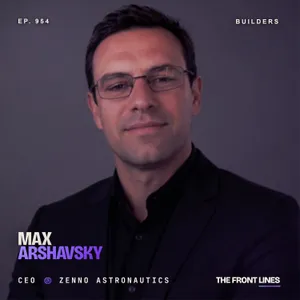
The first adopters of deep tech already understand the physics | Max Arshavsky
OCT 20, 202614 MIN
Description
Zenno Astronautics builds superconducting magnet systems for space, starting with a stabilization system that replaces fuel-based stabilization at higher orbits and expanding toward magnetic launch systems and radiation shielding.
In a recent episode of BUILDERS, we sat down with Max Arshavsky, Founder and CEO of Zenno Astronautics, to learn how the company took superconducting magnets from a technology most of the industry doubted to a commercial product that has flown in space twice.
Topics Discussed:
Why Zenno chose satellite stabilization as its first market
Why Max sees private companies as faster early buyers than government
Why the earliest adopters were engineers already literate in superconductivity
How an industry that treated superconductivity as a promise too good to be true came to see it as commercially applicable
Why six years passed between founding the company in 2017 and the first launch in 2023
How the third system is four hundred times more powerful than the first and forty times more powerful than the second in pretty much the same mass and volume
Why Max defines the entire stack of superconducting technologies as the product
Why building cool technology does not make it sell itself
GTM & Technology Adoption Lessons:
Enter through a function every customer already performs: Max said every satellite needs a stabilization system, and that the existing solutions are not self-sufficient and each has shortcomings. Zenno's first product went after that function rather than asking the market to accept a new use case.
Look for buyers who carry less risk: Asked about the first deal, Max said government is slow and more risk averse, while companies are much more agile and willing to take risk.
Find the people for whom the concept is not new: Max said the first adopters are literate in engineering and in superconductivity, so they did not need to buy into a novel concept. What they had not known was that it is now feasible in space. Because they understand it, he said, they see it as less of a risk.
Expect disbelief and answer it with hardware in orbit: Max said pretty much everyone doubted the technology and that most people in the industry saw superconductivity as a promise that was too good to be true. Zenno launched its first system in 2023 and its second in 2025, and Max described the next system as flight proven twice.
Do not assume the technology will sell itself: Max said he was one of the founders who believed it would take care of itself. He described an industry full of systems that have been invested in and stable for years, which are rightly not easy to disrupt. That reality, he said, forces you to understand the market, its trends, and what drives customers.
Define the product as the stack, then sequence it: Max defines the entire stack of superconducting technologies as the product, so the commercial actuator is not yet the complete product. The pillars he named are satellite mobility, magnetic launch systems, and radiation shielding. As each matures, Zenno builds a business around it or builds something itself around it.
Move from R&D lab to business: Max said Zenno has been a very successful R and D lab so far and that he is now laser focused on building a very successful business.
// Sponsors: Front Lines -- Silicon Valley's leading Podcast Production Studio. We help B2B tech companies launch, manage, and grow podcasts that drive demand, awareness, and thought leadership. Mention you are a listener and get a 10% discount. www.FrontLines.io/Podcast-as-a-Service