BUILDERS

Front Lines Media

Details

Welcome to BUILDERS — the show about how founders get new technology adopted. Each episode features a founder on the front lines of bringing new tech to market, sharing how they broke into their industry, earned early believers, built credibility, and unlocked real technology adoption. BUILDERS is part of a network of 20 industry-specific shows with a library of 1,200+ founder interviews conducted over the past three years. For the full network, visit FrontLines.io. Brought to you by:  www.FrontLines.io/FounderLedGrowth — Founder-led Growth as a Service. Launch your own podcast that drives thought leadership, demand, and most importantly, revenue.

Recent Episodes

OCT 22, 2026
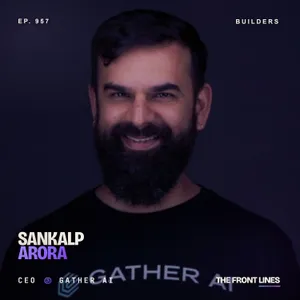
Why innovation labs are not the greatest customers | Sankalp Arora
Gather AI builds a physical AI platform for logistics, using cameras on drones, forklifts, and static mounts to digitize warehouse operations into a real-time digital twin and orchestrate facilities with AI agents. In a recent episode of BUILDERS, we sat down with Sankalp Arora, Chief Executive Officer of Gather AI, to learn how 175 customer discovery interviews turned a drone autonomy engine into a warehouse intelligence platform with 150 percent annualized NRR. Topics Discussed: How Sankalp's PhD work at Carnegie Mellon on the world's first fully safe autonomous helicopter led to Gather AI Why the team pivoted at customer discovery interview 75, after learning that large companies wanted drones but did not know what to do with them How a single VentureBeat article in August 2019 generated about 10 leads a day, pre-product, with no SEO or ads Why innovation labs at large companies turned out to be poor customers, and why mid-market operators became the real early adopters The barcode reader benchmark: Gather AI's goal of becoming a default line item when someone stands up a facility How market education evolved from live robot demos to a testimonial and reference engine Why door to door sales failed, and what it revealed about where the buyer actually sits Why 150 percent annualized NRR was the signal to build a commercial team What an engineer learned about sales: it can be more formalized than engineering The current GTM bottleneck: seller onboarding speed against a six to nine month sales cycle GTM & Technology Adoption Lessons: Pivot on buyer behavior, not technical identity: The three grad student founders assumed they would sell the autonomy engine they were known for. Discovery interviews showed that large companies would buy the engine but did not know what to do with the drones. Treat pre-product demand as the market signal: The first investment came from the conviction of people who said if you build it, I'll buy it. When the company launched a website in August 2019 with nothing behind it but a VentureBeat article, leads arrived at about 10 a day with no ads or SEO. Qualify early adopters by pain, not by title: The initial inbound came from innovation labs at large companies with a mandate to explore the problem. They turned out not to be the greatest customers. The best customers were operators, mostly mid-market, whose problems the product addressed directly. Sell where the budget sits, not where the product runs: Sankalp personally ran door to door sales at warehouses and it failed completely. The buyer, usually a VP of operations or senior director of operations, sat at the corporate head office, not at the facility. Turn early adopters into the education engine: Market education moved through phases: showing up at facilities to prove the robot works, then making early adopters successful, then circulating their testimonials. For 3PLs like the ones Gather AI serves, being featured was mutual value, since claiming differentiated, forward-looking innovation in a crowded market made them look good, backed by real ROI. Use NRR as the scaling trigger: The signal to build a commercial team came when annualized NRR reached about 150 percent while new customer acquisition was starved of investment. Hire GTM leaders who think differently: Sankalp's first commercial hire thought like him, and he calls that fault an expensive learning for the org. Running a sales team requires a different aptitude than building a solution, so he now looks for shared values with different thinking and real domain expertise. // Sponsors: Front Lines -- Silicon Valley's leading Podcast Production Studio. We help B2B tech companies launch, manage, and grow podcasts that drive demand, awareness, and thought leadership. Mention you are a listener and get a 10% discount. www.FrontLines.io/Podcast-as-a-Service

19 MIN
OCT 21, 2026
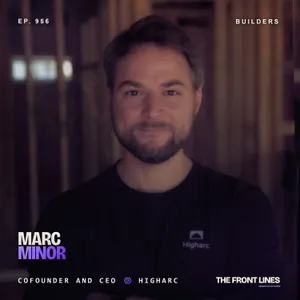
The sequencing problem in a category that takes a decade to build | Marc Minor
Higharc builds technology for home builders and distributors, taking a disconnected field of tools and third parties and streamlining the design-to-construction process digitally, producing buildable assets like construction drawings, estimating data, and pricing, along with 3D sales experiences. In a recent episode of BUILDERS, we sat down with Marc Minor, Co-founder & CEO of Higharc, to learn how the company sequenced eight years of product and market decisions and then dismantled its own functional org at 240 people. Topics Discussed: Why Higharc started with a direct-to-consumer and home builder experience and quickly learned that was the end state, not the entry point How the company moved to enterprise design partners who paid a small fee so Higharc could learn how to serve large builders Why homes are the most mass customized product out there and what that does to automation accuracy targets How Marc sequences a company's history in chapters by matching product maturity to a part of the market Why Higharc dismantled its functional matrix and flattened into a network of small teams run like general managers The first principles behind the restructure: what remote work is good at, accountability, and joy in work Why Higharc created physical hubs without moving to a full hybrid structure How a week-long, whole-company hackathon was used to get 200 plus people their own AI experience What Marc looks for in a defensible technology position: structured data that is out of distribution for the models GTM & Technology Adoption Lessons: Sequence the market to the maturity of the product: Marc described the company's chapters as "trying to place the state of the product experience to a part of the market. And over time discovering more and more about the market, about the homes, about the value chain as we go and sort of adjusting in real time." Charge your design partners something: Higharc worked with "enterprise design partners, early customers who were willing to let us serve them for a small fee, so that we could learn about how to serve large builders." A small fee does not fund a company. Accuracy sets the roadmap in high-stakes automation: "We service a very important and hard to service market because homes, you can't get it wrong." Marc added that Higharc automates many things and "Automation really has a high bar for accuracy and correctness." Design the org around the constraint you actually have: Marc did not start from an org design playbook. He started from being remote. Remote's superpowers are extreme focus and high autonomy, and its failure is collaboration. Accountability is the management surface that matters: "So high accountability is one of the only tasks I think that actually matters in a company structure to make a difference. Restructure before the hiring debt compounds: The tension Marc identified sits between "the historical functional owners where power is vested as you cl as you go up the hierarchical ladder" and an org where power follows output and team remit. Mandates do not create AI adoption, projects do: Higharc turned its annual March retreat into a week-long hackathon where "every one of our 200 plus people at that time" had to build something, salespeople included. Differentiated data is the asset, not the model: "if you have a rich structured set of data that is out of distribution for the models, you are sitting on an outstanding asset to go and build with." Higharc generates buildings as spatial data it can reason about, which is what makes agent-driven tooling on top of it defensible. // Sponsors: Front Lines -- Silicon Valley's leading Podcast Production Studio. We help B2B tech companies launch, manage, and grow podcasts that drive demand, awareness, and thought leadership. Mention you are a listener and get a 10% discount. www.FrontLines.io/Podcast-as-a-Service

19 MIN
OCT 20, 2026
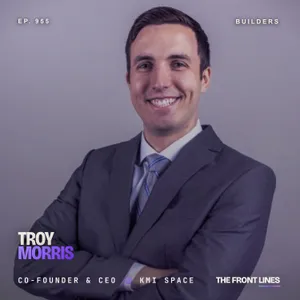
Why deep tech selling is a de-risking exercise | Troy M. Morris
Kall Morris Inc (KMI Space) is an in-space logistics company providing Relocation as a Service, covering end-of-life services, orbit change maneuvers, and active debris removal for satellite operators. In a recent episode of BUILDERS, we sat down with Troy M. Morris, Co-Founder & CEO of KMI Space, to learn how the company turned a hard physics problem into a service customers could name, understand, and buy. Topics Discussed: ● Why KMI Space reduced a complex orbital servicing category to "Tow trucks for space" and how long that clarity actually took ● How constant de-risking, not better renderings, moved KMI through its first government contracts ● Why KMI Space partnered with MIT, Stanford, and USC before applying for its first SBIRs, and how it framed those partnerships ● The 35-proposal exercise KMI Space ran against the Space Force Orbital Prime opportunity and how it narrowed to six ● The jump from a roughly quarter-million-dollar SBIR Phase I to a Phase II closer to $1.25 million, and what changes between them ● Why KMI Space built relationships with technical points of contact within hours of winning Phase I ● The customer insight that reframed the entire product: operators wanted prevention, not recovery ● Why "we want to partner with NASA" is not a go-to-market plan ● The decision to build a space company in Marquette, Michigan instead of El Segundo or the Space Coast ● What KMI Space proved on the International Space Station across 172 test runs ● How a US government shutdown and budget gap shaped KMI Space's 2026 priorities GTM & Technology Adoption Lessons: Message clarity is earned through customer contact, not workshops: KMI Space's positioning now compresses into a single phrase, "Tow trucks for space." Troy was direct about the cost of getting there. "we can absolutely lie and say that was day one. Selling deep tech is a de-risking exercise, not a demo: Troy reframed early contract wins as risk reduction rather than persuasion. "You can build awesome sketches, you can have the coolest AI write a speech or make a visual. Borrowed credibility only works if the partnership is real: KMI Space partnered with MIT, Stanford, and USC before applying for its first SBIRs, which changed how reviewers read the application. Troy drew a sharp line on how to think about it. "really leveraging it every step, not to borrow the prestige of the other group, but earn the partnership." Generate wide, then cut to where you have earned the right to win: KMI Space responded to the Space Force Orbital Prime opportunity by drafting 35 separate proposals, then narrowing to about six based on internal specialty and which partners they could actually recruit. The filter was capability plus access, not enthusiasm. Start the next contract the day you win the current one: Troy's rule for government sales is to move immediately from celebration to relationship-building with the people who will evaluate the work. "find the people who are going to be reviewing this, working with you, and build that relationship." Customer discovery is what separates an interesting capability from a fundable one: Asked what he would send back to his earlier self, Troy gave two words. "it would absolutely be two words: customer discovery." Institutions are not buyers. People inside them are: Troy described the most common mistake he sees, including from his own earlier self, as treating a large agency as a single addressable entity. "which part of NASA? What center? What mission? What human is going to read this?" // Sponsors: Front Lines -- Silicon Valley's leading Podcast Production Studio. We help B2B tech companies launch, manage, and grow podcasts that drive demand, awareness, and thought leadership. Mention you are a listener and get a 10% discount. www.FrontLines.io/Podcast-as-a-Service
25 MIN
OCT 20, 2026
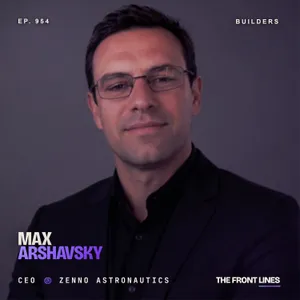
The first adopters of deep tech already understand the physics | Max Arshavsky
Zenno Astronautics builds superconducting magnet systems for space, starting with a stabilization system that replaces fuel-based stabilization at higher orbits and expanding toward magnetic launch systems and radiation shielding. In a recent episode of BUILDERS, we sat down with Max Arshavsky, Founder and CEO of Zenno Astronautics, to learn how the company took superconducting magnets from a technology most of the industry doubted to a commercial product that has flown in space twice. Topics Discussed: Why Zenno chose satellite stabilization as its first market Why Max sees private companies as faster early buyers than government Why the earliest adopters were engineers already literate in superconductivity How an industry that treated superconductivity as a promise too good to be true came to see it as commercially applicable Why six years passed between founding the company in 2017 and the first launch in 2023 How the third system is four hundred times more powerful than the first and forty times more powerful than the second in pretty much the same mass and volume Why Max defines the entire stack of superconducting technologies as the product Why building cool technology does not make it sell itself GTM & Technology Adoption Lessons: Enter through a function every customer already performs: Max said every satellite needs a stabilization system, and that the existing solutions are not self-sufficient and each has shortcomings. Zenno's first product went after that function rather than asking the market to accept a new use case. Look for buyers who carry less risk: Asked about the first deal, Max said government is slow and more risk averse, while companies are much more agile and willing to take risk. Find the people for whom the concept is not new: Max said the first adopters are literate in engineering and in superconductivity, so they did not need to buy into a novel concept. What they had not known was that it is now feasible in space. Because they understand it, he said, they see it as less of a risk. Expect disbelief and answer it with hardware in orbit: Max said pretty much everyone doubted the technology and that most people in the industry saw superconductivity as a promise that was too good to be true. Zenno launched its first system in 2023 and its second in 2025, and Max described the next system as flight proven twice. Do not assume the technology will sell itself: Max said he was one of the founders who believed it would take care of itself. He described an industry full of systems that have been invested in and stable for years, which are rightly not easy to disrupt. That reality, he said, forces you to understand the market, its trends, and what drives customers. Define the product as the stack, then sequence it: Max defines the entire stack of superconducting technologies as the product, so the commercial actuator is not yet the complete product. The pillars he named are satellite mobility, magnetic launch systems, and radiation shielding. As each matures, Zenno builds a business around it or builds something itself around it. Move from R&D lab to business: Max said Zenno has been a very successful R and D lab so far and that he is now laser focused on building a very successful business. // Sponsors: Front Lines -- Silicon Valley's leading Podcast Production Studio. We help B2B tech companies launch, manage, and grow podcasts that drive demand, awareness, and thought leadership. Mention you are a listener and get a 10% discount. www.FrontLines.io/Podcast-as-a-Service
14 MIN