FNDN Series

Matt McFarlane

Details

Heads of People, Experts and Operators sharing everything they know about building people and pay practices at some of the world most interesting companies.

Recent Episodes

NOV 14, 2026
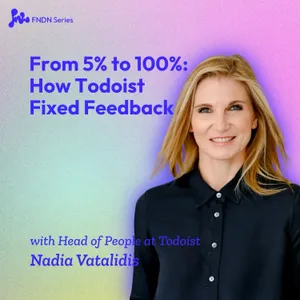
From 5% to 100%: How Todoist Fixed Feedback
Episode Summary: Nadia joined Todoist to find something unusual: a 20-year-old company, 108 people, some there for a decade, that had never had a formal career framework. No ladder. No performance system. On purpose. Todoist had always built on first principles — egalitarian, lean, and remote-first since before remote was cool. Off-the-shelf HR tools didn't fit, so they simply didn't use them. An informal pilot kept piloting, engagement sat at 5%, and feedback like "I really liked working with Matt. Great." was as deep as it got. In this episode of FNDN Series, Nadia joins Matt to share how she rebuilt everything from the ground up. From meeting all 108 employees in her first 90 days and planting seeds instead of mandating change, to launching scrappy V1s in public using Todoist's own boards. The result: 100% completion on self, peer and manager reviews with zero nudges, a public Feedback Compass built on Radical Candor, and a 3-lane nonlinear career framework where an IC9 can earn and impact like a Head 9. They also dive into the 80/20 Lead model (80% building, 20% leading), why in-the-moment feedback beats the 6-month essay, how Todoist OS powers reviews with AI, and why shadowing — like the 6-year CX team member who became a Product Designer — might be the most underrated growth tool we abandoned. Nadia also reflects on why you should never copy-paste her framework, the art of building systems not cycles, and why bringing back shadowing could be the unlock for lean, AI-native teams. This episode is brought to you by Leapsome: https://hubs.li/Q04BRZDY0 Leapsome is the Agentic HR Platform. For lean people teams with outsized business impact. Episode Chapters 00:00 – Intro: Knowing each other forever, finally connecting 01:45 – Why Todoist had nothing for 19 years 04:20 – The 108-person listening tour in 90 days 07:10 – The pilot that kept piloting: 5% engagement and incomplete reviews 09:45 – Why off-the-shelf competencies don't scale 12:15 – Planting seeds: How to build allies before you build systems 15:00 – The 3-lane framework: IC, Lead, Head 16:40 – The 80/20 Lead: 80% building, 20% leading, not managing 19:50 – Non-linear growth when you can't promote everyone to VP 22:30 – The Feedback Compass: Open-sourcing Radical Candor 25:00 – Public gratitude vs. 1:1 constructive in Bob 27:40 – Dogfooding Todoist boards to iterate the People system 30:45 – Why all feedback goes to the person + their manager 34:00 – Killing nudges and recency bias: 2 asks a month 37:45 – In-the-moment feedback vs. the 6-month ocean of feedback 41:20 – How Todoist OS and AI actually power self-reviews 44:00 – "I don't want a book": Why top 3 beats the essay 46:30 – Advice: Start with your philosophy, not a review cycle 49:10 – Shadow programs and the CX to Product Design move 52:30 – "An MBA in 2 weeks": Shadowing GitLab's CEO 55:00 – Bring back shadowing campaign 57:15 – Outro Resources 📘 Todoist Handbook & Feedback Compass: https://todoist.com/handbook — open-source guide to how Todoist gives and receives feedback 🗄 Todoist Career Framework: https://handbook.todoist.net/s/c60cbf71-0927-4d80-acec-1bb189b70a68 — visual guide used by Nadia on the episode, provides visibility into how career progression works at Todoist 💼 HiBob: https://www.hibob.com/ — HRIS Todoist uses to run feedback and reviews https://fndnseries.fndn.com.au/podcast
54 MIN
OCT 31, 2026
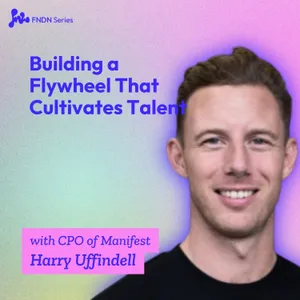
Building A Flywheel That Cultivates Talent
Harry Uffindell has spent his career hiring the kind of people you don’t need to manage. From law, to consulting, to founding his own startup, to 5.5 years as CPO at Partly, and now building at Manifest - Harry has seen what happens when you trade quality for speed. In this episode of the FNDN Series, Harry joins Matt McFarlane to share why great hiring starts before the JD goes live, how he stole Amazon’s Bar Raiser system for a Kiwi startup, and why his filter for 10x talent is simple: self-guided missiles. Matt and Harry dive into the AI-enabled 45-minute Role Launch process that saves you months of wheel-spinning, the post-loop debrief with silent reads that protects talent density, and the real cost of putting a good bum in a seat. They also unpack talent cultivation - how to build a 12-24 month tsunami of great people, why he partnered with top university societies to create a hiring flywheel, and the billboard he’d put in San Francisco to bring Aussie and Kiwi talent home. Harry also reflects on why the top 1% of grads right now are mind-blowing, why years of experience is a broken proxy for ability, and why having a non-traditional background in People might be his biggest superpower. Episode Chapters 00:00 – Intro - Welcome Harry to the FNDN Series 02:15 – How do you actually define top talent / 10x / A-players? 05:30 – The Role Launch Process: Why speed now elongates your hiring later 08:45 – Building a Claude Skill to fast-track the process for busy hiring managers 11:50 – Speed vs. Intentionality: How to get the business to accept diligence upfront 15:20 – The 50-interview junior designer and what great actually looks like 18:40 – The Bar Raiser: Stealing Amazon’s most frustrating, most impactful process 22:10 – Inside the post-loop debrief: silent reads, scores, and handling amber flags 26:35 – The vibe check: Are you excited to tap people on the shoulder? 29:30 – B-players hire C-players: When threat is actually opportunity 33:15 – Self-guided missiles: Harry’s filter for true end-to-end ownership 37:40 – Ghost jobs, 300 AI applications a day, and how to find the best in the country 41:05 – The care test: How Harry interviews for obsession 44:20 – Talent Cultivation: Playing the long game and building your tsunami 47:30 – Should you hire the person or the role? It’s stage dependent 52:00 – Referrals and the question: Who would you follow if they started a company? 55:40 – The uni society flywheel: Hiring the 2-3 go-to people in each cohort 59:10 – The San Francisco billboard to bring talent back to AU/NZ 01:02:30 – AI-native grads, equity, and why top grads want to control their destiny 01:06:45 – The AU/NZ problem: Why we can’t just trade the same talent pool 01:11:30 – Why scaling from 200 to 800 means we need to create new talent 01:14:00 – Law to CPO: Why outsiders make the biggest step changes Resources 🚀 Partly: https://www.partly.com/ - where Harry spent 5.5 years scaling the team 🛠️ Manifest: https://www.manifest.build/ - where Harry is building now https://fndnseries.fndn.com.au/podcast
40 MIN
OCT 17, 2026
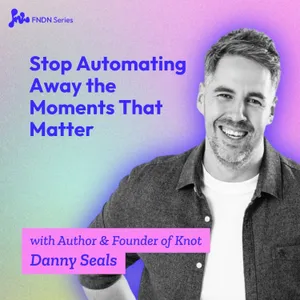
Stop Automating Away the Moments That Matter
Danny Seals has advised some of the most complex People teams in the world — big pharma, banking, and large-scale consultancies — and right now he's hearing the same thing from senior leaders everywhere: "I'm the most senior I've ever been in my career, and I feel like I'm the dumbest person. I'm burnt out. My experience has limited value because the instant answer is put it through ChatGPT." In this episode of the FNDN Series, Matt McFarlane sits down with Danny, founder of Knot, a People experience advisory, and author of The Insightful Innovator, to unpack the big addiction to efficiency that's sweeping People and Culture. Danny calls it Minutes vs. Moments — we’re obsessed with saving 10 minutes here and there, but we’re removing all the moments that actually build trust, loyalty and high-performing teams. From banking chatbots named Aura that add friction instead of removing it, to bereavement leave being handled by a bot, to HR teams vibe-coding their entire tech stack in Claude, we explore what should be automated and what should never be touched. Matt and Danny also get into product-led thinking for People teams, his SPIES framework (Subscription, Products, Interactions, Experiences, Services), why IKEA turned customer service reps into digital interior designers instead of making them redundant, what X-shaped people do differently from T-shaped specialists, and how his Team MRI diagnostic — run over 100 times — helps teams see where experience is really leaking. If you're building a People function in the age of AI, this is the filter you need before you automate anything. Episode Chapters 00:00 – Intro 01:08 – Welcome to the pod with Danny Seals 02:40 – Where is People experience practice today? 03:03 – The AI & efficiency addiction: why senior leaders feel burnt out 04:49 – Where AI pressure is really coming from in HR 05:53 – Minutes vs. moments: the framework 07:30 – Moments that matter that AI should never touch 09:30 – SPIES, banking apps, and situational design 13:00 – When fraud happens: why white-glove human service is becoming a premium 19:00 – Product thinking vs. "work as a product" — language matters 28:00 – SPIES explained: hardware is strategy, software is capability 32:00 – T-shaped vs M-shaped vs X-shaped people 37:00 – Hiring for curiosity: what X-shaped people do day-to-day 41:00 – From crime scene investigation to audience insight: what "leakage" tells you 46:00 – The rise of the People engineer and what IKEA got right 50:00 – Vibe-coding your HR stack and the redundancy-to-rehire trap 54:00 – The future of the HRBP role: capability vs. job description 60:00 – The Team MRI: diagnosing 12 traits of high-performing teams 67:22 – One idea to steal: problem valuation — talk in feelings and figures 🧠 Danny Seals – People Experience expert, founder of Knot and Knot Another Newsletter 📚 The Insightful Innovator – Book by Danny Seals on People experience 🏢 IKEA Case Study – Reskilling customer service reps into digital interior designers https://fndnseries.fndn.com.au/podcast
58 MIN
SEP 5, 2026
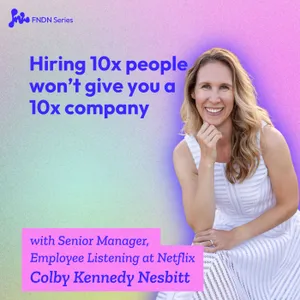
Hiring 10X People Will Not Give You a 10X Company with Colby Nesbit
Description: Welcome back to the FNDN Series, where we dive into startup compensation with industry leaders from across the startup world. In this episode, Matt McFarlane speaks with Colby Nesbitt about the “10X employee” and whether hiring exceptional people is really the key to building high-performance companies. They explore power laws, performance, compensation, AI, skills-based pay, and how changing technology is reshaping the way companies think about talent and work. They also discuss AI layoffs versus redeployment, team-based rewards, the future of job structures, and why building a great system may matter more than simply hiring great people. Chapters: 01:09 Guest Introduction: Colby Nesbitt 02:45 The Power Law and the 10X Employee 06:19 Performance, Compensation and 10X Pay 10:54 AI and the Future of Management 14:30 The Problem With Traditional People Analytics 18:45 AI, Skills and Career Progression 22:37 The Shelf Life of Skills 28:36 Why the Spreadsheet Never Tells the Whole Story 32:15 Redeployment vs. AI Layoffs 34:56 Building a High-Performance System 43:16 What Sports Teach Us About Talent 45:32 Team-Based Performance and Rewards 50:29 AI and the Future of Work 55:26 The Future of Jobs and “Tiger Teams” 59:39 Final Thoughts Follow Colby: https://linkedin.com/in/colby-kennedy-nesbitt-ph-d-0824b979/ Resources Mentioned: Colby Nesbitt Article: Variance, Explained: https://varianceexplained.substack.com/p/performance-is-not-a-power-law Work Rules! by Laszlo Bock https://hachettebookgroup.com/titles/laszlo-bock/work-rules/ Radical Candor by Kim Scott https://radicalcandor.com/the-book More FNDN Episodes: Spotify: https://open.spotify.com/show/4GeBIeZOKrFxG1oiiPxmiM Apple Podcasts: https://podcasts.apple.com/us/podcast/fndn-series/id1794263484 PowerLaw, 10XEmployees, HighPerformance, StartupCompensation, PeopleAnalytics, PerformanceManagement, FutureOfWork, AIAtWork, AICompensation, TalentStrategy, OrganizationalDesign, CompensationStrategy, TeamBasedRewards, MeritPay, SkillsBasedCompensation, WorkforceAnalytics, EmployeePerformance, TalentManagement, StartupLeadership, PeopleOperations, AIWorkforce, FutureOfCompensation, WorkRedesign, CareerProgression, OrganizationalPsychology

60 MIN
AUG 22, 2026
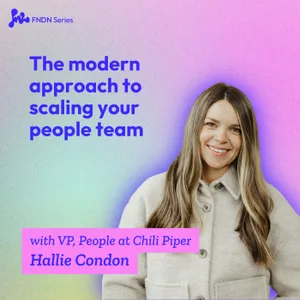
The Modern Approach to Scaling Your People Team with Hallie Condon,
Welcome back to the FNDN Series, where we continue our deep dive into startup people and reward practices, with industry leaders from across the startup world. In our conversation with Hallie Condon, VP of People at Chili Piper, we unpack what it actually looks like to build AI deep into a people function. We dive into how her small team decides what to automate and what to keep human, the "company brain" she built so institutional knowledge doesn't walk out the door when someone leaves, and the surprising shift in context she's losing now that employees go to AI before they come to the people team. We also get into her sharpest take of all: why the traditional promotion path expects people to do the job for free before anyone will pay them for it. Keep watching to hear how AI is reshaping people operations, performance reviews, and the employer-employee relationship. Join Startup People Summit, a one-day virtual conference designed for startup People leaders who want practical insight, honest conversations and proven approaches to scaling their People function — get your ticket here: www.startuppeoplesummit.com Chapters: 00:46 Guest Introduction: Hallie Condon, VP of People at Chili Piper 01:58 Managing a Fully Remote Team Across 36 Countries 04:07 How AI Shows Up in the People Function Day-to-Day 05:19 Automating Separation Letters and Admin Work 06:56 Using AI to Cross-Check Budgets Fairly 08:31 No Clean Strategy: Automating as Problems Come Up 10:29 The Tiered System: What Should and Shouldn't Be Automated 13:53 Introducing "Company Brain": Chili Piper's AI Knowledge Repo 16:03 Skills Library and Role-Based Onboarding 17:56 How Decision Memos Get Documented and Indexed 19:37 Company Brain and Reducing Attrition Risk 21:47 Fewer Conversations: Are People Going to AI Instead of HR? 23:20 Balancing Context-Gathering with Employee Trust 26:14 What the Memory System Deliberately Doesn't Retain 28:14 More Time for Deep Work, Fewer Casual Check-Ins 29:43 What Companies Got Wrong with AI-Driven Layoffs 32:36 The Breaking of the Employee-Employer Bargain 36:07 Gen Z, Boundaries, and the "Do the Job for Free First" Problem 39:01 Rethinking How Companies Assess Impact and Potential 40:04 Chili Piper's Approach: Promoting Early, Pay Range Transparency 42:06 Why People Managers Don't Get Paid More at Chili Piper 45:43 Introducing the "Impact Intelligence" Tool 50:30 Building Performance Principles with AI's Help 51:33 Final Advice: Get Curious About AI and Rethink Reciprocity Connect with Hallie Visit: chilipiper.com https://www.linkedin.com/in/hallie-condon-0b181325/ Resources Mentioned Company Mentioned: Chili Piper - B2B SaaS company where Hallie is VP of People, with ~150 employees across 36 countries Oyster - Global employment/compliance platform Hallie credits for managing their distributed workforce Claude - AI assistant used to power Chili Piper's "Company Brain" and impact intelligence tools Granola - Meeting notes tool Hallie uses to capture context from conversations More FNDN Episodes: Spotify: https://open.spotify.com/show/4GeBIeZOKrFxG1oiiPxmiM Apple Podcast: https://podcasts.apple.com/us/podcast/fndn-series/id1794263484
53 MIN