Futureproof Founder Podcast

Jeff Mains

Details

Futureproof Founder is the podcast for founders and executive leaders scaling companies from startup to $30M and beyond. Hosted by five-time founder Jeff Mains, each episode delivers real-world leadership insights, hard-earned lessons, and practical strategies for navigating growth. Tuesdays feature candid founder stories. Thursdays bring actionable playbooks from top operators and experts on AI, go-to-market, team building, leadership, and more. Real stories. Real decisions. Practical intelligence for what comes next.

Recent Episodes

OCT 22, 2026
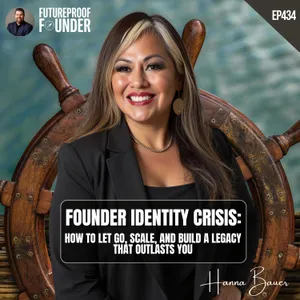
434 | Founder Identity Crisis: How to Let Go, Scale, and Build a Legacy That Outlasts You | Hanna Bauer
Seventy percent of digital transformations fail, and the software usually isn’t the problem. The people, processes, and culture weren’t ready for the change. In this episode, Hanna Bauer explains why every system needs a “human API,” how asking for feedback without following up destroys psychological safety, and why founders must decide whether they’re building a successful company or one that can succeed without them. She also shares how to stay anchored in identity while adapting to disruption, changing markets, and new technology. Key Takeaways 00:00 Discussing human API and feedback 06:15 Learning financial agility during disruption 09:16 Google's Project Aristotle findings 11:16 Importance of acting on feedback 15:00 Founder vision and succession planning 18:57 Resistance to New Tools 21:42 Discussing governance and technology adoption 25:01 Addressing communication and tech silos 28:22 Chasing funding at nonprofits 30:55 Adapting to industry disruption 34:47 Leadership and succession planning 37:10 Teaching organizational core method 41:03 Understanding Business Development Stages 44:57 Addressing communication and feedback issues 46:57 Aligning business decisions Tweetable Quotes “My friction was really the opportunity for the traction.” Hanna Bauer 05:14 “An increase in income did not necessarily mean an increase in profitability.” Hanna Bauer 06:43 “You can get really stuck in the details and miss the forest by just looking at the tree.” Hanna Bauer 07:35 “Whenever you do ask the question, I’m very much interested in the answer and I’m going to follow up.” Hanna Bauer 12:02 “The question isn’t whether your company is successful, it’s whether it can succeed without you.” Jeff Mains 03:15 “You’re not going to have something you don’t adopt.” Hanna Bauer 21:42 “I’m not going to adopt something that doesn’t look and feel and work like me.” Hanna Bauer 21:50 “The smallest of action will always trample the greatest of intention.” Hanna Bauer 38:27 “You have to know your season.” Hanna Bauer 42:08 “I cannot lead my people where I don’t know where we’re going.” Hanna Bauer 42:01 “If people are not responding to my overall call for feedback, I need to own that.” Hanna Bauer 45:36 “Success happens to you. Significance happens through you.” Hanna Bauer 14:24 SaaS Leadership Lessons Design the human API before choosing the tool. Hanna Bauer says the real question isn’t whether software works. It’s whether people can integrate it into their daily work. Without that connection, resistance and workarounds follow Treat feedback as a commitment. Asking for employee input and then going silent actively damages psychological safety. Leaders need to explain how ideas were evaluated, why some weren’t selected, and what happens next Build psychological safety through clear support systems. People need to know where to go with questions, how feedback is handled, and what follow-up looks like. Hanna Bauer compares this support structure to a spine that helps the whole organization function 10:09. Fix the process before forcing the software to fit. Start by identifying pain, waste, and duplicate work. Then adapt the tool to remove unnecessary steps instead of preserving inefficient processes simply because they’re familiar Keep identity stable while methods change. Hanna Bauer compares organizational culture to personal character. Processes, tools, and market approaches may change, but the company’s mission, values, and purpose should guide which opportunities it accepts Build a company that can make decisions without the founder. Founders need to give leaders a clear lens for decision-making through vision, mission, and values. That’s how teams make sound choices without sending every decision back to the founder Guest Resources [email protected] https://heartnomics.com https://facebook.com/hannad.bauer http://www.linkedin.com/in/bauerhanna https://www.instagram.com/hannabauer777/ Episode Sponsor The Futureproof Series - https://www.youtube.com/playlist?list=PLfkXKUPZ5xuOqMPR7_gzGybncTtavyR1N The Captain's Keys Small Fish, Big Pond – https://smallfishbigpond.com/ Use the promo code ‘SaaSFuel’ Champion Leadership Group – https://championleadership.com/ https://jeffmains.com/books/ SaaS Fuel Resources Website - https://championleadership.com/ Jeff Mains on LinkedIn - https://www.linkedin.com/in/jeffkmains/ Twitter - https://twitter.com/jeffkmains Facebook - https://www.facebook.com/thesaasguy/ Instagram - https://instagram.com/jeffkmains

48 MIN
OCT 20, 2026
433 | How to Disrupt a Dinosaur Industry: Gun Storage, Creative Conflict, and the Band of Misfits | Tom Kubiniec
What do you do when your revenue disappears completely? After eight months without a single order, Tom Kubiniec was preparing to sell his house to keep the business alive. Instead of doubling down on the same market, he found a $700 million consumer opportunity behind an $11 million defense market. In this episode, Tom explains why he avoids competitor research when solving a new problem, how “why do we have mice?” beats building a better mousetrap, and why creative conflict helps his team move faster. He also shares what happened when he shut off $30,000 a month in Google Ads and saw no change in traffic or sales. This is a conversation about pressure, purpose, fast course correction, and building a company around a problem worth solving. Key Takeaways 00:00 Discovering a $700M market 06:07 Switching from music to sales 08:23 Landing US Army contract 11:25 Reflecting on business challenges 14:44 The mindset of true entrepreneurs 17:43 Creative problem-solving approach 23:10 Modern threat: shift in break-ins 24:02 Discussing gun safe security issues 29:12 Encouraging Open Dialogue at Securit 31:34 Reflecting on marketing struggles 35:31 Empowering employees and valuing creativity 38:17 Questioning ad campaign results 40:57 Challenges of managing digital marketing 44:23 Mission to secure firearms safely 48:39 Engineering a high-speed small car 50:21 Rethinking business challenges Tweetable Quotes “Making money is a perk.” Tom Kubiniec 00:00 “The win is getting the order.” Tom Kubiniec 00:30 “Sometimes you don’t see the future properly unless your back’s against the wall.” Tom Kubiniec 10:55 “When your back’s against the wall, you see things differently.” Tom Kubiniec 11:18 “You have to love that battle.” Tom Kubiniec 14:08 “Every successful person is just jumping from failure to failure.” Tom Kubiniec 14:16 “The worst thing you can do is think about things too long.” Tom Kubiniec 14:30 “It’s not who’s right, it’s what’s right.” Tom Kubiniec 30:08 “The last thing I want to do is see what others have done.” Tom Kubiniec 17:52 “We didn’t know there was a box.” Tom Kubiniec 17:52 “Why do we have mice?” Tom Kubiniec 19:39 “If we solve the problem, we don’t need a mousetrap.” Tom Kubiniec 19:43 “Quirkiness is an asset in my world.” Tom Kubiniec 31:00 “I don’t have a problem admitting I’m wrong. In fact, sometimes it’s fun.” Tom Kubiniec 33:28 “Why do I do this?” Tom Kubiniec 44:12 “The what can sell, can run a company, but the why can change the world.” Tom Kubiniec 44:23 “You can build a company that lasts and live a life worth remembering.” Jeff Mains 01:43 “Don’t deny yourself the struggle.” Jeff Mains 51:12 SaaS Leadership Lessons Solve the underlying problem, not the visible symptom. Tom Kubiniec challenges founders to stop asking how to “build a better mousetrap” and ask, “Why do we have mice?” Start with the root problem before improving the existing solution Let constraints force better thinking. After eight months without an order, Tom moved from military storage into consumer products and found a much larger market. His lesson: “When your back’s against the wall, you see things differently” Fail fast, then course-correct. Tom Kubiniec says his company makes decisions quickly. If the decision is wrong, the team adjusts. Waiting too long creates its own risk Build a culture where people can challenge leadership. Tom tells new employees that he makes mistakes and needs people to speak up. His standard is simple: “It’s not who’s right, it’s what’s right” Don’t confuse personal taste with performance. An outside agency created ads Tom disliked, but the campaigns produced strong results. He accepted that the work performed better than his own preference and let the data decide Give the company a purpose beyond revenue. For Tom, money is a byproduct. Secure-It’s purpose is to change how America stores firearms, and the win is seeing customers realize the product solves the problem better Guest Resources [email protected] https://www.secureitgunstorage.com/ https://www.linkedin.com/in/tomkubiniec/ Episode Sponsor The Futureproof Series - https://www.youtube.com/playlist?list=PLfkXKUPZ5xuOqMPR7_gzGybncTtavyR1N The Captain's Keys Small Fish, Big Pond – https://smallfishbigpond.com/ Use the promo code ‘SaaSFuel’ Champion Leadership Group – https://championleadership.com/ https://jeffmains.com/books/ SaaS Fuel Resources Website - https://championleadership.com/ Jeff Mains on LinkedIn - https://www.linkedin.com/in/jeffkmains/ Twitter - https://twitter.com/jeffkmains Facebook - https://www.facebook.com/thesaasguy/ Instagram - https://instagram.com/jeffkmains

52 MIN
OCT 15, 2026
432 | How Cross-Functional Alignment Prevents Costly Project Failures | Deborah Kaminetzky
A software implementation can be delivered on time and on budget, then fail the moment people refuse to use it. In this episode, Jeff Mains talks with Deborah Kaminetzky, founder of De Facto Project Management, about the gap between what companies buy and what their teams actually need. Deborah explains why adoption belongs in the project plan from day one, how secret spreadsheets expose broken processes, and why the people using the system every day need a voice before anything gets built. They also tackle sales-to-delivery misalignment, change management, custom development, AI-built tools, data ownership, security, and the real cost of maintenance. Because technology can’t fix a broken process. It can only make the break easier to automate. Key Takeaways 00:00 Build vs. buy in tech decisions 04:58 Reflecting on career path decisions 06:59 Translating between software and client 11:20 Importance of early training integration 13:49 Gathering input from all levels 19:35 Dealing with SaaS integrations 20:29 Documenting Processes and Risk Management 25:16 Ensuring client project understanding 28:12 Navigating client project expansion 31:10 Importance of Client Understanding 35:47 Choosing the right SaaS provider 39:17 App security vulnerabilities 42:11 Importance of preparing clients 46:11 Upcoming founder and playbook episodes 47:02 Introduction to Future Proof Founder Tweetable Quotes - “On time and on budget are nice, but adoption is the main thing.” Deborah Kaminetzky [09:23] - “Technology won’t fix bad processes, and it definitely won’t fix communication.” Deborah Kaminetzky [08:26] - “If you don’t build what they need and what they’re going to use, they won’t adopt it.” Deborah Kaminetzky [09:23] - “You need to consider training and adoption at the very beginning.” Deborah Kaminetzky [11:20] - “No company should be running with really important information in somebody’s head.” Deborah Kaminetzky [17:29] - “You have to take risks because those are also opportunities.” Deborah Kaminetzky [21:25] - “I don’t mince words. I’m not going to be like, ‘Oh, okay, fine.’” Deborah Kaminetzky [22:47] - “Just because somebody can do it for you does not mean they’re going to be able to maintain it.” Deborah Kaminetzky [35:02] - “Just because you can doesn’t mean you should.” Deborah Kaminetzky [40:09] - “Software is never done.” Jeff Mains [40:19] - “You need to know what you’re getting into.” Deborah Kaminetzky [43:22] - “Technology can’t fix a broken process. It just makes the break easier to automate.” Jeff Mains [46:08] SaaS Leadership Lessons 1. Measure adoption, not delivery. On time and on budget don’t matter if nobody uses the software. Plan for adoption from day one. 2. Understand the real process first. Technology won’t fix broken workflows. Talk to the people doing the work, not only executives. 3. Involve delivery before the sale closes. Bring an engineer, project architect, or project manager into pre-sales to confirm the solution is practical. 4. Train people in context. Use real workflows, devices, and customizations. Include users throughout the project and show them what improves their work. 5. Treat shadow IT as a warning sign. Secret spreadsheets and workarounds create inaccurate reporting and concentrated knowledge risk. 6. *Price the maintenance, not just the build. Before choosing a custom solution, assess ownership, security, compliance, integrations, and failure scenarios. Guest Resources https://defactoprojectmanagement.com/ https://www.linkedin.com/in/deborah-kaminetzky-pmp-fractional-project-manager/ Episode Sponsor The Futureproof Series - https://www.youtube.com/playlist?list=PLfkXKUPZ5xuOqMPR7_gzGybncTtavyR1N The Captain's Keys Small Fish, Big Pond – https://smallfishbigpond.com/ Use the promo code ‘SaaSFuel’ Champion Leadership Group – https://championleadership.com/ https://jeffmains.com/books/ SaaS Fuel Resources Website - https://championleadership.com/ Jeff Mains on LinkedIn - https://www.linkedin.com/in/jeffkmains/ Twitter - https://twitter.com/jeffkmains Facebook - https://www.facebook.com/thesaasguy/ Instagram - https://instagram.com/jeffkmains
47 MIN
OCT 13, 2026
431 | The Hidden Work Behind Cross-Border Supply Chains | Daman Grewal
Daman Grewal grew a logistics company from $1 million to $24 million in four years, working across dispatch, safety, accounts receivable, and sales before he fully recognized the skills he was building. Now he runs Centurion Trucking, teaches sales through the free Logistics Sales platform, and is building a visibility tool for small and mid-sized carriers. In this conversation, Daman breaks down why sales is really communication, how to question the belief that you “can’t afford to hire,” and what to do when a development vendor keeps promising progress without delivering the product. He also shares why service should come before the sale, how setbacks build resilience, and why better visibility can help smaller logistics companies compete with larger players. Key Takeaways 00:00 Sales is applied communication 01:45 The complexity behind modern logistics 04:31 Lessons from starting work at 19 05:32 What happens when freight crosses borders 09:22 Why Logistics Sales was created 11:58 Discovering the value of sales work 14:26 Teaching sales across 65 countries 18:36 Rethinking the cost of hiring 20:50 “Is that really true?” 25:01 What COVID revealed about supply chains 28:18 Building visibility for trucking companies 33:33 What went wrong with the first development vendor 36:36 Rebuilding with an in-house team 39:12 Sales as service, not pressure 45:52 Consistency, mindset, and resilience Tweetable Quotes - “There’s nothing crazy about sales besides just the art of communication. And we all do it every day.” Daman Grewal [00:14] - “When you don’t have any limitations per se, then sky’s the limit.” Daman Grewal [05:19] - “If you bought it, a truck brought it.” Daman Grewal [06:02] - “Every single business has a sales component.” Daman Grewal [10:45] - “Let’s take the fear out of this whole thing. Let’s take the blocks away.” Daman Grewal [11:16] - “Solve the problem first. Worry about everything later.” Daman Grewal [20:03] - “Is that really true?” Daman Grewal [20:50] - “You don’t realize that you can create opportunities.” Daman Grewal [23:18] - “Everything, if you follow it to its origin, has a story.” Daman Grewal [27:54] - “There’s no way that we can move forward” when trust is gone. Daman Grewal [36:29] - “Everyone has to go through challenges.” Daman Grewal [37:01] - “The person that’s been to zero has nothing to lose and everything to gain in life.” Daman Grewal [48:31] - “Who’s the programmer?” Daman Grewal [49:26] - “The only person that’s truly putting restrictions on ourselves is the person that’s looking in the mirror.” Daman Grewal [22:20] - “If we do well, we want the people around us to do well.” Daman Grewal [40:40] SaaS Leadership Lessons 1. Prove capability before funding development. Ask vendors to demonstrate the core feature before committing further resources 2. Tie payments to milestones. Daman Grewal stopped paying invoices when the team couldn’t show progress on the product’s main feature 3. Build for a clear customer segment. His platform targets small and midsize logistics companies that lack the tools available to larger operators 4. Make visibility simple. The product combines vehicles, providers, shipment tracking, and paperwork in one platform 5. Use transparency to retain customers. Daman Grewal linked customer retention over 20 years to the visibility his company provided 6. Treat setbacks as information. After changing vendors, he built an in-house team and kept moving forward [36:36] Guest Resources www.linkedin.com/in/daman-grewal-12424a16 www.LogisticsSales.com https://www.facebook.com/centurion.trucking Episode Sponsor The Futureproof Series - https://www.youtube.com/playlist?list=PLfkXKUPZ5xuOqMPR7_gzGybncTtavyR1N The Captain's Keys Small Fish, Big Pond – https://smallfishbigpond.com/ Use the promo code ‘SaaSFuel’ Champion Leadership Group – https://championleadership.com/ https://jeffmains.com/books/ SaaS Fuel Resources Website - https://championleadership.com/ Jeff Mains on LinkedIn - https://www.linkedin.com/in/jeffkmains/ Twitter - https://twitter.com/jeffkmains Facebook - https://www.facebook.com/thesaasguy/ Instagram - https://instagram.com/jeffkmains
53 MIN
OCT 8, 2026
430 | Revenue Per Employee, Capital Efficiency, and the Future of Startup Growth | Lindsey Mignano
Are you raising venture capital because your business needs it—or because getting funded feels like proof you’ve made it? In this episode of Futureproof Founder, Jeff Mains sits down with Lindsey Mignano, founder of Mignano Law Group and a fourth-generation entrepreneur, to explore how AI is reshaping legal services, startup economics, and fundraising expectations. Drawing on her work with venture-backed technology companies, Lindsey explains why she is seeing working products and customer trials at pre-seed, tougher questions about retention and repeatable sales at seed, and substantial financing rounds supporting surprisingly small teams. She also makes the case that valuable legal counsel is increasingly about judgment, communication, and understanding risk—not simply providing information founders can find themselves. The conversation goes beyond getting a term sheet. Jeff and Lindsey examine the tradeoffs between raising another round and pursuing an acquisition, why founders should evaluate investors like other service providers, and how the prestige of venture backing can distract from more suitable funding options. Key Takeaways [~09:30] How AI is changing the economics of legal services. Lindsey explains how a virtual, AI-enabled firm combines experienced attorneys with lower overhead—and discusses the training challenges created when firms hire fewer junior lawyers. [~16:00] Information is accessible. Judgment is the differentiator. Good counsel helps founders understand their options, recognize meaningful risks, and make decisions that fit their risk tolerance rather than simply delivering more information. [~27:30] A pitch deck alone is no longer the pre-seed standard Lindsey is seeing. As AI reduces some development costs, founders face greater expectations to arrive with a functional product, customer trials, and evidence that people will use what they are building. [~32:30] Seed is starting to look like the old Series A. Lindsey describes earlier scrutiny of paying customers, retention, expansion, unit economics, and whether the sales process works beyond a founder’s personal relationships. [~34:00] Your lead investor can bring more than a check. Discussing the difficult transition from seed to Series A, Lindsey highlights the strategic support, relationships, and potential follow-on funding that strong institutional investors can provide. [~36:30] A substantial financing round does not require a substantial headcount. Lindsey describes companies pairing a $25 million Series A with teams of ten or fewer, illustrating the attention investors are giving automation and capital efficiency. [~39:00] Growth at all costs is facing harder questions. Jeff and Lindsey explore the tension between moving quickly and building durable growth through the right customers, sustained usage, and expansion. [~45:30] Round labels tell less of the story than they used to. Lindsey argues that financing size, business requirements, and diligence expectations can be more useful than labels such as pre-seed, seed, or Series A. [~48:00] Acquisitions are becoming part of the early-stage conversation. Lindsey shares examples of Series A companies acquiring smaller startups and founders considering another financing round and a potential sale in parallel. [~55:00] Venture capital is not automatically the right destination. Market opportunity, ownership preferences, growth expectations, and personal goals all belong in the decision. Lindsey also discusses alternatives such as revenue-based financing, loans, and grants. [~01:03:30] Evaluate investors like any other important service provider. A willingness to invest is not enough. Lindsey urges founders to assess the expertise, guidance, partnership, and expectations that come with the money. [~01:07:00] Redefine success beyond headcount and office size. Lindsey brings the discussion back to revenue quality, operating efficiency, and whether founders genuinely want to run the kind of business they are building. Tweetable Quotes “I think there’s just no room for people who just give options anymore.”— Lindsey Mignano “There’s more money at seed than there was before, and so the demands are higher.”— Lindsey Mignano “I think there are a lot of companies that don’t need to accept venture dollars.”— Lindsey Mignano “Venture funds are service providers.”— Lindsey Mignano “Venture capital isn’t a milestone. It’s a service with a price, terms, strings, and a very specific kind of life attached to it.”— Jeff Mains SaaS Leadership Lessons Choose your capital strategy after defining your goals. Lindsey challenges founders to separate the prestige of venture backing from its practical fit. Consider the business you want to operate, the control you value, and the growth expectations you are willing to accept before pursuing a financing path. Turn early traction into a repeatable business. A trial, a letter of intent, and a paying customer represent different levels of validation. Lindsey’s seed-stage discussion emphasizes what happens next: customers staying, expanding their usage, and buying through a sales process that works beyond the founder’s existing network. Measure results and economics—not organizational size. The lean-team examples challenge the idea that hiring more people automatically signals progress. Focus on what the team produces, what it costs to generate revenue, and where automation genuinely improves efficiency. A larger payroll is not the same thing as a stronger company. Evaluate the investor relationship, not just the offer. Lindsey’s service-provider framing encourages founders to look beyond the amount raised. Consider an investor’s guidance, connections, expectations, and capacity to support future stages. Being excited that someone said yes should not replace evaluating whether the relationship fits. Pay for judgment that improves decisions. The legal-services discussion offers a broader leadership lesson: access to information does not eliminate the need for expertise. Valuable advisers explain complexity, understand the decision-maker, and help distinguish material risks from possibilities that deserve less attention. Do not assume another funding round is the only next step. Lindsey describes founders weighing further financing against acquisition opportunities. The lesson is to examine the tradeoffs deliberately: additional dilution, future expectations, potential outcomes, and personal priorities. Continuing to raise and choosing to sell are different paths—not automatic measures of ambition. Guest Resources [email protected] www.mignanolawgroup.com https://www.facebook.com/lindsey.mignano/ https://www.linkedin.com/in/lindsey-mignano-477a0167/ https://www.instagram.com/lindsey_mignano Episode Sponsor The Futureproof Series - https://www.youtube.com/playlist?list=PLfkXKUPZ5xuOqMPR7_gzGybncTtavyR1N The Captain's Keys Small Fish, Big Pond – https://smallfishbigpond.com/ Use the promo code ‘SaaSFuel’ Champion Leadership Group – https://championleadership.com/ https://jeffmains.com/books/ SaaS Fuel Resources Website - https://championleadership.com/ Jeff Mains on LinkedIn - https://www.linkedin.com/in/jeffkmains/ Twitter - https://twitter.com/jeffkmains Facebook - https://www.facebook.com/thesaasguy/ Instagram - https://instagram.com/jeffkmains
54 MIN