



Futureproof Founder Podcast
Jeff Mains
435 | The VC Incentives Every Founder Must Understand Before Taking Institutional Money | Calvin Cooper
OCT 27, 202649 MIN
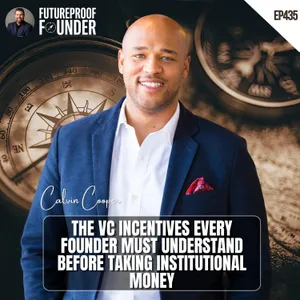
Description
Most founders don’t realize what changes when venture capital enters the business. A $5 million check returning $50 million may sound like a win, but for a large fund, that outcome can still fall short. Before taking institutional capital, understand the fund’s economics, return expectations, and the growth trajectory you’re agreeing to pursue.
This episode explores venture finance, Rove’s path from idea to public company, and the pressure to go bigger when profitable growth isn’t enough for the backers. The conversation also turns to AI inference, where task-specific systems can cut costs from tens of thousands of dollars to hundreds per month. The through line is simple: understand the other side of the table, stay curious, and build what lasts.
Key Takeaways
00:00 Understanding VC Fund Mechanics
06:18 Working at Apple retail
07:49 Deciding to become a venture capitalist
13:11 Taking unconventional paths to success
14:02 Understanding Venture Capital Dynamics
17:45 Deciding to pursue the dream
23:07 Understanding venture capital suitability
23:57 Understanding Venture Capital Basics
29:20 Trends and opportunities in venture capital
32:10 Forming a tech startup team
34:34 Early product development stages
37:54 Challenges of scaling AI models
42:27 Understanding the importance of empathy
45:06 Promoting personal and company projects
48:11 VC expectations and future-proofing
Tweetable Quotes
“Entrepreneurship is water and you're a fish and you just swim.” [06:10]
“I assumed the field doesn't want me.” [09:50]
“You don't need a job or a status symbol credential or permission to do most things today.” [15:10]
“Your identity can precede status labels in the world.” [14:52]
“If you don't run the business, then I'm out.” [17:40]
“Ship the product and get a dollar.” [22:14]
“The buyers are liars.” [22:31]
“Is this the right source of capital for you?” [23:07]
“Raising venture capital isn't the goal. It's an enabler.” [28:12]
“Most inference requests don't need frontier capability.” [31:36]
“You really can't have something that's the smartest, fastest, and cheapest.” [33:07]
“Ask yourself where you're not being curious.” [43:33]
SaaS Leadership Lessons
1. Understand investor incentives: A $5 million check returning $50 million may still fall short for a large venture fund. Know what your backers need.
2. Match capital to ambition: Venture capital fits companies pursuing very large outcomes. It isn’t the right path for every profitable business.
3. Ship early: At the zero-to-one stage, the product is the survey. Get something into customers’ hands and earn the first dollar.
4. Filter feedback: Take useful input seriously, reject what doesn’t fit, and move quickly on the rest.
5. Ask where curiosity is missing: That question exposes weak assumptions about customers, markets, and decisions.
6. Optimize for the job, not the biggest model: Most AI workloads don’t need frontier capability. Task-specific systems can cut costs while maintaining performance.
Guest Resources
https://legendarypodcasts.com/calvin-cooper/
Episode Sponsor
The Futureproof Series - https://www.youtube.com/playlist?list=PLfkXKUPZ5xuOqMPR7_gzGybncTtavyR1N
The Captain's Keys
Small Fish, Big Pond – https://smallfishbigpond.com/ Use the promo code ‘SaaSFuel’
Champion Leadership Group – https://championleadership.com/
https://jeffmains.com/books/
SaaS Fuel Resources
Website - https://championleadership.com/
Jeff Mains on LinkedIn - https://www.linkedin.com/in/jeffkmains/
Twitter - https://twitter.com/jeffkmains
Facebook - https://www.facebook.com/thesaasguy/
Instagram - https://instagram.com/jeffkmains