


Rad Chat
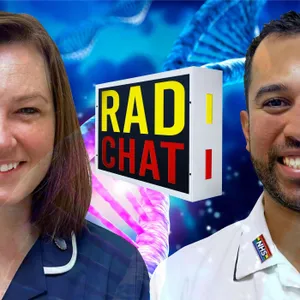
Naman Julka-Anderson and Jo McNamara
E225: Pierre Montay-Gruel - Radiobiology and the FLASH Revolution
NOV 5, 202638 MIN
Description
Trigger Warning: this episode discusses cancer and cancer treatment.
Episode 225: Part of the Education and Workforce Development series (Part 77)
Description: In this fascinating episode, Naman Julka-Anderson and Jo McNamara sit down with Dr. Pierre Montay-Gruel.
Pierre graduated from the École Normale Supérieure de Cachan and Université Paris-Sud 11 with training in oncology and radiobiology. He obtained his PhD in 2018 through a joint programme between the University of Lausanne and Université Paris-Sud under Prof. Marie-Catherine Vozenin, where he was among the first researchers investigating FLASH radiotherapy for glioblastoma and normal brain preservation.
Following a postdoctoral fellowship at the University of California, Irvine, he joined Iridium Netwerk in Antwerp as Radiobiology Group Leader and is a Visiting Professor at the University of Antwerp. His research focuses on FLASH radiotherapy and its clinical translation.
Pierre is actively involved in ESTRO, serving on the Scientific Council, FLASH Focus Group, Early Career Committee and Equity, Diversity and Inclusion Working Group, and coordinating the ESTRO Mentorship Programme.
This episode is a deep dive into the fundamentals of radiobiology, the Rs of radiobiology behind fractionation, why patients respond differently to radiotherapy, the science and promise of FLASH radiotherapy, and why Pierre believes we should never forget ourselves in the process.
CPD Reflection Points:
Applying the Rs of radiobiology: Pierre explained how repair, reoxygenation, redistribution and immune reactivation underpin fractionated radiotherapy. How confidently could you explain to a patient why their treatment is delivered in fractions, and how could you use radiobiology to strengthen the way you discuss side effects, treatment gaps or lifestyle factors such as exercise?
Individual radiosensitivity: Pierre described how genetic differences can make some patients far more sensitive to radiation, and how biomarkers may one day allow screening before treatment. When a patient develops unexpectedly severe side effects, how do you currently recognise, document and escalate this, and how might personalised radiosensitivity testing change your role in the future?
From bench to bedside: Pierre discussed the long journey from preclinical models to clinical use of FLASH radiotherapy, and his hope for a truly interdisciplinary community that involves patients. How do you stay informed about emerging techniques such as FLASH, and what could you do to strengthen links between your clinical team, researchers and patients?
Complete this form for your accredited digital badge: Digital Badge Form.
Links from the Episode:
Pierre's first paper: Irradiation in a flash
Éric Deutsch – Gustave Roussy
Institut Curie
Vincent Favaudon – Institut Curie
Marie-Catherine Vozenin research group – University of Geneva
ESTRO Early Career Committee
ESTRO Mentoring Programme
Bladder carbogen and nicotinamide(BCON) radiotherapy – The Christie
Research links from the Episode:
An exploration of the Rs of radiobiology in prostate cancer
The 6th R of Radiobiology: Reactivation of Anti-Tumor Immune Response
The Normal, the Radiosensitive, and the Ataxic in the Era of Precision Radiotherapy: A Narrative Review
Ultrahigh dose-rate FLASH irradiation increases the differential response between normal and tumor tissue in mice
Biology news in a FLASH
Rad Chat Links:
Rad Chat Website
Link Tree
Facebook
Instagram
LinkedIn
TikTok
BlueSky
YouTube
Credits: Music and jingle credits: Dr. Ben Potts and Adam Cooke.
© Rad Chat 2026. All rights reserved.
We (or our licensors) own all intellectual property rights in this podcast and all related content, online and offline.
You may not use, copy, modify, download, archive, reproduce, distribute, display, publish, licence, create derivative works from or commercially exploit any part of our content unless we expressly agree in writing.
You must not use any images, audio, video, graphics or clips separately from their accompanying context.
Please acknowledge Rad Chat (and any identified contributors) clearly whenever referencing or sharing our content.