



RPGBOT.Podcast
RPGBOT.net
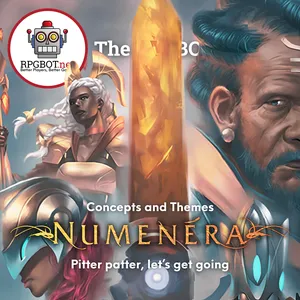
NUMENERA HOW TO PLAY - CONCEPTS AND THEMES: Pitter Patter, Let's Get Going
OCT 1, 202656 MIN
Description
Welcome to the Ninth World, where civilization has ended eight times, nobody understands how anything works, and sufficiently advanced technology is mostly an excuse to point at a laser pistol and yell, "Magic!"
In this first part of our How to Play Numenera series, Randall attempts to explain a billion years of lost civilizations, Ash discovers that physics are apparently optional, and Tyler starts asking the dangerous questions about Edge. Before long, we have ancient nanotechnology, mysterious artifacts, cyphers that might explode if you hoard them, stat pools that double as hit points, and a GM who can literally bribe you with XP to make your life more interesting.
Also, we say "moist" far too many times while explaining a d20 mechanic. We regret nothing. Well, some of us regret quite a lot.
VBM.games/rpgbot
Numenera 2-Book Set (affiliate link)
RPGBOT.Podcast Episodes
Old Gods of Appalachia AP Part 1
Old Gods of Appalachia AP Part 2
Old Gods of Appalachia AP Part 3
Old Gods of Appalachia AP Part 4
Show Notes
We're kicking off our How to Play Numenera series with a tour of the Ninth World and the Cypher System mechanics that make this wonderfully strange science fantasy RPG work.
Randall walks Ash and Tyler through the Numenera setting, a version of Earth roughly a billion years in the future after eight unimaginably advanced civilizations have risen and disappeared. Their technology is everywhere, but the people of the Ninth World understand so little of it that ancient machinery might as well be magic. That gives Numenera its central science fantasy theme: sufficiently advanced technology is indistinguishable from magic.
We dig into the Steadfast, the Beyond, and the increasingly strange places beyond civilization, along with the remnants left behind by previous worlds. Those remnants include reusable artifacts, one-use cyphers, mysterious oddities, and massive ancient structures that the characters may have absolutely no idea how to operate. Sometimes the players know they have discovered an elevator. Their characters definitely do not.
From there, we get into how to play Numenera and the Cypher System core mechanics. Tasks have difficulty levels from 0 to 10, with the target number determined by multiplying the difficulty by three. Instead of piling bonuses onto a d20 roll, characters make challenges easier through training, specialization, assets, and Effort.
Effort introduces one of Numenera's most interesting resource-management decisions. Might, Speed, and Intellect are not simply ability scores. They are pools that power abilities, fuel Effort, and absorb damage. Spend too aggressively and you may discover that the resource you just used to succeed is also the thing keeping your character alive.
Then there's Edge, which reduces the cost of spending points from those pools. Naturally, Tyler immediately begins investigating whether enough Edge will allow him to achieve his ultimate character build: the Edge Lord.
We also explore one of the signature Cypher System RPG mechanics, GM intrusions. The GM can offer XP to introduce an unexpected complication, while players can spend XP to reject intrusions, reroll critical checks, create temporary skills, trigger player intrusions, or advance their characters. The goal is not simply to punish players. A good GM intrusion makes the story more interesting, creates new opportunities, and occasionally puts something cool behind the wall that just collapsed on you.
By the end, we've covered the Numenera setting, cyphers and artifacts, task difficulty, Effort, Edge, stat pools, XP, GM intrusions, player intrusions, and the basics of character advancement. It's a surprisingly streamlined system hiding underneath one of the strangest tabletop RPG settings we've explored.
Key Takeaways
Numenera takes place on Earth roughly one billion years in the future, after eight previous civilizations have risen and disappeared.
The Ninth World mixes science fiction and fantasy by treating incomprehensibly advanced technology like magic.
Numenera includes artifacts, one-use cyphers, oddities, and enormous remnants of ancient civilizations.
The Cypher System uses a d20, but characters generally reduce task difficulty instead of adding large numerical bonuses to rolls.
Task difficulty ranges from 0 to 10, with the target number equal to the difficulty multiplied by three.
Training, specialization, assets, and Effort can ease difficult tasks and bring otherwise impossible rolls within reach.
Might, Speed, and Intellect are resource pools used for abilities and Effort, but they also function as your character's health.
Damage normally reduces Might first, followed by Speed and then Intellect. If all three pools reach zero, things have gone very badly.
Edge reduces the cost of spending points from a stat pool and becomes increasingly powerful as characters advance.
In the Cypher System, the GM generally does not roll dice. Players make both offensive and defensive rolls.
GM intrusions let the GM introduce complications in exchange for XP, turning unexpected problems into part of the game's advancement economy.
XP can be spent on rerolls, player intrusions, temporary skills, and permanent character advancement, creating a constant choice between helping yourself now or saving for later.
Numenera encourages creativity over strict simulation. Sometimes the explanation really is, "Ancient technology did it."
Most importantly, never tell the RPGBOT Discord you are trying to keep the math "moist." They cannot be trusted with that information.
Welcome to the RPGBOT Podcast. If you love Dungeons & Dragons, Pathfinder, and tabletop RPGs, this is the podcast for you.
Support the show for free: Rate and review us on Apple Podcasts, Spotify, or any podcast app. It helps new listeners find the best RPG podcast for D&D and Pathfinder players.
Level up your experience: Join us on Patreon to unlock ad-free access to RPGBOT.net and the RPGBOT Podcast, chat with us and the community on the RPGBOT Discord, and jump into live-streamed RPG podcast recordings.
Support while you shop: Use our Amazon affiliate link at https://amzn.to/3NwElxQ and help us keep building tools and guides for the RPG community.
Meet the Hosts Tyler Kamstra – Master of mechanics, seeing the Pathfinder action economy like Neo in the Matrix.
Randall James – Lore buff and technologist, always ready to debate which Lord of the Rings edition reigns supreme.
Ash Ely – Resident cynic, chaos agent, and AI's worst nightmare, bringing pure table-flipping RPG podcast energy.
Join the RPGBOT team where fantasy roleplaying meets real strategy, sarcasm, and community chaos.
How to Find Us:
In-depth articles, guides, handbooks, reviews, news on Tabletop Role Playing at RPGBOT.net
Tyler Kamstra BlueSky: @rpgbot.net
TikTok: @RPGBOTDOTNET
Ash Ely Professional Game Master on StartPlaying.Games
BlueSky: @GravenAshes
YouTube: @ashravenmedia
https://ashelydm.com/
https://ashelydm.com/
Randall James BlueSky: @GrimoireRPG
Amateurjack.com
Read Melancon: A Grimoire Tale (affiliate link)
Producer Dan @Lzr_illuminati