


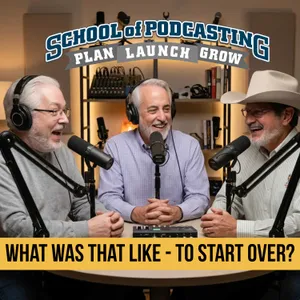
What Was That Like To Start Over? With Scott Johnson and Glenn Hebert
NOV 16, 202648 MIN
Description
What happens when two podcasters with decades of combined experience start a brand-new show from zero? Scott Johnson, of the wildly successful What Was That Like, has tested 140 different ways to grow a podcast, and he’ll tell you which ones still work today. Glenn Hebert, who has put out more than 4,100 episodes of Horses in the Morning, reveals where 70% of his new listeners actually come from. Hint: it isn’t an algorithm. Together they launched Did I Hear That Right?, and they’re sharing what has changed since they started, why they made a show with no pressure to earn a dime, how they find guests in a flood of AI pitches, and the one mistake that makes them stop listening within two minutes. If you’ve ever wondered whether you’re doing enough to grow your show, this episode will make you rethink “enough.”
Note: While these show notes were created by AI, the content is not. - Dave
140 Ways to Grow a Podcast (and Why There's No Magic Switch)
What happens when two podcasters with more than 50 years of combined experience start a brand-new show from zero? Scott Johnson, of the wildly successful What Was That Like, has tested 140 different ways to grow a podcast, and he tells me which ones still work today. Glenn Hebert, who has put out more than 4,100 episodes of Horses in the Morning, reveals where 70% of his new listeners actually come from. Hint: it isn't an algorithm. Together they launched Did I Hear That Right?, and they're sharing what has changed since they started, why they made a show with no pressure to earn a dime, how they find guests in a flood of AI pitches, and the one mistake that makes them stop listening within two minutes. If you've ever wondered whether you're doing enough to grow your show, this episode will make you rethink "enough."
Meet Two Professional Podcasters
Scott was an early School of Podcasting member. He started with The Computer Tutor back in 2012 (he still has a few remote computer repair clients who beg him never to retire), then launched What Was That Like. Glenn has been on this show more than any other guest, and he still runs Horses in the Morning, the daily flagship show of the Horse Radio Network.
These two put serious time into every episode:
Scott: about 15 hours per episode of What Was That Like, from idea to promotion.
Glenn: five to eight hours per daily episode of Horses in the Morning, including booking five to six guests a week. (As he says, everybody knows booking guests is the biggest pain of all.)
What's the Difference Between a Hobby Podcaster and a Pro?
Glenn's definition comes from the horse world: in competition, a pro is someone who makes their living from competing. Same for podcasting. If you make your living from it, you're a pro. Scott agreed, then joked that the problem with the new show is figuring out what to do with all the money coming in.
140 Podcast Marketing Strategies (and Counting)
Scott has documented every marketing strategy he's tried since starting his show almost nine years ago. The count is around 140. Did he just say 140? Yes, 140.
So while you're sitting there wondering, "Would that work? What's the return going to be?" Scott is out there trying it.
Scott's advice:
Do the tried-and-true stuff. He still guests on other shows and does promo trades all the time.
Think outside the box sometimes too.
Stop looking for the one big thing. Instead of hunting for the switch that brings in hundreds of listeners, do 100 different strategies that each bring in a few.
Some of what he tried didn't work, and something that works for him may not work for you. You only find out by trying. I talked about this same idea in episode 1053, Attention vs. Connection: quit trying to hit a grand slam, and grow your audience one listener at a time.
And yes, Scott is going to write a book about all of this at some point. The line starts behind me.
Word of Mouth Still Wins
Glenn has run enough listener surveys to know that 70% of his new listeners come from referrals. "But Dave, there's no algorithm. There's a discoverability problem in podcasting." Poppycock.
Glenn also points out that hitting "subscribe" is a bigger commitment than it was 10 years ago. There's more to listen to and less time, so people are doing math in their heads: "Do I have an extra hour a week for this?" Scott goes a step further. He thinks about which show he'd have to drop to make room for a new one.
That's also why I've never understood seasons for most independent shows. Take three weeks off, and you're hoping nobody takes your slot in a listener's routine.
How to Write Podcast Episode Titles People Click
When you're staring at 48 unplayed episodes, you cherry-pick, even from shows you love. Scott names his episodes for that person scrolling past. "Somebody got bitten by a rattlesnake? I want to hear that story."
A few titles from these guys:
What Was That Like: "Matt Counseled New Millionaires," "Angel Tried to Kill His Father," "Felicia Was at the Pentagon on 9/11"
Horses in the Morning: "Barn Hacks: It's Only Weird If It Doesn't Work," "Police Horse Retirement," "Horses and Halloween"
Did I Hear That Right?: "Phil Won $500,000," "Robin Worked for Burt Reynolds," "She Lived in a Swiss Castle," "She Adopted the Neighbor"
Here's my test: does the title make you want to click? If it does, it's a good title.
Glenn uses the 80/20 rule, and his surveys back it up. About 20% of your audience loves you and will listen to anything you put out. The other 80% are reading titles. Write for the 80%. As Scott puts it: you've got to have a hook.
Starting a New Podcast From Square One
Did I Hear That Right? is a brand-new show trying to build a brand-new audience. The difference from What Was That Like: the stories are about people who chose to do something unusual, not things that happened to them. There's no trauma, less crying, and the interviews are cut off at 15 minutes.
What about going from four- and five-figure downloads back to small numbers? It doesn't bother them. They have no expectations. As Scott says, their why isn't 100,000 downloads an episode. They like hanging out with each other and talking to fun people.
That's the part people miss. Many shows start for fun, then decide they aren't "real" until they have sponsors, and stop enjoying the sun they're standing in. The shows that keep it fun keep going, and the ones that keep going grow. (Glenn admits they're already set up to monetize if the audience shows up. They just aren't putting a deadline on it.)
Tips for Podcast Co-Hosts
Have the awkward conversation. Every year, Jim Collison and I have the "awkward conversation" about who does what on Ask the Podcast Coach and who makes what. Glenn and Scott split the work almost down the middle, made a list, and didn't have to talk about it again.
Sign an agreement, even if you never expect to make money. They did the legal agreement up front.
Different styles help. Scott has three pages of checklist items for every episode. Glenn puts out a daily show and can wing it and still sound great. If your co-host is exactly like you, you have one of you too many. Find the same passion with a different viewpoint.
Give Your Audience Your Thoughts After the Interview
Glenn's pet peeve with interview shows: when the interview ends, the show ends, and the host never says what they thought. People come for the content and stay for the host. On Did I Hear That Right?, after the 15-minute interview, Scott and Glenn talk about it for up to 10 minutes. Did they ever win money? What would they have done?
I call this the Jerry Springer: after the chair-throwing, Jerry looked into the camera and asked what we learned today. It gives listeners your take on the guest, and it quietly reminds everyone whose show this is.
And please don't end with "visit my guest's website, see you next week." The last URL on your podcast should be yours.
How to Find Podcast Guests Through Your Community
With AI, we all get 30 bad pitches an hour. Did I Hear That Right? uses one question: "What's the one unusual thing you've done that no one else you know has?" Scott and Glenn post that question in their Facebook groups and mine the comments, and that's where many of their guests have come from. When they disagree on a guest, they just do the episode anyway.
How to Build a Podcast Community
Both of these guys have vibrant communities, built in different ways:
Glenn's community is made up of Patreon supporters, so there's a built-in filter. He calls them his auditors because they audit the show and tell him things like "never have that guest back."
Scott's Facebook group is free, private, and has around 10,000 members, and he's the only admin. "Join the Facebook group" has been his call to action on almost every episode.
Glenn's point: the biggest mistake podcasters make is not giving their community a place to be a community. When your content is engaging enough, listeners need somewhere to talk about it, because none of their friends listen to your show.
How Much Do Patreon and Subscriptions Really Make?
Scott: subscriptions (Patreon, Supporting Cast, and Apple Podcasts Subscriptions with ad-free and bonus episodes) are roughly 10% of his income.
Glenn: about 5%, and his Patreon consistently converts 3 to 5% of his average audience.
That lines up with what I've found: NPR told me about 1% subscribe to NPR Plus, Teachable said 2%, and most of the people I interviewed for my book said about 3%. Not the answer people want, but it is what it is.
The best way to monetize a podcast is still to sell your own product or service. Glenn told us about a history-and-food YouTuber who just raised $800,000 on Kickstarter for a board game based on his show. Think outside the box.
Working With a Podcast Ad Agency
Scott has been with Glassbox Media for almost three years, after two years with a different agency, and he's hosted on Megaphone. The agency handles sponsor acquisition, talking points, and collecting the money. He doesn't even want to be involved in rate negotiations as long as the direct deposit shows up.
How big is "big enough"? When Scott started, agencies wanted roughly 10,000 to 15,000 downloads per new episode in the first month. Now, because programmatic ads monetize the whole back catalog, he thinks they look for about 100,000 total downloads a month as a minimum. On CPMs, he'd only say that they vary by brand.
Podcast Mistakes That Make Pros Stop Listening
Not editing (Scott). Crutch words, repetition, and tangents make some shows unlistenable to him, even big ones. Edit to make your guest sound good, or they won't share the episode.
Losing them in the first two minutes (Glenn). You decide fast whether you like a host. Glenn completely changed how Horses in the Morning opens after hearing me ask, "Why are you wasting my time at the beginning of the show?"
The apology opening and the "I don't know what I'm talking about today" opening (me). If you don't know what you're going to talk about, I'm not going to let you waste my time.
"So what'd you do last weekend?" (Scott). No one cares at the start. Move it to the end, where your 20% are still listening because they love you. Podnews Weekly Review does this with James Cridland and Sam Sethi.
Try a Low-Cost Community Platform
I use Heartbeat for the School of Podcasting, and Circle is another great option, but both cost a bit more. If you want to test a paid community, look at Skool (spelled with a K). The entry plan is $9 a month, and they take 10% if you sell memberships. Once your community grows, you can move to the higher plan (I believe about $99 a month) and pay a lower transaction fee.
A community tells you who you're talking to, and when you know that, you make better content. Glenn's auditors tell him when a guest stunk up the joint. Scott knew the true-crime audience would like his true stories, so he cross-promotes with true-crime shows even though his isn't one. (You're looking for a show that shares an audience).
Doing nothing to promote your show because you're not sure something will work is wasting your time. Scott tried 140 things. Try one.
How Long Does It Take to Make Money Podcasting?
Scott said it without me asking: "You don't make money for three years anyway." Congratulations, Scott, you've joined the montage. Stick around to the end of the episode to hear the newly updated version of podcasters and creators saying it takes about three years. I'm not trying to discourage you. I'm trying to help you set realistic expectations.
Want to Launch Your Podcast in January 2027? Start Now
Apple typically takes the last two weeks of the year off, so if you want your show live in January, you really needed to start about a week and a half ago. Get going today.
Need help? That's what we do at schoolofpodcasting.com: courses, an amazing community, and coaching with me. Use the coupon code LISTENER for a monthly, quarterly, or yearly subscription. My website is courtesy of PodPage.
Websites Mentioned
School of Podcasting (coupon code LISTENER): https://schoolofpodcasting.com
Episode 1062 show notes and links: https://schoolofpodcasting.com/1062
Episode 1053, Attention vs. Connection: https://schoolofpodcasting.com/1053
Follow the School of Podcasting: https://schoolofpodcasting.com/follow
Did I Hear That Right? (pitch your unusual story): https://didihearthatrightpodcast.com
What Was That Like: https://whatwasthatlike.com
Horses in the Morning / Horse Radio Network: https://horseradionetwork.com
Ask the Podcast Coach: https://askthepodcastcoach.com
Everything Everywhere Daily (Gary Arndt): https://everything-everywhere.com
Glassbox Media: https://glassboxmedia.com
Supporting Cast: https://supportingcast.fm
Patreon: https://patreon.com
Heartbeat: https://heartbeat.chat
Circle: https://circle.so
Skool: https://supportthisshow.com/skool
Podnews (Podnews Weekly Review): https://podnews.net
PodPage: https://podpage.com
This content may contain affiliate links, meaning I earn a small commission if you purchase through these links at no additional cost to you. I only recommend products or services I trust and believe will provide value to you. Thank you for your support!
Mentioned in this episode:
Live Appearances
I love traveling and telling the world about podcasting. Check out where I'll be using this link
Where Will I Be?
Question of the Month: What is a "Newbie Podcaster"
Poll Question: What makes someone a “newbie podcaster”?
Is it how long they’ve been podcasting or how many episodes they’ve published? Is it something else? How would you define a newbie podcaster?
Leave your answer at schoolofpodcasting.com/question by November 27th and don't forget to mention your show and your website address so I can link to it in the show notes.
(Please try to keep them under 5 minutes if you can).
Question of the Month
You Have A Message That Needs to Be Heard
You have a message that needs to be shared. Discover the art of podcasting at the School of Podcasting. We teach you to shine a light on your stories, inspiring others one episode at a time.
Let your voice be your legacy. Go to www.schoolofpodcasting.com/join
<a...