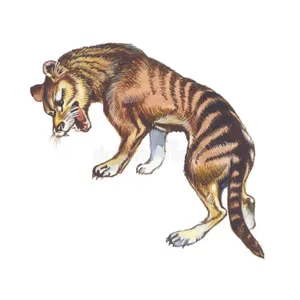
Tasmanian tiger 2026.Mainland Australian introduction ?Parks Victoria not screening for thylacine.

Michael Moss

Details

Three mainland Tasmanian devils examined to see if they were introduced or remnant on the Australian mainland. They were found on Mainland Australia. Correction second devil was found in 1971 not 1978 as i mention. Parks Victoria confirm they are not screening for Thylacine. The Tasmanian tiger has been extinct in Tasmania since late 1936. Tasmanian tiger also brought onto mainland Australia secretly ? See below links.... https://tunein.com/podcasts/Science/T... https://shows.acast.com/expedition-un... https://www.smh.com.au/national/thyla... https://www.youtube.com/watch?v=Ct0XTZaMXbc

Recent Episodes

OCT 25, 2026
Tasmanian Tiger shot at Cape Otway lighthouse (1973)? | Mainland Thylacine search 2026
Does the worlds most elusive marsupial have a bizarre habit of getting caught in chicken coops ? In this episode we dive into two astonishing Thylacine encounters spanning forty years and both sides of the Bass Strait. First, we unpack the historic and tragic 1930 Mawbanna shooting in a chicken pen in Tasmania, widely recognized as the last known wild Tasmanian Tiger ever killed in Tasmania. Then, we cross over to mainland Australia to investigate a gripping 1973 case brought to light by David Chinn, an ex assistant light house keeper detailing an alleged shooting of a Tasmanian Tiger also inside a chicken pen by the Cape Otway lighthouse keeper.The 1930 Mawbanna Thylacine: Special Collection: ThylacinesGareth Linnard Corresponding Author, Stephen R. Sleightholme Corresponding AuthorAustralian Zoologist (2024) 44 (1): 131–172.ABSTRACTThe last confirmed wild Thylacine kill, that of an adult male, was made by Wilfred Batty on a property leased by his father in the Parish of Anderson, within the Mawbanna district on the north-west coast of Tasmania, at midday on the 13th of May 1930. In terms of the historical traceability of the species in the wild, the shooting of the Mawbanna Thylacine, the first of only four evidentially supported specimens recovered during the 1930s. Otway Lighthouse Tasmanian Tiger 1973"I managed to contact Mr Chinn today and we spoke on the phone for about ten minutes...A key difference he pointed out to what the article says is that he does not know if the body was buried.The account he gave was that he had arrived in Australia 2 and a half years prior, and had spent that time working at the Cape Otway Lightstation as a grounds keeper, through until 1974. His main duty was cutting crass and occasionally doing odd jobs such as painting.Mr Chinn his boss Mr Ernie Jones, who was fond of his home brew beer, was the one to discover the Tasmanian tiger. They kept a pet rabbit and chickens at the lightstation. One morning they discovered the rabbit dead in the garden and Ernie found the thylacine inside the chook pen. He said the thylacine probably got in by climbing under the wire mesh but when Mr Jones arrived it tried frantically to escape. Nevertheless Mr Jones took his gun and shot the animal.Mr Jones then brought the dead animal into the workplace to show Mr Chinn. Mr Chinn said he didn't know what the animal was but when he saw the photograph accompanying the first newspaper article this month he recognised it. He said he was certain it had dark stripes from mid body to its rump - just as reported in the second article.According to Mr Chinn, Mr Jones said he would dispose of the body and Mr Chinn is not sure how the animal was disposed of - he reasoned it might have been buried, or just as easily thrown into the sea. He says that in 1974 he contacted the relevant government department to report the case but he felt like they considered him a nutcase, so he decided to leave his report at that.When I asked Mr Chinn if he had ever seen a photograph of a spotted-tailed quoll he said he didn't know that animal. I then asked about the size of the animal he saw and he said it was the size of a large greyhound dog ruling out, in my opinion, a spotted-tailed quoll.He mentioned the animal was "pretty healthy" and I asked whether it might have been a dog with poor fur condition that made it appear as if it was striped. He repeated again that the animal was "pretty healthy", that it "wasn't skin and bones" and said its fur condition was good.I asked what colour it was and he said "tan beige" and that the stripes were "dark". I let him know that thylacines have been variously reported as choclatey-brown through grey like an Eastern grey kangaroo through to tan and beige and I asked whether he noticed if it was male or female. He replied that he didn't take note and when I mentioned thylacines having a pouch he said that he didn't know that.Finally, Mr Chinn reported that Mr Jones is now deceased."
24 MIN
OCT 7, 2026
Tasmanian Tiger Incompetence | Mainland Thylacine Search
This investigative breakdown exposes the archival oversight surrounding the final thylacine specimen at the Tasmanian Museum and Art Gallery, while connecting past institutional failures to the modern Mainland Thylacine Search. Historical data reveals that the famous zoo specimen known as "Benjamin"—a name later exposed as a historical fake—was not actually the last surviving Tasmanian tiger. Instead, a newly uncovered female specimen outlasted him before her remains were misplaced for 85 years, fundamentally altering the extinction timeline and baseline data used for current mainland tracking initiatives. https://www.nine.com.au/australia-news/tasmanian-tiger-thylacine-remains-found-in-the-back-of-tmag-museum-cupboard-20221206-p5ymzy.html Remains of last known Tasmanian tiger found in the back of a museum cupboardRaffaella CiccarelliDecember 6, 2022 - 7.13am. One of the world's enduring zoological mysteries has been solved after the remains of the last-known thylacine - also known as the Tasmanian tiger - were discovered in the back of a dusty museum cupboard.The remains were found in the collections of the Tasmanian Museum and Art Gallery (TMAG) and had been missing for more than 85 years.In a soon-to-be-published paper, researchers found the old female animal had been caught illegally by trapper Elias Churchill from the Florentine Valley. It died a few months after being sold to Beaumaris Zoo in Hobart in May 1936.The thylacine remains came into the possession of the Tasmanian Museum and Art Gallery (TMAG) in 1936, but had until now remained unidentified.The animal was skinned and its skeleton "disarticulated" for a newly-formed education collection - but it disappeared among the museum's archives."The sale was not recorded or publicised by the zoo because, at the time, ground-based snaring was illegal and Churchill could have been fined," Robert Paddle, paper co-author and comparative psychologist from the Australian Catholic University, said."The thylacine only lived for a few months and, when it died, its body was transferred to TMAG."For years, many museum curators and researchers searched for its remains without success, as no thylacine material dating from 1936 had been recorded in the zoological collection, and so it was assumed its body had been discarded."Tasmanian tiger may not be extinctAn animal called Benjamin was previously believed to the last known Tasmanian tiger, but the recent find has flipped that on its head. A thylacine called Benjamin, famously immortalised in grainy black and white video, was previously believed to be the last of the species.Benjamin died alone in his enclosure after succumbing to exposure at the Beaumaris Zoo on September 7, 1936, however, the rediscovered female is thought to have outlasted him.The remains, still attached to the five cards created for the education collection, are now on display in the museum's thylacine gallery."It is bittersweet that the mystery surrounding the remains of the last thylacine has been solved, and that it has been discovered to be part of TMAG's collection," TMAG Director Mary Mulcahy said.The Tasmanian tiger was hunted to extinction upon European settlement as farmers blamed the native carnivorous marsupial for the deaths of livestock.It became feared and in 1888 the Tasmanian government introduced a bounty of £1 per full-grown animal and 10 shillings per juvenile animal destroyed.The species was declared officially extinct in 1986. https://www.abc.net.au/news/2018-07-10/curious-hobart-what-happened-to-hobart-beaumaris-zoo/9898128 Don’t call it Benjamin. Lennard said it was a furphy that the last tiger in captivity at Beaumaris was ever known as Benjamin."That came about in the 1960s … no-one who worked at the zoo, including Alison Reid, ever knew it by that name," he explained."It is thought the person who started that, who said they worked at the zoo, never did."
12 MIN
SEP 19, 2026
The Phantom Tasmanian Tiger of Papua New Guinea
Is the thylacine alive and in Papua New Guinea? While rumors persist of a phantom predator, evidence shows the "Tasmanian Tiger" does not exist there.New Guinea singing dog photographed in the wild for the first timecover imageJeremy Hance3 Dec 2012IndonesiaArticle Summary.Cropped close-up of New Guinea singing dog. This is arguably the first time the dingo-like canine has been photographed in the wild. Photo by: Tom Hewitt.A rarely seen canine has been photographed in the wild, likely for the first time. Tom Hewitt, director of Adventure Alternative Borneo, photographed the New Guinea singing dog during a 12-day expedition up a remote mountain in Indonesian Papua. Very closely related to the Australian dingo, the New Guinea singing dog, so named for its unique vocalizations, has become hugely threatened by hybridization with domesticated dogs.“When we reached [our guide and cook] the guide proclaimed ‘dog,'” Hewitt writes in a blog entry about his trip up Mandala Mountain. “This took me quite by surprise and it took three explanations by him for me to understand. But sure enough above us on the rocky outcrop in the bush there was a dog—the guide seemed as bemused by it being there as we were. […] We watched it for around 15 minutes as it continued to watch us. It seemed as curious as we were but not particularly scared or nervous. What stood out was how healthy it looked upon closer examination with binoculars.”Hewitt’s sighting is the first report ever of a New Guinea sighting dog in the region. Described as looking like foxes, due to reddish coats, the dogs are known for an ability to climb trees.“At the time of the sighting we were in a dramatic, wide valley with 4,000 [meter] peaks and limestone walls with waterfalls on either side,” Hewitt continues. “We spent a total of 4 days camping in this valley and there was regular contact with a number of exciting animals: couscous, possums and even tree kangaroos were seen most days, as well as many unidentified ground nesting birds living in the swamp grass. One species of bird of paradise was heard in the lower forest, but not seen. There were a few highland flowers and grasses and occasional groves of an ancient cycad species—primordial in every respect.”No one knows how rare the New Guinea singing dog has become, but in addition to being imperiled by breeding with domestic canines, the species is also hunted by locals. It is killed as a competitor and often eaten. Almost nothing is known about its life in the wild.There are no active conservation programs working to protect the species in New Guinea, however there are a number of groups in the U.S.—including New Guinea Singing Dog International and the New Guinea Singing Dog Conservation Society—that promote establishing a strong captive population as an insurance policy against extinction on the island. Just over 200 New Guinea singing dogs are found both in captivity outside New Guinea, but the population is severely inbred. https://news.mongabay.com/2012/12/new-guinea-singing-dog-photographed-in-the-wild-for-the-first-time/ Quoll farmhttps://documentarytelevision.com/aus...Ned Terryhttps://catalogue.nla.gov.au/catalog/...
16 MIN
SEP 19, 2026
The 4 Genetic Flaws of the Tasmanian Tiger: What it Means for Mainland Survival
"While institutional science focuses on these four genetic flaws regarding the thylacine's historic decline, my research applies this directly to the mainland Australian population. Because these gene losses occurred millions of years ago, any thylacines introduced or surviving on the mainland possessed the exact same genetic vulnerabilities as the isolated Tasmanian populations. Below is a summary of the genetic study:"November 11, 2025 at 12:55 pmHome » ANIMALS » What Really Caused The Tasmanian Tiger To Go Extinct? New Research Finds That Their Doom Began Over A Million Years Ago With The Loss Of Four Key Genesby Michael LevanduskiThe Tasmanian tiger, also known as the Thylacine (Thylacinus cynocephalus), was a major predator in Australia and surrounding regions for millions of years. The last one to be seen, however, was in 1936 and since then they are believed to have gone extinct.Most people assumed that they went extinct largely because of human influence. As people settled in different areas, they would hunt the Tasmanian tiger because it was considered a pest that would eat their livestock. While both of these things undoubtedly contributed to the hastening of extinction for the animal, a new study published in the Proceedings of the Royal Society says that they were likely headed to that fate for much longer. In fact, it says that the loss of four key genes sometime over a million years ago might have led to their downfall. In the paper, the team explains:“The thylacine genome exhibits the loss of four genes—SAMD9L, HSD17B13, CUZD1 and VWA7—each with important biological functions and implications for species fitness. Our investigation into the timing of gene loss events revealed a staggered pattern, occurring over a span of approximately 13−1 [million years ago]. This temporal distribution indicates that the gene losses were not confined to a single evolutionary event but occurred progressively after the Middle Miocene Climate Transition.”This transition time took place sometime between 15 and 13 million years ago and it is considered to be a major ecological and climate change. The ancient ancestors to the Tasmanian tiger would have been a lot smaller at the time. The animal evolved to become larger, which may have been the result of the gene changes, or the cause of them.Those four genes, however, were important for the species immune functions, including key antiviral and anti-tumor abilities. In addition, around the same time, the Tasmanian tiger experienced a reduction in its olfactory receptor genes. This reduction in sensitivity to smell indicates that the species was moving from hunting by scent to relying more on sight and hearing. the team says:“Unlike the Tasmanian Devil, a scavenger, the taller thylacine likely depended on vision and sound for hunting, aided by its ability to see over vegetation.”While the team does not know what exactly triggered these evolutionary changes, the loss of those genes made the species less able to survive in the world of the future. This does go to show that some evolutionary changes that have benefits at the time can actually cause problems for future generations. The team said:“Whatever the cause for gene loss, the loss of SAMD9L, HSD17B13, CUZD1, and VWA7 genes in the thylacine possibly had negative pleiotropic effects, potentially compromising its health by affecting antiviral defense, metabolic processes, lactation, pancreatitis, and tumor susceptibility. Although model-based population viability analyses suggest that the disease played only a minor role in thylacine extinction, other studies suggest that a ‘canine-distemper-like’ disease played a role in exacerbating its extinction.”Of course, this does not let humans off the hook entirely. Just because the Thylacine’s evolutionary path made their survival more difficult, they likely could have been fine for thousands of years more if it weren’t for the actions of people.
11 MIN
SEP 7, 2026
Tasmanian Tiger Extinction Myth: 2026 Mainland Thylacine Search and Research
Life ScienceTasmanian tiger wrongfully hunted to extinctionSkull analysis reveals it hunted prey smaller than sheepJustine E. Hausheer • November 15, 2011Article Summary.Marie Attard and Christopher HammangA new examination of the skull of an extinct Tasmanian tiger, reported recently in the Journal of Zoology, suggests that the dog-like marsupial, also known as a thylacine, was mistakenly branded as a livestock killer and wrongfully hunted to extinction by Australian and Tasmanian farmers in the early 20th century.Skull examinations by biologist Marie Attard of the University of New South Wales indicate that the carnivore was also vulnerable to extinction because it had a very narrow range of prey, probably consisting of animals smaller than itself, like wallabies, bandicoots, and possums. Limitations in killing larger prey would have increased the thylacine’s vulnerability to extinction, unless smaller prey was consistently abundant. If Attard is correct, thylacines did not regularly hunt cattle or sheep and thus were wrongfully eradicated by farmers.Thylacines resembled a medium-sized dog, with a long, stiff tail and dark brown stripes across the rump. Wild thylacines persisted in Tasmania until the early 1930s. The last captive thylacine, nicknamed Benjamin, died of neglect in 1936 when he was left outside in cold weather. Two months before his death, the Tasmanian government passed laws to protect thylacines. Before that year, the government issued bounties on thylacines, rewarding farmers for their kills.Attard’s team used an X-ray computed tomography (CT) scanner to create a three-dimensional computer model of the skull, and then examined how the skull functioned under certain stresses, including the strain of biting and holding struggling prey. The team then compared the thylacine’s skull to those of two other carnivorous marsupials — the Tasmanian devil and the spotted-tailed quoll. These animals are closely related to the thylacine and lived alongside it.Attard’s results show that the thylacine’s skull was weaker than the other two marsupials, especially when compensating for movements caused by struggling prey. According to Attard, this finding suggests that, unlike many carnivores, the thylacine primarily hunted prey smaller than itself. It also means the thylacine probably competed with the other two marsupials for food, increasing its risk of extinction.“Particularly among large predators, the more specialized a species is, the more vulnerable they are to extinction. I want[ed] to see how specialized the diet of the thylacine was, and whether this may have increased their extinction risk,” explains Attard. Earlier news coverage of the study focused on the implication that the thylacine was mistakenly killed because its skull was too weak to allow it to kill sheep. That may not be entirely true, according to Graham Slater, an evolutionary biologist at the University of California, Los Angeles, who has performed similar studies on carnivore skulls. A more fragile skull would make it more difficult for a thylacine to kill a larger animal, but not impossible, he explains. For example, compared to a mountain lion, a coyote has a weaker, narrow skull, like the thylacine’s. But, as Slater says, “coyotes are also pretty good at killing sheep.”Little is known about the thylacine’s hunting strategy. Most eyewitness accounts indicate that the thylacine was a solitary hunter, but these reports date from just before they became extinct, and could be biased by the low numbers of thylacines alive at the time. Though it may have killed sheep on occasion, its reputation as a major predator of livestock was probably exaggerated. https://scienceline.org/2011/11/tasmanian-tiger-wrongfully-hunted-to-extinction/The mainland Tasmanian tiger is a Claytons Tasmanian tiger. It is the Tasmanian tiger you have when you are not having a Tasmanian tiger. Famous TV adverthttps://www.youtube.com/watch?v=3qf4yUMxnjw

15 MIN