



The Critical Edge Podcast
The Critical Edge
Lit Review: Closing Hostile Abdomens and Sparing Kidneys
OCT 2, 202635 MIN
Description
These academic articles investigate recent advancements in surgical wound care and the pharmacological management of severe infections during emergency procedures. The first study demonstrates that utilizing triclosan-coated barbed sutures significantly reduces the risk of fascial dehiscence following emergency abdominal surgeries compared to standard materials. A second multi-center trial examines skin closure techniques in urgent colorectal surgery, concluding that primary closure is a safe option that may lower mortality and shorten hospital stays. Finally, research into necrotizing soft tissue infections suggests that linezolid is a safe and effective alternative to the traditional combination of clindamycin and vancomycin. Collectively, these sources provide evidence-based strategies to improve clinical outcomes and decrease post-operative complications in high-risk surgical patients.
DISCLAIMER
The Critical Edge is for educational and informational purposes only and is not intended to diagnose, treat, cure, or prevent any disease, nor does it substitute for professional medical advice, diagnosis, or treatment from a qualified healthcare provider—always seek in-person evaluation and care from your physician or trauma team for any health concerns.
EMERGENCY LAPAROTOMY CLOSURE AND NSTI ANTIMICROBIAL STRATEGY
STUDY GUIDE
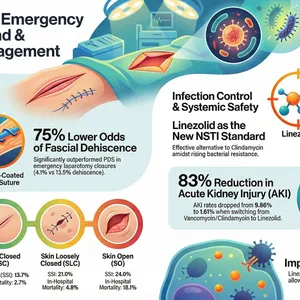
1. Barbed fascia first: In emergency laparotomy, running triclosan-coated no. 1 barbed suture was associated with lower fascial dehiscence than running no. 1 triclosan-coated PDS (4% vs 14%; multivariable OR 0.07–0.25 depending on model).
2. STITCH still applies: Small-bite technique with a suture-to-wound length ratio of 4:1 remains the foundational closure principle; suture material is an incremental variable on top of that standard.
3. Infection signal is weaker: SSI rates trended lower with barbed suture (11% vs 21%, p = 0.07) but did not reach significance; evisceration and systemic complications were similar.
4. Damage control is the dominant risk: Delayed fascial closure after damage-control laparotomy independently increased dehiscence risk (OR ≈ 3.1) even when barbed suture was used.
5. Skin can be closed in dirty colorectal cases: In a 15-center EAST cohort of emergent nontrauma colorectal operations, complete skin closure had the lowest crude SSI (13.7%) and was not independently associated with deep-space infection.
6. Loosely closed skin is not a free lunch: Incomplete (“loosely closed”) skin closure independently increased superficial SSI (adjusted OR 3.44) compared with complete closure.
7. Open skin tracks with sicker patients and worse logistics: Skin-left-open patients had longer length of stay, lower rates of discharge home, and higher crude in-hospital mortality; after risk adjustment, open skin remained associated with mortality (OR 3.00).
8. NPWT and delayed primary closure were not independent drivers: Negative-pressure devices and delayed primary closure did not independently change SSI, fistula, dehiscence, reoperation, or 30-day readmission in the EAST analysis.
9. Linezolid is a reasonable toxin-suppression substitute: In a matched quasi-experimental NSTI cohort, linezolid plus standard gram-negative/anaerobic coverage produced 30-day mortality similar to vancomycin plus clindamycin (6.5% vs 8.1%).
10. Renal and stewardship advantages: Acute kidney injury was more common with vancomycin–clindamycin (9.7% vs 1.6%); linezolid also allows earlier oral step-down and avoids rising clindamycin resistance among streptococci.
STUDY GUIDE
I. Fascial Closure After Emergency Laparotomy: Barbed Versus Conventional Absorbable Suture
The STITCH trial established that small fascial bites and a 4:1 suture-to-wound length ratio reduce dehiscence in both elective and emergency laparotomy. Dilday and colleagues asked whether the *type* of running, triclosan-coated suture further modifies that risk.
A. Study design and population
Prospective observational cohort from LAC+USC and the Medical College of Wisconsin. Two hundred six patients meeting emergency-laparotomy inclusion criteria were analyzed; median BMI exceeded 28. Trauma accounted for approximately 73% of cases; damage-control laparotomy occurred in 27%. Thirty-five percent of fascial closures used no. 1 triclosan-coated barbed suture; 65% used no. 1 triclosan-coated PDS, both in running fashion. Technique (bite size, ratio) was not mandated, reflecting real-world practice. The barbed-suture group contained more colorectal injuries and all of the staged/damage-control closures among the emergency-general-surgery subset.
B. Primary and secondary outcomes
Overall SSI was 18% and overall fascial dehiscence 10%. Fascial dehiscence occurred in 4% of barbed closures versus 14% of PDS closures (p < 0.05). SSI events trended lower with barbed suture (11% vs 21%, p = 0.07). Evisceration, superficial versus deep SSI, and systemic complications did not differ. Subgroup analysis by trauma versus nontrauma indication showed the same directional findings.
C. Multivariable interpretation
After adjustment, triclosan-coated barbed suture independently reduced the odds of dehiscence (published models range from OR 0.07 to OR 0.25). Damage-control strategy independently increased dehiscence (OR 3.1–3.13). The authors emphasize that dehiscence was diagnosed clinically rather than by routine CT, so subclinical events may have been undercounted. Delayed incisional hernia was not assessed.
D. Practical caveats for the trauma and acute-care surgeon
The study is pragmatic and Level III. Residual confounding by unmeasured closure technique is possible. Nonetheless, the signal is consistent enough that many high-volume centers now default to running triclosan-coated barbed suture for emergency midline fascia, especially when the abdomen has been left open. Cost, surgeon familiarity, and availability remain local variables.
II. Skin Management After Emergent Colorectal Surgery
Surgical-site infection remains the most common hospital-acquired infection after colorectal operations and drives billions of dollars in cost. Traditional teaching favors leaving dirty or contaminated skin open. Feather and the EAST multi-institutional trials group tested whether that dogma still holds when modern risk adjustment is applied.
A. Cohort construction
Fifteen centers enrolled 557 adults undergoing urgent or emergent colorectal surgery between March 2021 and March 2023. Trauma, pregnancy, incarceration, and age <18 years were excluded. Wounds were classified as skin closed (SC), skin loosely closed (SLC; incomplete approximation allowing packing or drainage), or skin open (SO). Left-colon procedures predominated (59%). Dirty/infected wounds, EBL >500 mL, vasopressors, hypothermia, stoma creation, ICU admission, and damage-control surgery were all more common in the SLC and SO groups—exactly the patients surgeons historically leave open.
B. Unadjusted and risk-adjusted results
Crude SSI was 18.5% overall: 13.7% SC, 21.0% SLC, 24.0% SO. After adjustment for demographics, comorbidities, and operative details, SLC independently predicted superficial SSI (OR 3.439). Skin-closure strategy was *not* an independent predictor of deep-space infection. Length of stay was shortest with SC (14.5 days) versus SLC (16.4 days) and SO (21.0 days). In-hospital mortality was 2.7% SC, 4.8% SLC, and 18.1% SO; after adjustment, SO remained associated with death (OR 3.003). Discharge home was less frequent after SO management. Fistula, fascial dehiscence, unplanned reoperation, and 30-day readmission did not differ by skin strategy.
C. Negative-pressure and delayed-primary-closure adjuncts
Neither NPWT application nor delayed primary closure independently altered SSI, fistula, deep infection, length of stay, reoperation, or readmission. The data therefore do not support routine “leave it open and vac it” as a default for every dirty colorectal wound.
D. Clinical synthesis
Complete skin closure is a viable option even in contaminated emergent colorectal surgery when the fascia is sound and the patient is otherwise resuscitated. Loosely closed skin appears to combine the worst of both worlds—enough occlusion to trap fluid, not enough approximation to protect the wound. Open-skin management should be reserved for the physiologically devastated patient in whom the priority is source control and second-look surgery, not because the wound class itself forbids closure.
III. Empiric Toxin Suppression in Necrotizing Soft-Tissue Infection
Rising clindamycin resistance among streptococci has forced a re-evaluation of the classic vancomycin-plus-clindamycin backbone used with piperacillin-tazobactam (or equivalent) and immediate operative source control. Linezolid is a protein-synthesis inhibitor that also suppresses exotoxin production and can be given orally. Dorazio and colleagues performed the largest published comparison of the two strategies.
A. Quasi-experimental design
Single-center, before-and-after study after an institutional guideline change from piperacillin-tazobactam + vancomycin + clindamycin to piperacillin-tazobactam + linezolid. Two hundred seventy-four patients with an admission code for NSTI or Fournier gangrene were screened; 164 underwent surgery within 24 hours and 62 propensity-matched pairs were analyzed. Primary endpoint was 30-day mortality (in-hospital or after discharge). Secondary endpoints were AKI and *Clostridioides difficile* infection.
B. Efficacy and safety results
Thirty-day mortality was 8.06% with vancomycin–clindamycin versus 6.45% with linezolid (HR 1.67, 95% CI 0.32–10.73). CDI rates were 6.45% versus 1.61% (not statistically significant). AKI was more frequent in the vancomycin–clindamycin era (9.68% vs 1.61%; HR 6). A composite of death, AKI, or CDI favored the linezolid period. Linezolid’s oral bioavailability also permitted earlier enteral transition.
C. Mechanistic and stewardship rationale
Linezolid retains high in-vitro activity against the usual gram-positive NSTI pathogens, including many clindamycin-resistant streptococci and MRSA. Dual coverage with vancomycin plus clindamycin is therefore redundant once linezolid is chosen. Avoiding vancomycin reduces nephrotoxicity in a population already at high risk of AKI from sepsis and rhabdomyolysis. Avoiding clindamycin reduces CDI pressure.
D. Limitations and remaining questions
The study is retrospective, single-center, and modestly powered for mortality. Residual confounding by era (improved source-control culture, earlier surgery) cannot be excluded. Microbiology-specific subgroup analyses (pure group A Streptococcus versus polymicrobial) were limited. Nonetheless, the data support linezolid as an evidence-based alternative when local streptococcal clindamycin resistance is high or when vancomycin nephrotoxicity is a concern. Source control within hours remains the dominant determinant of survival; antibiotics are adjunctive.
REFERENCES
1. Dilday J, McGillen P, Park S, Gallagher S, Lee H, Schellenberg M, Matsushima K, Inaba K, Martin MJ. Is barbed better? Evaluation of triclosan-coated barbed suture on wound complications following emergency laparotomy. *J Trauma Acute Care Surg*. 2024;97(1):149-157. doi:10.1097/TA.0000000000004341
2. Feather CB, Rehrig S, Allen R, et al. To close or not to close? Wound management in emergent colorectal surgery, an EAST multicenter prospective cohort study. *J Trauma Acute Care Surg*. 2024;97(1):73-81. doi:10.1097/TA.0000000000004321
3. Dorazio J, Chiappelli AL, Shields RK, et al. Clindamycin plus vancomycin versus linezolid for treatment of necrotizing soft tissue infection. *Open Forum Infect Dis*. 2023;10(6):ofad258. doi:10.1093/ofid/ofad258