The Critical Edge Podcast

The Critical Edge

Details

Welcome to The Critical Edge, the podcast where cutting-edge trauma surgery and critical care research meets clear, actionable insight—curated by a Harvard-trained, AAST-certified trauma surgeon dual-boarded in Surgical Critical Care and General Surgery. In each episode, we distill the latest high-impact studies, meta-analyses, and guideline updates—from journals like the Journal of Trauma and Acute Care Surgery, Journal of the American College of Surgeons, World Journal of Surgery, and EAST Practice Management Guidelines—into digestible discussions. Whether it's evolving damage control resuscitation strategies, refined whole blood protocols, updated ERATIC (Enhanced Recovery After Trauma and Intensive Care) recommendations, geriatric trauma management, or debates around REBOA and non-operative approaches to solid organ injuries, we break it down with clinical relevance front and center. No fluff, no filler—just the evidence that matters right now in the OR, ICU, or trauma bay. Perfect for busy surgeons, fellows, residents, APPs, and intensivists who need to stay sharp without wading through stacks of PDFs. Join us to sharpen your practice with the critical edge that saves lives. New episodes drop regularly—subscribe today and stay ahead of the curve in this fast-moving field. Please contact us at: [email protected] The Critical Edge is for educational and informational purposes only and is not intended to diagnose, treat, cure, or prevent any disease, nor does it substitute for professional medical advice, diagnosis, or treatment from a qualified healthcare provider—always seek in-person evaluation and care from your physician or trauma team for any health concerns.

Recent Episodes

NOV 6, 2026
Lit Review: Pancreatitis, Frailty, and Wound Dogmas Overturned
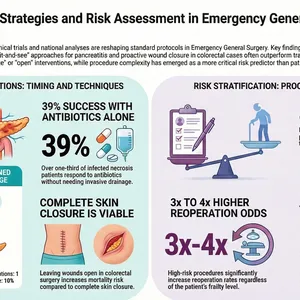
These clinical sources investigate modern management strategies and risk assessment tools in emergency general surgery, with a specific focus on infected necrotizing pancreatitis. Research from the POINTER trial indicates that delaying invasive drainage in favor of initial antibiotic therapy is safe and results in fewer total interventions without increasing long-term mortality or complications. Beyond pancreatitis, the texts examine how procedure risk often outweighs patient frailty when predicting outcomes for elderly surgical patients. Additionally, the studies assess wound closure techniques in colorectal procedures, suggesting that complete skin closure may be a superior option for reducing certain risks. Collectively, these findings advocate for multidisciplinary care, risk-stratified decision-making, and more conservative surgical timing to improve patient survival and recovery. DISCLAIMER The Critical Edge is for educational and informational purposes only and is not intended to diagnose, treat, cure, or prevent any disease, nor does it substitute for professional medical advice, diagnosis, or treatment from a qualified healthcare provider—always seek in-person evaluation and care from your physician or trauma team for any health concerns. DELAYED INTERVENTION FOR INFECTED PANCREATIC NECROSIS, PROCEDURE RISK VERSUS FRAILTY, AND SKIN CLOSURE AFTER EMERGENT COLORECTAL SURGERY STUDY GUIDE TOP TEN TAKEAWAYS1. POINTER (n = 104) found no reduction in complications or death when infected necrotizing pancreatitis was drained within 24 hours of diagnosis versus waiting for walled-off necrosis: Comprehensive Complication Index 57 versus 58; mortality 13% versus 10%.2. Immediate drainage produced more procedures (mean 4.4 versus 2.6). In the postponed arm, 39% never needed an invasive intervention—antibiotics alone sufficed.3. Long-term POINTER follow-up (median 51 months; 88 survivors re-evaluated) showed no late excess of death or major complications (15% immediate versus 17% postponed). Cumulative interventions remained higher after immediate drainage (median 4 versus 1).4. Of 15 postponed patients who avoided any intervention in the first six months, 93% still needed none at four years. Pancreatic function and quality of life were indistinguishable.5. Immediate source control remains mandatory if the patient deteriorates on antibiotics, resuscitation, and nutrition. POINTER does not license neglect; it licenses patience in a stable infected collection.6. In 59,633 NSQIP patients older than 65 years undergoing emergency general surgery, both frailty (modified 5-item frailty index) and procedure risk predicted death, complications, failure to rescue, and readmission—but procedure risk moved the needle farther.7. High-risk EGS operations (open cholecystectomy, colectomy, small-bowel resection, perforated-ulcer repair, adhesiolysis, laparotomy) produced an approximately eight-fold increase in 30-day mortality versus low-risk operations (laparoscopic or open appendectomy, laparoscopic cholecystectomy); severe frailty produced an approximately three-fold increase.8. Non-frail patients still died at 7.1% after high-risk emergency procedures versus 0.2% after low-risk ones. Frailty assessment without naming the operation is an incomplete risk conversation.9. In 557 urgent or emergent nontrauma colorectal operations across 15 EAST centers, complete skin closure had the lowest crude SSI (13.7%) and was not independently associated with deep-space infection.10. After risk adjustment, loosely closed skin independently increased superficial SSI (OR 3.44); skin left open independently increased in-hospital mortality (OR 3.00). NPWT and delayed primary closure were not independent drivers of SSI, length of stay, reoperation, or readmission. STUDY GUIDE I. Infected Necrotizing Pancreatitis: Immediate Drainage Is Not SuperiorOpen necrosectomy has given way to a step-up sequence: antibiotics, percutaneous or e

45 MIN
OCT 23, 2026
Lit Review: Why Speed Beats Labs and Ambulances
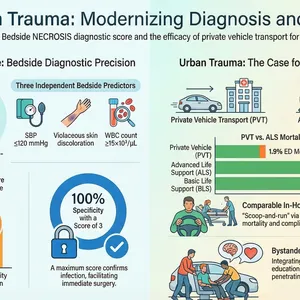
The provided sources detail contemporary advancements in emergency trauma care and diagnostic accuracy through multicenter clinical trials. One primary focus is the development of the NECROSIS score, a simplified tool that utilizes bedside clinical markers to identify necrotizing soft tissue infections more effectively than older laboratory-based models. A second study investigates prehospital transport methods for penetrating injuries in urban settings, suggesting that private vehicle transport may be more beneficial for survival than traditional ambulance services due to reduced delays. Together, these articles emphasize early intervention and the importance of prioritizing speed and clinical assessment over complex, time-consuming procedures. By validating clinical risk indices and re-evaluating transport paradigms, the research aims to improve outcomes for patients facing life-threatening surgical emergencies. This collection highlights an evolving trend toward practical, efficient strategies in the management of critical trauma and aggressive infections. DISCLAIMER The Critical Edge is for educational and informational purposes only and is not intended to diagnose, treat, cure, or prevent any disease, nor does it substitute for professional medical advice, diagnosis, or treatment from a qualified healthcare provider—always seek in-person evaluation and care from your physician or trauma team for any health concerns. BEDSIDE NSTI RECOGNITION AND URBAN PENETRATING-TRAUMA TRANSPORT STUDY GUIDE TOP TEN TAKEAWAYS1. NSTI remains under-diagnosed; among 362 emergency-general-surgery patients evaluated for severe soft-tissue infection across 16 U.S. centers, 297 (82%) ultimately had confirmed NSTI and overall mortality was 12.3%.2. LRINEC is too slow and too insensitive for the decision that matters—whether to take the patient to the operating room now. In the validation cohort its sensitivity was only 35%.3. Three independently associated findings constitute the NECROSIS score (one point each): systolic blood pressure ≤120 mm Hg, violaceous skin discoloration, and WBC ≥15 × 10³/μL.4. A NECROSIS score of 1 captured most cases (sensitivity 92%); a score of 3 was 100% specific in this derivation–validation sample. Discrimination was modest but stable (AUC / c-statistic 0.75) and identical in derivation and validation sets.5. Because the three variables are available at the bedside, NECROSIS is intended to shorten the interval from first examination to source-control incision, not to replace operative exploration when clinical suspicion is already high.6. For urban penetrating torso or proximal-extremity trauma, private-vehicle transport (PVT) was not associated with higher in-hospital mortality, longer stay, or more complications than EMS transport after propensity matching.7. Advanced life support (ALS) transport had higher emergency-department mortality than PVT (3.9% vs 1.9%), consistent with the hypothesis that scene procedures delay definitive hemorrhage control.8. Logistic models in the parent EAST analysis suggested lower odds of death with PVT versus basic life support; the post-hoc paper treats that signal as supportive rather than definitive.9. The matched PVT cohort was predominantly young, male, Black, and injured by gunshot—the demographic in which “scoop and run” has the most prior observational support.10. Extending Stop the Bleed from hemorrhage control to bystander transport is operationally attractive in dense urban grids but requires destination control so that the car arrives at a trauma center, not the nearest emergency department. STUDY GUIDE I. The NECROSIS Score: A Bedside Index for Suspected Necrotizing Soft-Tissue InfectionTime to operative source control dominates NSTI survival. Existing laboratory-heavy scores, principally LRINEC, require tests that are not always back before the decision to operate and have repeatedly shown poor sensitivity in prospective series. Kim and t
25 MIN
OCT 16, 2026
Lit Review: Modern Burn Care Innovation Outcomes
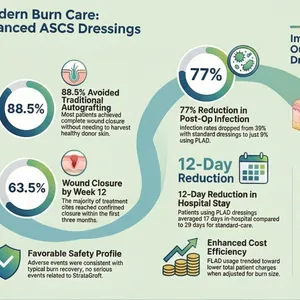
This episode examines innovative therapeutic approaches for treating severe thermal burns, focusing on reducing the need for traditional autografting. One study highlights the safety and efficacy of StrataGraft, a bioengineered skin substitute that successfully promoted wound closure in a majority of adult patients with deep partial-thickness burns. Another research paper compares the outcomes of using autologous skin cell suspensions (ASCS) with different dressing types, specifically evaluating contact layer dressings against poly-lactic acid dressings (PLAD). The findings indicate that utilizing PLAD alongside cell suspensions significantly lowers infection rates, shortens hospital stays, and reduces overall medical costs. Together, these articles suggest that advancing skin substitute technology and optimizing post-surgical dressings can improve clinical recovery while sparing healthy donor skin. This collective research underscores a shift toward biosynthetic solutions that simplify burn management and enhance patient outcomes in real-world medical settings. DISCLAIMER The Critical Edge is for educational and informational purposes only and is not intended to diagnose, treat, cure, or prevent any disease, nor does it substitute for professional medical advice, diagnosis, or treatment from a qualified healthcare provider—always seek in-person evaluation and care from your physician or trauma team for any health concerns. DONOR-SPARING COVERAGE FOR DEEP PARTIAL-THICKNESS AND LARGE BURNS STUDY GUIDE TOP TEN TAKEAWAYS1. StrataGraft is a bioengineered bilayer construct used as a single application on deep partial-thickness (DPT) burns that still have intact dermal elements, with the explicit goal of avoiding or minimizing autograft harvest.2. In the StrataCAT expanded-access cohort (n = 52; 3–50% TBSA), 88.5% of patients achieved complete wound closure without additional autografting; only 11% needed partial autograft at incomplete sites.3. Confirmed closure by week 12 occurred in 63.5% of patients (71.9% of treatment sites); durable closure by week 24 occurred in 55.8% of patients (60.4% of sites).4. Safety was consistent with ordinary burn-unit morbidity: 88.5% had at least one TEAE (most often mild pruritus); 19.2% had serious TEAEs, none attributed to StrataGraft; four deaths were unrelated.5. Prior RCTs (STRATA2011, STRATA2016) already showed that most DPT wounds treated with StrataGraft needed no autograft by day 28 and closed at rates comparable to autograft by month 3; StrataCAT extends that experience into a real-world, broader-access population.6. Autologous skin cell suspension (ASCS) expands a small thin donor harvest at approximately 1:80 and can be used alone or with split-thickness skin graft (STSG) on larger TBSA injuries.7. The kit’s default contact-layer dressing (CLD) is prone to poor adherence, fluid pooling, and infection; a poly-lactic acid biosynthetic dressing (PLAD) adheres more closely, permits fluid egress, and functions as a temporary epithelial barrier.8. In a single-center before-after cohort of ≥10% TBSA burns treated with ASCS (± STSG), PLAD versus CLD was associated with shorter length of stay (17 vs 29 days) and fewer postoperative wound infections (approximately 7–9% vs 32–39%).9. After adjustment for grafted area and TBSA, CLD carried an 8-fold higher odds of postoperative infection; antibiotic days were also substantially shorter with PLAD (0.47 vs 4.39 days).10. Inflation-adjusted charges per %TBSA trended lower with PLAD ($18,459 vs $25,396); the biologic dressing therefore functions as both a clinical and a resource intervention, not merely a coverage layer. STUDY GUIDE I. StrataGraft for Deep Partial-Thickness Burns with Intact DermisAutograft remains the reference standard for definitive closure of deep burns, but donor-site morbidity—pain, infection, hypertrophic scar, and limited harvestable skin in the elderly or the thin-skinned—creates a standing n
54 MIN
OCT 2, 2026
Lit Review: Closing Hostile Abdomens and Sparing Kidneys
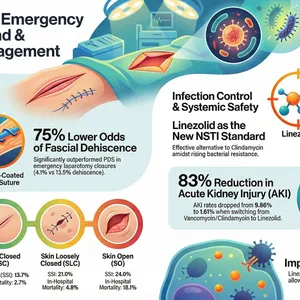
These academic articles investigate recent advancements in surgical wound care and the pharmacological management of severe infections during emergency procedures. The first study demonstrates that utilizing triclosan-coated barbed sutures significantly reduces the risk of fascial dehiscence following emergency abdominal surgeries compared to standard materials. A second multi-center trial examines skin closure techniques in urgent colorectal surgery, concluding that primary closure is a safe option that may lower mortality and shorten hospital stays. Finally, research into necrotizing soft tissue infections suggests that linezolid is a safe and effective alternative to the traditional combination of clindamycin and vancomycin. Collectively, these sources provide evidence-based strategies to improve clinical outcomes and decrease post-operative complications in high-risk surgical patients. DISCLAIMER The Critical Edge is for educational and informational purposes only and is not intended to diagnose, treat, cure, or prevent any disease, nor does it substitute for professional medical advice, diagnosis, or treatment from a qualified healthcare provider—always seek in-person evaluation and care from your physician or trauma team for any health concerns. EMERGENCY LAPAROTOMY CLOSURE AND NSTI ANTIMICROBIAL STRATEGY STUDY GUIDE 1. Barbed fascia first: In emergency laparotomy, running triclosan-coated no. 1 barbed suture was associated with lower fascial dehiscence than running no. 1 triclosan-coated PDS (4% vs 14%; multivariable OR 0.07–0.25 depending on model).2. STITCH still applies: Small-bite technique with a suture-to-wound length ratio of 4:1 remains the foundational closure principle; suture material is an incremental variable on top of that standard.3. Infection signal is weaker: SSI rates trended lower with barbed suture (11% vs 21%, p = 0.07) but did not reach significance; evisceration and systemic complications were similar.4. Damage control is the dominant risk: Delayed fascial closure after damage-control laparotomy independently increased dehiscence risk (OR ≈ 3.1) even when barbed suture was used.5. Skin can be closed in dirty colorectal cases: In a 15-center EAST cohort of emergent nontrauma colorectal operations, complete skin closure had the lowest crude SSI (13.7%) and was not independently associated with deep-space infection.6. Loosely closed skin is not a free lunch: Incomplete (“loosely closed”) skin closure independently increased superficial SSI (adjusted OR 3.44) compared with complete closure.7. Open skin tracks with sicker patients and worse logistics: Skin-left-open patients had longer length of stay, lower rates of discharge home, and higher crude in-hospital mortality; after risk adjustment, open skin remained associated with mortality (OR 3.00).8. NPWT and delayed primary closure were not independent drivers: Negative-pressure devices and delayed primary closure did not independently change SSI, fistula, dehiscence, reoperation, or 30-day readmission in the EAST analysis.9. Linezolid is a reasonable toxin-suppression substitute: In a matched quasi-experimental NSTI cohort, linezolid plus standard gram-negative/anaerobic coverage produced 30-day mortality similar to vancomycin plus clindamycin (6.5% vs 8.1%).10. Renal and stewardship advantages: Acute kidney injury was more common with vancomycin–clindamycin (9.7% vs 1.6%); linezolid also allows earlier oral step-down and avoids rising clindamycin resistance among streptococci. STUDY GUIDE I. Fascial Closure After Emergency Laparotomy: Barbed Versus Conventional Absorbable SutureThe STITCH trial established that small fascial bites and a 4:1 suture-to-wound length ratio reduce dehiscence in both elective and emergency laparotomy. Dilday and colleagues asked whether the *type* of running, triclosan-coated suture further modifies that risk. A. Study design and population Prospective observational cohort from LAC+USC
35 MIN
OCT 1, 2026
Lit Review: Stop Delaying Palliative Care in Trauma
These research articles examine the integration of palliative care and goals of care (GOC) discussions within the management of seriously ill trauma patients. One study identifies a significant gap between national guidelines and clinical practice, noting that GOC documentation remains infrequent despite institutional recommendations. Another investigation highlights how palliative care consultations (PCC) and do-not-resuscitate (DNR) orders are associated with older patients and those with traumatic brain injuries, ultimately leading to shorter hospital stays for terminal cases. Additionally, the literature emphasizes the unique challenges of providing supportive care in neurotrauma cases, where uncertain prognoses and family surrogate decision-making are common. Collectively, these sources advocate for system-level interventions and improved communication strategies to better align acute trauma treatment with patient-centered palliative philosophies. DISCLAIMERThe Critical Edge is for educational and informational purposes only and is not intended to diagnose, treat, cure, or prevent any disease, nor does it substitute for professional medical advice, diagnosis, or treatment from a qualified healthcare provider—always seek in-person evaluation and care from your physician or trauma team for any health concerns. Adherence and Integration of Palliative Care in Trauma Settings This study guide synthesizes current research regarding the implementation of palliative care within Level I trauma centers. It focuses on the adherence to national guidelines, the specific challenges of neurotrauma, and the impact of Do-Not-Resuscitate (DNR) orders on patient outcomes and hospital utilization. National Guidelines and the TQIP Framework The American College of Surgeons Trauma Quality Improvement Program (TQIP) provides a framework for integrating palliative care into trauma services. These guidelines advocate for a "parallel" approach, where palliative care is delivered alongside life-sustaining treatments rather than as a replacement for them. Goals of Care (GOC) Requirements The primary recommendation of the TQIP guidelines is the initiation and documentation of Goals of Care (GOC) discussions within 72 hours of admission for patients identified as having a "serious illness." GOC discussions aim to align medical interventions with the patient's values and preferences. Adherence Reality Research conducted at Level I trauma centers indicates a significant gap between TQIP recommendations and clinical practice: Initial Adherence: Only approximately 18.9% to 19% of seriously ill trauma patients have GOC discussions documented within the recommended 72-hour window. Overall Hospitalization: Throughout the entire duration of a hospital stay, documentation only increases to roughly 25% to 26%. Impact of Policy Changes: Studies show that simply updating institutional guidelines to reflect TQIP recommendations does not significantly improve documentation rates. This suggests that "systems-level interventions"—rather than just policy updates—are required to change clinician behavior. Factors Associated with GOC Completion Certain clinical factors significantly increase the likelihood that a GOC discussion will be documented: Mechanical Ventilation: Patients on ventilators are more than six times more likely to have documented GOC discussions. Multiple Serious Illness Criteria: Patients meeting multiple criteria for serious illness are approximately four times more likely to have documented GOC discussions. Age: Advanced age is a frequent correlate for palliative care engagement. Palliative Care in Neurotrauma Traumatic Brain Injury (TBI) represents a unique challenge for palliative care due to the high levels of mortality, morbidity, and prognostic uncertainty involved. Barriers to Care Integration of palliative care in neurotrauma is often delayed or omitted due to: The "Oncology Stigma": Improper associations
39 MIN