


The Critical Edge Podcast
The Critical Edge
Lit Review: Why Speed Beats Labs and Ambulances
OCT 23, 202625 MIN
Description
The provided sources detail contemporary advancements in emergency trauma care and diagnostic accuracy through multicenter clinical trials. One primary focus is the development of the NECROSIS score, a simplified tool that utilizes bedside clinical markers to identify necrotizing soft tissue infections more effectively than older laboratory-based models. A second study investigates prehospital transport methods for penetrating injuries in urban settings, suggesting that private vehicle transport may be more beneficial for survival than traditional ambulance services due to reduced delays. Together, these articles emphasize early intervention and the importance of prioritizing speed and clinical assessment over complex, time-consuming procedures. By validating clinical risk indices and re-evaluating transport paradigms, the research aims to improve outcomes for patients facing life-threatening surgical emergencies. This collection highlights an evolving trend toward practical, efficient strategies in the management of critical trauma and aggressive infections.
DISCLAIMER
The Critical Edge is for educational and informational purposes only and is not intended to diagnose, treat, cure, or prevent any disease, nor does it substitute for professional medical advice, diagnosis, or treatment from a qualified healthcare provider—always seek in-person evaluation and care from your physician or trauma team for any health concerns.
BEDSIDE NSTI RECOGNITION AND URBAN PENETRATING-TRAUMA TRANSPORT STUDY GUIDE
TOP TEN TAKEAWAYS
1. NSTI remains under-diagnosed; among 362 emergency-general-surgery patients evaluated for severe soft-tissue infection across 16 U.S. centers, 297 (82%) ultimately had confirmed NSTI and overall mortality was 12.3%.
2. LRINEC is too slow and too insensitive for the decision that matters—whether to take the patient to the operating room now. In the validation cohort its sensitivity was only 35%.
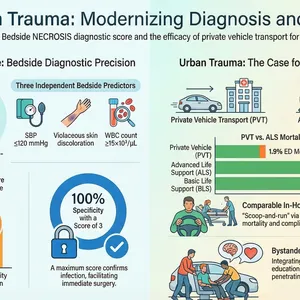
3. Three independently associated findings constitute the NECROSIS score (one point each): systolic blood pressure ≤120 mm Hg, violaceous skin discoloration, and WBC ≥15 × 10³/μL.
4. A NECROSIS score of 1 captured most cases (sensitivity 92%); a score of 3 was 100% specific in this derivation–validation sample. Discrimination was modest but stable (AUC / c-statistic 0.75) and identical in derivation and validation sets.
5. Because the three variables are available at the bedside, NECROSIS is intended to shorten the interval from first examination to source-control incision, not to replace operative exploration when clinical suspicion is already high.
6. For urban penetrating torso or proximal-extremity trauma, private-vehicle transport (PVT) was not associated with higher in-hospital mortality, longer stay, or more complications than EMS transport after propensity matching.
7. Advanced life support (ALS) transport had higher emergency-department mortality than PVT (3.9% vs 1.9%), consistent with the hypothesis that scene procedures delay definitive hemorrhage control.
8. Logistic models in the parent EAST analysis suggested lower odds of death with PVT versus basic life support; the post-hoc paper treats that signal as supportive rather than definitive.
9. The matched PVT cohort was predominantly young, male, Black, and injured by gunshot—the demographic in which “scoop and run” has the most prior observational support.
10. Extending Stop the Bleed from hemorrhage control to bystander transport is operationally attractive in dense urban grids but requires destination control so that the car arrives at a trauma center, not the nearest emergency department.
STUDY GUIDE
I. The NECROSIS Score: A Bedside Index for Suspected Necrotizing Soft-Tissue Infection
Time to operative source control dominates NSTI survival. Existing laboratory-heavy scores, principally LRINEC, require tests that are not always back before the decision to operate and have repeatedly shown poor sensitivity in prospective series. Kim and the EAST multicenter group therefore derived a three-item clinical index in the population that actually presents to the emergency-general-surgery service: adults being evaluated for severe skin and soft-tissue infection.
A. Cohort and gold standard
Sixteen U.S. centers enrolled patients over approximately 30 months. Of 362 evaluated patients, 297 (82%) had confirmed NSTI. Overall mortality was 12.3%. That high pretest probability is important: NECROSIS was built in a enriched EGS population, not in undifferentiated cellulitis in a walk-in clinic.
B. Independent predictors and score construction
Multivariable analysis isolated three findings:
- Systolic blood pressure ≤120 mm Hg
- Violaceous skin discoloration
- White-blood-cell count ≥15 × 10³/μL
Each contributes one point (range 0–3). Model calibration was acceptable (Hosmer–Lemeshow p = 0.9). Discrimination, expressed as the c-statistic of the prediction curve, was 0.75.
C. Operating characteristics versus LRINEC
In the validation cohort a score ≥1 yielded 92% sensitivity, substantially higher than LRINEC’s 35% in the same patients. A score of 3 was 100% specific. Test characteristics did not degrade between derivation and validation samples. The practical reading is therefore: one point should lower the threshold for immediate surgical exploration; three points make the diagnosis sufficiently certain that delay for additional imaging is difficult to justify.
D. What the score does not do
NECROSIS is Level III diagnostic evidence. External validation in lower-prevalence settings (community emergency departments, tropical environments, pediatric patients) has not been published. It does not incorporate microbiology, imaging, or Laboratory Risk Indicator components that some centers still find useful as adjuncts. It also does not replace the surgeon’s judgment when pain out of proportion, crepitus, or rapid progression is already obvious. Its claim is narrower and more useful: when you are still deciding, three data points you already have outperform a delayed composite laboratory score.
II. Private Vehicle versus EMS for Urban Penetrating Trauma
Stop the Bleed trained bystanders to pack and tourniquet. The unanswered systems question is whether those same bystanders should then wait for an ambulance or put the patient in a car. Simpson and colleagues performed a post-hoc analysis of an EAST multicenter trial that had already enrolled adults with penetrating torso or proximal-extremity wounds at 25 urban trauma centers (May 2019–May 2020). The analytic sample described in the source review was 1,999 patients; propensity matching produced 778 patients in balanced PVT and EMS groups.
A. Matched population
PVT patients were 90.5% male, 71.2% Black, and 68.9% gunshot wounds—the classic urban penetrating cohort in which scene time is the enemy.
B. Mortality and secondary outcomes
In-hospital mortality, hospital length of stay, ICU-free days, and complications did not differ between PVT and EMS (BLS or ALS combined). ALS transport, which delivers more prehospital procedures than BLS, had significantly higher emergency-department mortality than PVT (3.9% vs 1.9%, p = 0.03). That ED-death signal is the most clinically important finding: additional airway, vascular-access, and scene-treatment steps appear to trade minutes of hemorrhage for interventions that do not change the anatomy of a torso gunshot wound.
C. Interpretation against prior “scoop-and-run” literature
The result is directionally consistent with older Philadelphia and urban-cohort work showing equivalent or better survival with police or private-vehicle arrival. It is also consistent with randomized and observational data that prehospital procedures in penetrating trauma are associated with longer scene times and no outcome benefit. Logistic regression in the parent data set suggested lower mortality odds for PVT versus BLS; the authors treat that as supportive, not as a license to abandon EMS in every geography.
D. Implementation limits
PVT only helps if the destination is a verified trauma center. Rural distances, highway crashes, and patients who need a secured airway before movement are outside the inference. Ethical and legal questions—who is responsible if the private vehicle is in a collision, how 911 call-takers should script the advice—are unresolved. Police transport programs already running in several cities are the nearest operational analogue and should be the template if civilian PVT is formalized.
III. How the Two Papers Speak to the Same Clock
Both studies are about compressing time to a definitive intervention that only a surgeon can perform. For NSTI that intervention is wide debridement; for torso hemorrhage it is the operating room or hybrid suite. NECROSIS tries to remove laboratory delay from the first decision. PVT tries to remove ambulance-scene delay from the second. Neither paper argues that systems sophistication is worthless; both argue that sophistication applied in the wrong interval—waiting for a complete LRINEC panel, or performing ALS procedures on a bleeding torso wound—costs the minutes the disease process does not give back.
REFERENCES
1. Kim DY, Iavasile A, Kaji AH, Nahmias J, et al. Prospective derivation and validation of a necrotizing soft tissue infections score: An EAST multicenter trial. *J Trauma Acute Care Surg*. 2024;97(6):910-917. doi:10.1097/TA.0000000000004374
2. Simpson JT, Nordham KD, Tatar A, et al. Stop the Bleed—wait for the ambulance or get in the car and drive? A post hoc analysis of an EAST multicenter trial. *Am Surg*. 2025;91(2):233-241. doi:10.1177/00031348241265135