WORKERS.COM Staffing Pulse : Labor Market Insights and Hiring Trends

WORKERS.COM - Insights From The Frontline

Details

WORKERS.COM Staffing Pulse delivers expert insights on hiring trends, recruitment strategies, technology, retention, compliance, and workplace culture. Twice weekly, we share practical advice to help Employers build stronger teams and Job Seekers succeed in today’s U.S. labor market. We cover workforce planning and talent acquisition across Light Industrial, Skilled Trades, Engineering, Manufacturing, Construction, Warehouse, Transportation & Logistics, and Office & Clerical, with actionable guidance drawn from staffing industry experience.

Recent Episodes

OCT 22, 2026
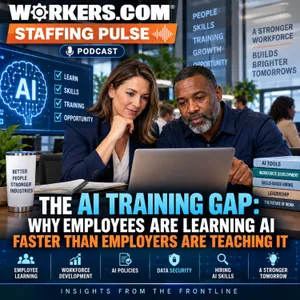
The AI Training Gap: Why Employees Are Learning AI Faster Than Employers Are Teaching It
Employees and Job Seekers are building AI skills, but many lack structured Employer training. New iCIMS research found 47% of surveyed U.S. Job Seekers had developed their AI skills during the previous six months, up from 41% one year earlier. Self-directed AI learning increased from 22% to 30%, while Employer-provided training stayed near one in six workers. Meanwhile, 45% reported seeing generative AI skills required in jobs they would consider. Employers need AI-skilled workers, but familiarity with ChatGPT, Microsoft Copilot, Google Gemini, and other generative AI tools does not automatically translate into workplace-ready skills. In this episode of WORKERS.COM Staffing Pulse: Insights From The Frontline, we examine the growing AI training gap and its implications for Employers, Managers, Recruiters, HR teams, and Job Seekers. We discuss practical AI literacy, including applying AI to workplace tasks, evaluating AI-generated information, protecting confidential data, following workplace policies, and recognizing when human judgment is required. For Employers, AI workforce readiness requires approved tools, data security, responsible AI policies, role-specific training, Manager education, and realistic AI requirements in job descriptions. For Recruiters and Hiring Managers, the challenge is evaluating candidates who list AI skills on their resumes. Employers need ways to assess how candidates have used AI, their results, how they verified outputs, and whether their skills match job requirements. Topics include: • Employee AI learning versus Employer-led training • Why Employees and Job Seekers teach themselves AI skills • AI literacy versus familiarity with generative AI tools • Employer responsibility for AI training and upskilling • ChatGPT, Microsoft Copilot, Google Gemini, and workplace AI • Approved AI tools and workplace policies • Data security, confidentiality, and responsible AI use • Training Managers to supervise AI-enabled work • How Recruiters should evaluate AI skills • Assessing AI proficiency during hiring • Setting realistic AI requirements in job descriptions • Skills-based hiring and demonstrable AI capabilities • AI training as a recruiting and retention consideration • Preparing Office and Administrative teams for AI-enabled workflows • AI skills for Engineering, Recruiting, HR, and Operations roles • Building an AI-ready workforce through structured training The iCIMS findings also highlight AI training as a recruiting consideration. Forty-two percent of surveyed Job Seekers said an Employer offering AI training would be more attractive than a comparable Employer without such training. For Employers, the priority is developing an AI-ready workforce with the skills, policies, training, and oversight needed for responsible AI use. For Job Seekers, the opportunity is to develop practical AI skills they are prepared to demonstrate during hiring and apply on the job. WORKERS.COM Staffing Pulse: Insights From The Frontline covers workforce trends, recruiting strategies, staffing, career opportunities, workforce development, and changes affecting Employers and workers across today's labor market. 🏢 Employers: Find workforce solutions at https://www.workers.com 👷 Job Seekers: Explore opportunities at https://jobs.workers.com 🌐 More Insights: https://www.workers.com/community
32 MIN
OCT 19, 2026
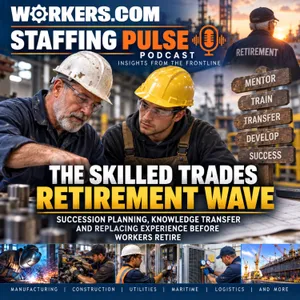
The Skilled Trades Retirement Wave: Succession Planning, Knowledge Transfer And Replacing Experience Before Workers Retire
America's Skilled Trades workforce is entering a major generational transition. More than one-quarter of Skilled Trades workers are age 55 or older, and Lightcast research estimates retirements account for roughly 40% of annual Skilled Trades openings. Employers already face an estimated 2.1 million Skilled Trades openings each year. For Manufacturers, Contractors, Maintenance Operations, Warehouses, Utilities, Shipyards, and other Industrial Employers, replacing retiring workers involves more than filling open positions. Experienced Electricians, Welders, Machinists, Mechanics, HVAC Technicians, Maintenance Technicians, and other tradespeople often hold decades of practical knowledge. They know the equipment, recurring failures, repair history, safety concerns, troubleshooting sequences, and operational problems that rarely appear in a job description. In this episode of WORKERS.COM Staffing Pulse: Insights From The Frontline, we discuss how Employers can prepare for Skilled Trades retirements before critical experience leaves the workforce. Topics include: • The Skilled Trades retirement wave and aging workforce • Skilled Trades succession planning • Retirement forecasting for critical positions • Skills inventories for Electricians, Welders, Machinists, Mechanics, HVAC Technicians, and Maintenance Technicians • Identifying positions with high knowledge-loss risk • Capturing equipment and troubleshooting knowledge • Documenting maintenance procedures and recurring failures • Mentoring experienced tradespeople with developing workers • Structured job shadowing and knowledge transfer • Apprentice and Trainee overlap before retirements • Cross-training across critical equipment and processes • Developing future Supervisors, Leads, and Technical Specialists • Building Skilled Trades talent pipelines before vacancies occur • Recruiting experienced tradespeople while developing new talent • Workforce planning for Manufacturing, Maintenance, Construction, Logistics, Utilities, Maritime, and Industrial Operations With roughly three Skilled Trades openings for every person completing a relevant training program, Employers face a workforce-planning challenge that external recruiting alone does not solve. Succession planning gives employers time to identify critical skills, transfer institutional knowledge, develop emerging workers, prepare future leaders, and recruit for gaps before experienced Employees retire. For workers entering or advancing in the Skilled Trades, this generational transition also creates career opportunities. Employers need the next generation of Electricians, Welders, Machinists, Mechanics, Maintenance Technicians, HVAC Technicians, Controls Specialists, Leads, Supervisors, and other technical professionals. WORKERS.COM Staffing Pulse covers practical workforce strategies and career opportunities across Skilled Trades, Manufacturing, Light Industrial, Logistics, Engineering, Construction, Maritime, Maintenance, and related industries. 🏢 Employers: Find workforce solutions at https://www.workers.com 👷 Job Seekers: Explore opportunities at https://jobs.workers.com 🌐 More Insights: https://www.workers.com/community
33 MIN
OCT 15, 2026
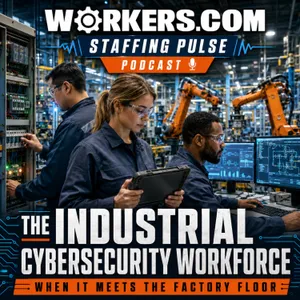
The Industrial Cybersecurity Workforce: IT/OT Jobs, Factory Automation, Connected Manufacturing And Hiring
Connected machinery is changing who Manufacturers need to hire. PLCs, Robotics, Sensors, Industrial Networks, Warehouse Systems, Cloud Platforms, and Artificial Intelligence now connect factory-floor operations with traditional information technology. This growing overlap between information technology and operational technology, often called IT/OT convergence, is creating technical roles across Cybersecurity, Engineering, Automation, Maintenance, and Industrial IT. In this episode of WORKERS.COM Staffing Pulse: Insights From The Frontline, we examine the workforce responsible for maintaining, connecting, and protecting modern industrial systems. The discussion explores why Cybersecurity inside a Manufacturing plant requires a different approach from traditional office IT. A routine network change, software update, or security response might affect production uptime, equipment reliability, product quality, and worker safety. Topics include: • Information Technology and Operational Technology convergence • Industrial Cybersecurity workforce development • OT Technicians and Industrial IT Support roles • Controls Engineers and Automation Engineers • Industrial Network Specialists • Cybersecurity professionals in Manufacturing • Systems integrators and equipment vendors • Maintenance Technicians working with connected equipment • PLCs, HMIs, Robotics, Sensors, and Industrial Control Systems • Network access, system backups, software updates, and remote support • Ownership of connected industrial systems • Coordination between IT, Engineering, Maintenance, and Operations • Recruiting candidates with technology and production experience • Transferable skills from IT, cybersecurity, controls, and maintenance • Scenario-based interviews for IT/OT positions • Internal training, mentorship, and cross-functional development • Career pathways into Industrial Cybersecurity • Workforce planning for connected factories and warehouses Employers will learn how to define ownership, identify staffing gaps, improve job descriptions, assess transferable skills, and build stronger coordination between information technology and plant operations. Job Seekers will learn how experience in Maintenance, Controls, Automation, Networking, Cybersecurity, Electronics, Engineering Technology, or Industrial Support might lead toward an IT/OT career. As Manufacturers invest in Robotics, Connected Equipment, Production Analytics, Automated Material Handling, and AI, they need qualified people to configure, maintain, troubleshoot, and protect the systems supporting daily operations. 🏢 Employers: Find workforce solutions at https://www.workers.com 👷 Job Seekers: Explore opportunities at https://jobs.workers.com 🌐 More Insights: https://www.workers.com/community Follow, Subscribe, Rate, and Review WORKERS.COM Staffing Pulse: Insights From The Frontline on your preferred Podcast platform.

40 MIN
OCT 12, 2026
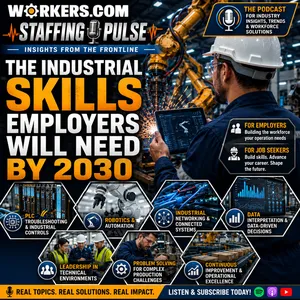
The Industrial Skills Employers Will Need By 2030: Automation, Robotics, PLCs, Manufacturing Technology And Leadership
What Industrial and Manufacturing skills will Employers need by 2030? Automation, Robotics, Programmable Logic Controllers, connected Manufacturing systems, and Industrial data are changing how production facilities operate and the skills Employers need from their workforce. In this episode of WORKERS.COM Staffing Pulse: Insights From The Frontline, we examine the Industrial skills expected to become increasingly important through 2030 and how Manufacturers, Industrial Employers, Skilled Trades professionals, Maintenance Technicians, and Manufacturing workers can prepare. As factories become more automated and connected, Employers need people who understand technology while still bringing practical troubleshooting, communication, leadership, safety awareness, and continuous improvement skills to the production floor. We discuss how Employers can identify future skill gaps, develop existing Employees, recruit specialized technical talent, and create career pathways that prepare their workforce for increasingly technical industrial operations. Topics include: • PLC troubleshooting and programmable logic controllers • Industrial controls and electrical troubleshooting • Robotics and Industrial Automation • Automated Manufacturing equipment • Industrial networking and connected Manufacturing systems • Sensors, drives, HMIs, and control systems • Manufacturing data interpretation • Data-driven production and maintenance decisions • Mechanical, Electrical, and Controls skill development • Industrial maintenance and multi-skilled technicians • Technical leadership and supervisor development • Root-cause analysis and structured problem solving • Continuous improvement and operational excellence • Internal training and technical career pathways • Recruiting Skilled Trades and technical Manufacturing talent • Workforce planning and skills development for 2030 The conversation also examines an important workforce planning challenge. Employers do not need every Employee to become a PLC Programmer, Robotics Engineer, or Automation Specialist. They need to determine which technical capabilities each position requires, which skills should be present on day one, and which skills Employees can develop through training and experience. For Industrial Professionals and Job Seekers, the episode explores how building stronger foundations in maintenance, controls, automation, robotics, data interpretation, problem solving, and leadership can create new career opportunities as Manufacturing technology advances. For Manufacturers and Industrial Employers, we discuss why preparing for 2030 should start with the workforce you have today. Identifying knowledge gaps, developing internal talent, creating advancement pathways, recruiting for specialized expertise, and preparing supervisors to lead technical teams can help build a stronger long-term talent pipeline. Whether you are a Manufacturing leader planning your future workforce, an Employer recruiting Skilled Trades and Technical talent, or an Industrial Professional developing your career, this episode provides practical guidance for preparing for the skills modern Manufacturing will demand through 2030. 🏢 Employers: Find workforce solutions at https://www.workers.com 👷 Job Seekers: Explore opportunities at https://jobs.workers.com 🌐 More Insights: https://www.workers.com/community
32 MIN
OCT 8, 2026
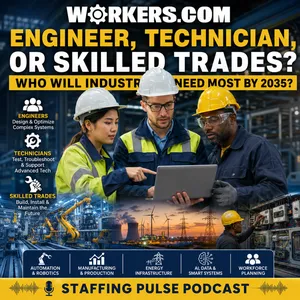
Engineer, Technician, Or Skilled Trades? Engineering Careers, Automation, Manufacturing Jobs And Workforce Demand Through 2035
Who will industry need most by 2035: Engineers, Engineering Technicians, or Skilled Trades professionals? As Manufacturing, Automation, Robotics, AI, Energy Infrastructure, Data Centers, and advanced Production systems expand, demand for technical talent is changing. In this episode of WORKERS.COM Staffing Pulse: Insights From The Frontline, we examine U.S. Bureau of Labor Statistics 2025-2035 Occupational Outlook projections and explore the future of Engineering, Industrial Maintenance, Automation, and Skilled Trades careers. We discuss opportunities for Industrial, Mechanical, Electrical, Electronics, and Civil Engineers; Engineering Technologists and Technicians; Electricians; Industrial Machinery Mechanics; Maintenance Technicians; Millwrights; Automation Technicians; Controls Technicians; and other Technical professionals. Topics include: • Engineering and Manufacturing workforce demand • Automation, Robotics, PLCs, Controls, Sensors, Drives, and HMIs • Electrical systems, power infrastructure, and electrification • Industrial Maintenance and advanced troubleshooting • Engineering Technician and Technologist career paths • Electrician, Millwright, and Industrial Machinery Mechanic demand • Skills-based hiring and Technical workforce planning • Apprenticeships, internships, co-ops, and technical education • Workforce succession planning and skills needed before 2035 We also address a critical hiring question: Does your operation need an Engineer, Engineering Technician, or experienced Skilled Trades professional? Engineers typically focus on design, analysis, optimization, integration, and engineering responsibility. Technicians and Technologists support testing, commissioning, troubleshooting, and implementation. Skilled Trades professionals bring hands-on expertise in installing, maintaining, repairing, wiring, fabricating, and servicing industrial equipment. For Employers, the message is clear: technology planning and workforce planning must develop together. Listen to WORKERS.COM Staffing Pulse: Insights From The Frontline for practical insights on Staffing, Recruiting, Manufacturing, Engineering, Skilled Trades, Automation, Workforce Development, and the future of Industrial employment. 🏢 Employers: Find workforce solutions at https://www.workers.com 👷 Job Seekers: Explore opportunities at https://jobs.workers.com 🌐 More Insights: https://www.workers.com/community
38 MIN