



WORKERS.COM Staffing Pulse : Labor Market Insights and Hiring Trends
WORKERS.COM - Insights From The Frontline
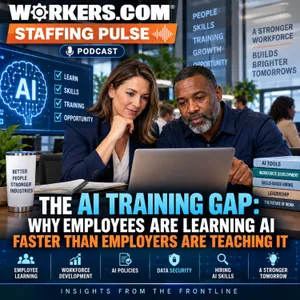
The AI Training Gap: Why Employees Are Learning AI Faster Than Employers Are Teaching It
OCT 22, 202632 MIN
Description
Employees and Job Seekers are building AI skills, but many lack structured Employer training.
New iCIMS research found 47% of surveyed U.S. Job Seekers had developed their AI skills during the previous six months, up from 41% one year earlier. Self-directed AI learning increased from 22% to 30%, while Employer-provided training stayed near one in six workers. Meanwhile, 45% reported seeing generative AI skills required in jobs they would consider.
Employers need AI-skilled workers, but familiarity with ChatGPT, Microsoft Copilot, Google Gemini, and other generative AI tools does not automatically translate into workplace-ready skills.
In this episode of WORKERS.COM Staffing Pulse: Insights From The Frontline, we examine the growing AI training gap and its implications for Employers, Managers, Recruiters, HR teams, and Job Seekers.
We discuss practical AI literacy, including applying AI to workplace tasks, evaluating AI-generated information, protecting confidential data, following workplace policies, and recognizing when human judgment is required.
For Employers, AI workforce readiness requires approved tools, data security, responsible AI policies, role-specific training, Manager education, and realistic AI requirements in job descriptions.
For Recruiters and Hiring Managers, the challenge is evaluating candidates who list AI skills on their resumes. Employers need ways to assess how candidates have used AI, their results, how they verified outputs, and whether their skills match job requirements.
Topics include:
• Employee AI learning versus Employer-led training
• Why Employees and Job Seekers teach themselves AI skills
• AI literacy versus familiarity with generative AI tools
• Employer responsibility for AI training and upskilling
• ChatGPT, Microsoft Copilot, Google Gemini, and workplace AI
• Approved AI tools and workplace policies
• Data security, confidentiality, and responsible AI use
• Training Managers to supervise AI-enabled work
• How Recruiters should evaluate AI skills
• Assessing AI proficiency during hiring
• Setting realistic AI requirements in job descriptions
• Skills-based hiring and demonstrable AI capabilities
• AI training as a recruiting and retention consideration
• Preparing Office and Administrative teams for AI-enabled workflows
• AI skills for Engineering, Recruiting, HR, and Operations roles
• Building an AI-ready workforce through structured training
The iCIMS findings also highlight AI training as a recruiting consideration. Forty-two percent of surveyed Job Seekers said an Employer offering AI training would be more attractive than a comparable Employer without such training.
For Employers, the priority is developing an AI-ready workforce with the skills, policies, training, and oversight needed for responsible AI use.
For Job Seekers, the opportunity is to develop practical AI skills they are prepared to demonstrate during hiring and apply on the job.
WORKERS.COM Staffing Pulse: Insights From The Frontline covers workforce trends, recruiting strategies, staffing, career opportunities, workforce development, and changes affecting Employers and workers across today's labor market.
🏢 Employers: Find workforce solutions at https://www.workers.com
👷 Job Seekers: Explore opportunities at https://jobs.workers.com
🌐 More Insights: https://www.workers.com/community