Worth Listening: How to Make a Mission-Driven Podcast

Next Chapter Podcasts & Voxtopica

Details

Podcasting is one of the most powerful ways to build trust, reach new audiences, and drive real impact. But for mission-driven organizations, finding the time, budget, and internal buy-in to launch and grow a show feels impossible. That’s where Worth Listening comes in. In each episode, media strategists Jeremiah Tittle and Richard Fawal sit down with creators, CMOs, and industry leaders who have been in your shoes. They pull back the curtain on what actually works, sharing the wins, the missteps, and the battle-tested tactics you need to create a podcast that cuts through the noise and advances your mission. Whether you’re trying to convince your board, stretch a lean budget, or turn listeners into advocates, this is the practical, no-fluff guide to building a non-profit podcast that matters. That’s where Worth Listening comes in. Each episode, media strategists Jeremiah Tittle and Richard Fawal sit down with creators, CMOs, and industry leaders who have been in your shoes. They pull back the curtain on what actually works—sharing the wins, the missteps, and the battle-tested tactics you need to create a podcast that cuts through the noise and moves your mission forward. Whether you’re trying to convince your board, stretch a lean budget, or turn listeners into advocates, this is the practical, no-fluff guide to building a non-profit podcast that matters. Subscribe now, and let’s make something worth listening to.

Recent Episodes

NOV 11, 2026
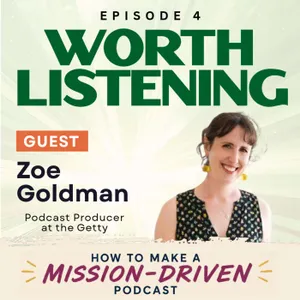
What Getty Learned By Adding Video to a Museum Podcast
Getty piloted its meditation podcast as audio-only, and about half of listeners said they needed to see the art. Zoe Goldman, a podcast producer at Getty, explains why OMMM: Our Museum Mindfulness Meditation became Getty's first video podcast and what the camera cost her team. She also explains where Getty's podcast ideas come from and why she tells every organization to make a pilot first. Zoe Goldman says any organization considering a podcast should make a pilot first, because a pilot shows how much work the show will take and whether the idea works at all. Getty has made five podcast series since 2016, and Goldman said she is currently the main person working on its shows. They include Recording Artists, built from tapes and letters in the Getty Research Institute archives, and the family show If Objects Could Talk, now in its second season. Goldman studied art history and came to Getty in 2017, then took over production of Art + Ideas in 2018. She tells JT and Richard how she turns down podcast ideas without damaging relationships, and why the Getty Center's year-long closure, starting March 15, 2027, won't change the podcasts' strategy. Key points Goldman said the awards Recording Artists has won help her ask curators and archivists for their time, since podcast work comes on top of their regular jobs. She said all the archival material for a season is picked out before recording starts, because finding it and clearing the rights take so much work. OMMM adapted gallery educator Lilit Sadoyan's weekly mindfulness tours at the Getty Center. About half the people who heard the audio-only pilot said they needed to see the art, so it became Getty's first video podcast. Goldman said its audience has split about evenly between audio apps and YouTube. If Objects Could Talk went from her idea notes in 2020 to launch in 2025. Goldman said the pandemic and her team's workload slowed it, and the first season's 10 episodes took about a year to produce once Getty committed. Conservators review each episode at the outline stage and again at a late script draft, and Getty's communications department has final approval. Goldman said video made OMMM slower and more expensive to produce. Getty rented a studio for it, and a cut that listeners would never hear in audio shows up on screen. She doubts video is worth the added cost for many projects. Goldman said planning time should go into narrowing the audience. “The audience is not ‘everyone,’” she said, and a defined audience makes it easier to say no to ideas that don't fit. About Zoe Goldman Zoe Goldman is a podcast producer at Getty in Los Angeles. She joined Getty in 2017 and began producing Art + Ideas with then-president Jim Cuno in 2018. She produces Recording Artists and created If Objects Could Talk and OMMM: Our Museum Mindfulness Meditation. Mentioned in this episode Getty Podcasts Recording Artists If Objects Could Talk OMMM: Our Museum Mindfulness Meditation Art + Ideas If this episode was informative, send it to someone at a mission-driven organization who is making or considering a podcast. Follow Worth Listening wherever you get your podcasts. Have a question about how to make a mission-driven podcast? Get in touch at www.MissionDrivenPodcasts.com or email us at [email protected]
35 MIN
OCT 28, 2026
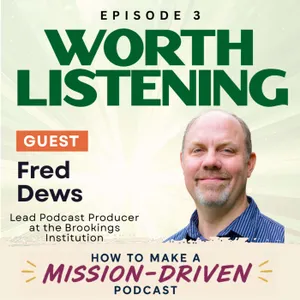
How the Brookings Institution Measures Podcast Impact
The Brookings Institution started podcasting in 2013 with the Brookings Cafeteria, a weekly interview show first recorded in a makeshift studio. Fred Dews, lead podcast producer at Brookings, explains how that one show gave rise to seven shows covering multiple policy areas. He explains how a new show gets approved, how Brookings measures impact beyond downloads, and why podcasting hasn’t replaced any of its other channels. Brookings shows include The Beijing Brief and a show about rural America. Each one starts with a concept note from the scholars who want to make it. Fred tells JT and Richard how an internal team reviews each show’s results at the end of a season, and why his goal is to constantly learn more about how audiences use Brookings’ multimedia work. Key points A new Brookings show starts with a concept note from a scholar or program team. Dews said the note covers the host, format, release cadence, whether it’s a limited or ongoing series, and how it fits the scholar’s research plan, and senior leadership signs off before pre-production begins. Brookings looks beyond audio downloads to YouTube views of each full episode and the two or three vertical clips cut from most episodes, along with Instagram engagement and feedback that scholars hear at conferences. A group compares the results with success metrics set in pre-production, usually at the end of a season. Dews described a show with low download numbers whose host was approached at a conference by a senior government official from another country who had listened to an entire episode. Brookings wound down the Brookings Cafeteria after eight and a half years and more than 400 episodes. Dews said an internal study found scholars wanted shows on specific topics, and a weekly grab bag might interest a congressional staffer on a foreign affairs subcommittee in only one episode out of ten. Dews said podcasting hasn’t replaced any of Brookings’ other channels. Scholars still testify on Capitol Hill, speak at events, and publish books and papers, and a video crew may film a short vertical video with a scholar right after a hearing. In the listener mail segment, JT and Richard answer two questions from Rika: how an organization can tell the stories of vulnerable people such as refugees without exploiting them, and whether a limited series or an episodic show offers more value. About Fred Dews Fred Dews is the lead podcast producer at the Brookings Institution, where he is in his 30th year. He launched the Brookings Cafeteria in 2013 and hosted and produced more than 400 episodes before ending the show in 2022. The Academy of Podcasters named it Best News & Politics Podcast in 2015 and Best Education Podcast in 2017, and it was nominated for an Ambie in 2021. Coming up next: In two weeks, we’ll talk with Zoe Goldman, a podcast producer at Getty, about building a podcast program inside an art museum and making audio about art that listeners can’t see. If you found this episode helpful, share it with someone who might find it useful as well, and follow Worth Listening wherever you get your podcasts. If you have questions about mission-driven podcasting, get in touch with us at MissionDrivenPodcasts.com.
35 MIN
OCT 14, 2026
Phil Buchanan on How a Nonprofit Podcast Finds Listeners
Giving Done Right started during the pandemic and was recorded in a dining room and a closet. Phil Buchanan, president of the Center for Effective Philanthropy (CEP), explains how the show reached its sixth season with help from the Chronicle of Philanthropy and a network of donor advisors. He covers what hosting takes in time and staff, why CEP hired an outside producer, and the two things he would tell any nonprofit starting a podcast. Phil Buchanan, president of the Center for Effective Philanthropy, says a nonprofit starting a podcast should do two things first. It should find an experienced producer and line up distribution partners who will put the show in front of its audience. His own show, Giving Done Right, is in its sixth season at 10 or 11 episodes a year, and it reaches donors through the Chronicle of Philanthropy, wealth advisors, donor-advised fund providers, and community foundations. Buchanan joined CEP as its first employee in 2001. He started the podcast during the pandemic to carry the ideas in his 2019 book of the same name to a wider audience. He tells JT and Richard how the audience grew to include foundation staff, how a season is made within a five-week recording window, and what an outside evaluation could and couldn’t show about the podcast’s impact. Key points Buchanan said the Chronicle of Philanthropy posts each Giving Done Right episode on its website the day after it reaches podcast apps and promotes it in its email. The Chronicle has no role in producing the show. After CEP saw how many foundation staff were listening, it changed how it describes the show. Buchanan said it is now for “anyone who gets to give money away,” whether an individual donor, a program officer, or a foundation president. CEP records almost all of a season’s episodes in about five weeks. Buchanan said this means a longer wait between recording and release but frees him for the rest of his job, and timely episodes get turned around quickly while less time-sensitive ones are released later. Buchanan doesn’t send guests interview questions in advance because he worries they’ll script their answers. He sends a few bullet points on topics instead. A third-party evaluation by Impact Architects found some evidence that the show’s stories influence how listeners give. Buchanan noted the limitation: only listeners willing to be interviewed or surveyed are counted, and a show can’t identify everyone who listens. About Phil Buchanan Phil Buchanan is president of the Center for Effective Philanthropy, which he joined as its first employee in 2001. CEP now has 60 staff in Cambridge and San Francisco and does research and advisory work for funders, including its Grantee Perception Report. Buchanan wrote Giving Done Right (2019) and hosts the podcast of the same name. Mentioned in this episode Center for Effective Philanthropy Giving Done Right podcast and book Giving Done Right, Season 6, Episode 2, with KaBOOM! CEO Lysa Ratliff The Chronicle of Philanthropy Impact Architects, the firm that evaluated Phil’s podcast Coming up next: In two weeks, we’ll talk with the leader of the podcast team at the Brookings Institution about how they won internal buy-in. If this episode helped, send it to someone at a mission-driven organization who is asking the same questions. Follow Worth Listening wherever you get your podcasts. Have a question about how to make a mission-driven podcast? Get in touch at www.missiondrivenpodcast.com.

40 MIN